AI in Injection Molding: Where It Improves Cycle Stability, Scrap Rate, and Maintenance




AI in injection molding is becoming a plant-floor discipline
AI in injection molding is no longer discussed as a distant factory upgrade. It is becoming a practical response to unstable cycles, rising scrap costs, and tighter compliance pressure.
That shift matters across the broader polymer processing landscape. Injection molding now sits inside a more connected industrial system shaped by extrusion, blow molding, rubber processing, and recycled feedstock variability.
From the recent signals tracked by PFRS, the strongest change is not simple automation. It is the move toward data-guided process control that links machine behavior, material response, and quality outcomes.
In that context, AI in injection molding gains attention because it addresses three issues that affect margins every day: cycle stability, scrap rate, and maintenance timing.
This is especially relevant where part tolerances are narrow, resin costs fluctuate, and energy use is under review. Medical components, automotive parts, packaging formats, and technical products all feel this pressure differently, but the direction is shared.
The practical question is no longer whether AI belongs in injection shops. The real question is where it delivers measurable value first, and what operational conditions make that value repeatable.
Why this change is becoming more visible now
Several forces are converging at once. One is the growing demand for consistent output despite more variable material streams, including recycled content and specialty compounds with narrower processing windows.
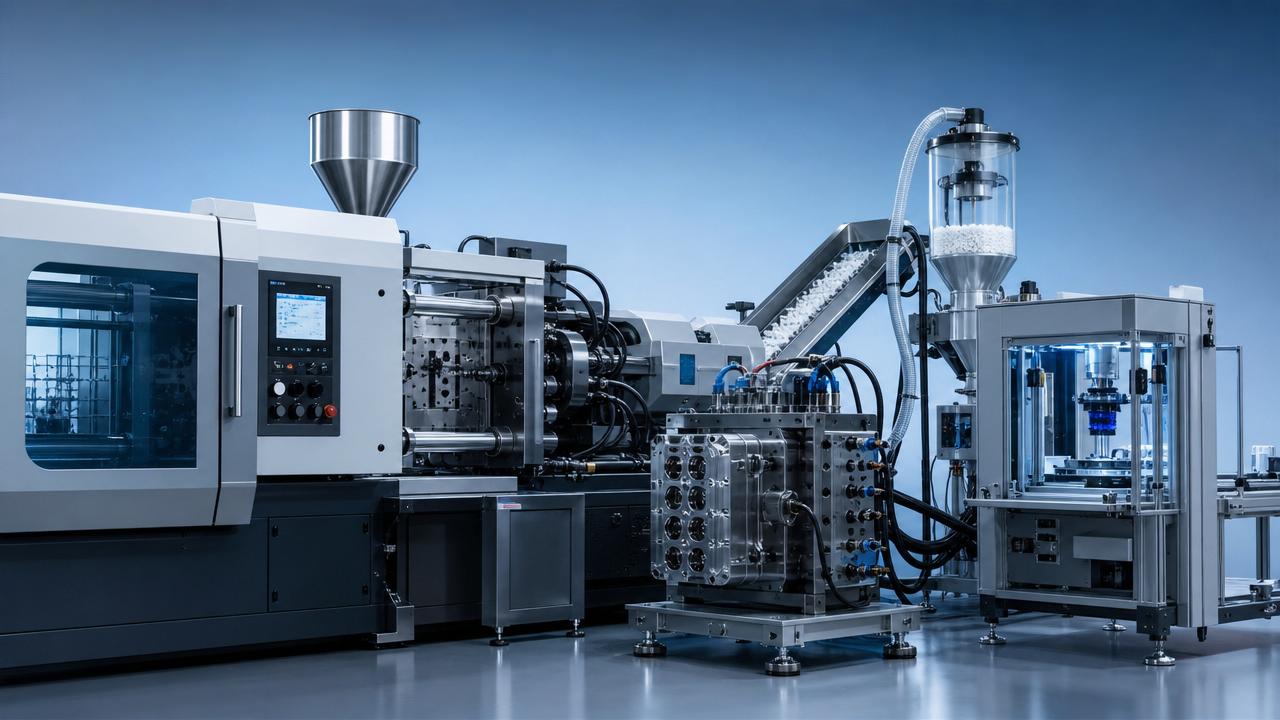
Another driver is the spread of all-electric and high-response servo machines. These platforms generate richer process data and react faster to control adjustments, making AI in injection molding more useful than it was on older assets.
Energy has also become a strategic metric, not just an overhead item. When cycle drift increases hold time, clamp inefficiency, or cooling inconsistency, the cost shows up in both electricity use and material waste.
Compliance adds another layer. Global packaging rules, traceability demands, and customer audits increasingly require proof of stable processing conditions rather than general quality claims.
What PFRS observes across polymer equipment is a wider digitalization push. Intelligence once focused on scheduling or dashboards is moving deeper into rheology-sensitive process decisions.
- Sensor coverage is improving, especially for pressure, temperature, screw position, vibration, and energy draw.
- Edge computing makes real-time recommendations feasible without slowing production.
- Machine builders and processors are under pressure to document repeatability, not only output volume.
- Recycled and blended materials increase process uncertainty, which raises the value of adaptive control.
Taken together, these forces explain why AI in injection molding is moving from pilot language to operational language.
Where AI in injection molding delivers the clearest gains first
The most credible gains do not usually come from replacing process engineers. They come from identifying repeatable patterns that humans cannot monitor continuously across every shot.
Cycle stability improves when variation is detected early
Cycle stability depends on more than machine speed. It reflects melt behavior, mold temperature balance, fill pressure response, cooling uniformity, and environmental changes across long runs.
AI in injection molding helps by recognizing when a stable cycle begins to drift before parts fail inspection. It can flag pressure curve deviations, cooling anomalies, or unusual recovery patterns within a few cycles.
Scrap reduction becomes more realistic at the process-window level
Scrap often comes from cumulative micro-variation rather than one major fault. Short shots, flash, sink marks, burns, warpage, and dimensional drift can all emerge from small shifts that seem harmless in isolation.
That is where AI in injection molding shows value. It can correlate part defects with subtle combinations of barrel temperature, hold pressure profile, injection velocity, cushion, and cooling time.
Maintenance becomes less reactive and less disruptive
Maintenance teams have long monitored screws, hydraulic systems, clamps, heaters, and molds. The difference now is the ability to predict performance decline from changing signatures rather than waiting for failure alarms.
For example, AI in injection molding can interpret rising motor load, abnormal vibration, longer plastication time, or shifting pressure response as early indicators of wear, contamination, leakage, or cooling blockage.
The gains depend on data quality more than dashboard design
A common mistake is to start with software selection before checking data reliability. In practice, AI in injection molding is only as strong as the process history behind it.
Good results usually require synchronized machine signals, stable part-quality feedback, clear lot tracking, and enough production diversity to separate random noise from true process behavior.
This is why the strongest adopters often begin with one stable product family, one mold group, or one machine cluster. Narrow scope usually creates better insight than broad but shallow deployment.
It also explains why broader polymer intelligence matters. When extrusion compounding changes pellet consistency, or recycling lines alter moisture and contamination risk, injection data must be interpreted in that wider materials context.
The impact reaches beyond a single molding cell
One reason AI in injection molding is attracting executive attention is that the impact spreads across operations. Better control at the machine level affects planning, energy management, customer confidence, and even sustainability reporting.
For quality teams, it means fewer unexplained deviations and faster root-cause analysis. For operations, it means more predictable throughput and less unplanned intervention during critical runs.
For finance, lower scrap is only part of the story. More stable cycles also reduce hidden losses tied to regrind handling, delayed approvals, overtime recovery, and avoidable mold stress.
There is also a strategic materials angle. As recycled content targets grow, processors need tighter control to offset feedstock variability. AI in injection molding becomes more valuable when material behavior is no longer fully predictable batch to batch.
This is consistent with the broader PFRS view of modern material shaping. Digital intelligence is not isolated from sustainability. It is increasingly the mechanism that makes circular material use commercially workable.
What deserves closer evaluation before scaling adoption
Not every line needs the same AI model, and not every plant should start with predictive maintenance. The better starting point depends on where instability creates the highest cost or compliance exposure.
- Check whether cycle drift, scrap spikes, or unplanned downtime causes the largest recurring loss.
- Assess sensor health and signal consistency before promising plant-wide analytics.
- Review whether quality data is linked to shot data quickly enough to support learning loops.
- Test explainability. Teams need recommendations they can trust, not opaque alerts.
- Define success in operational terms such as CpK stability, scrap reduction per mold family, or downtime avoided.
A careful rollout usually beats a dramatic one. The strongest early projects tend to focus on high-volume parts, quality-sensitive molds, or lines exposed to material variability.
That approach reduces disruption and produces evidence that can later support expansion into extrusion, blow molding support systems, or recycling-linked molding programs.
The next phase will reward operational realism
The market is moving past the stage where AI in injection molding is judged by presentation quality. It is now judged by whether it stabilizes real cycles, cuts real scrap, and prevents real downtime.
That makes the next phase more demanding, but also more useful. Plants that connect process intelligence with material behavior, machine response, and maintenance evidence will build a stronger base for precision and sustainability together.
A sensible next step is to map one production area where variation is persistent, data already exists, and the cost of instability is visible. From there, compare whether AI in injection molding improves control decisions faster than current practice.
The broader lesson is clear. In polymer manufacturing, intelligence creates value when it stays close to physics, process discipline, and measurable plant outcomes.
Related News
- 00
0000-00
Plastic Compounding Cost Explained: How Throughput, Fillers, and Energy Change Total Cost - 00
0000-00
Injection Molding Price Breakdown: What Drives Tooling, Material, and Unit Costs? - 00
0000-00
Industrial Injection Molding for Automotive: Common Defects and Process Fixes - 00
0000-00
Automotive Plastic Molding Machinery Selection: Key Clamping, Shot Size, and Automation Factors - 00
0000-00
How Underwater Pelletizing Technology Works and Which Polymers It Fits Best
Weekly Insights
Stay ahead with our curated technology reports delivered every Monday.
Related News
 Prof. Marcus ChenGlobal Plastic Ban Trends: Which Packaging Materials and Export Markets Face the Biggest Changes?Global plastic ban trends are reshaping packaging choices and export strategy. See which materials and markets face the biggest shifts, and how to reduce compliance risk.Jun 22, 2026
 Prof. Marcus ChenPolymer Rheology Trends That Matter in Extrusion: Melt Strength, Shear, and StabilityPolymer rheology trends are reshaping extrusion performance. Learn how melt strength, shear, and stability affect quality, efficiency, and recycled resin processing.Jun 18, 2026
 Prof. Marcus ChenPlastic Circularity Strategies for Manufacturers: Recycled Content, Design, and TraceabilityPlastic circularity strategies for manufacturers: learn how recycled content, smarter design, and traceability can reduce risk, improve compliance, and strengthen supply resilience.Jun 18, 2026
 Prof. Marcus ChenAdvanced Materials Processing Equipment in High-Performance Manufacturing: Where It Fits BestAdvanced materials processing equipment drives precision, speed, and sustainability in manufacturing. Explore where each system fits best to improve quality, efficiency, and ROI.Jun 16, 2026
 Prof. Marcus ChenWhat Is Driving the Circular Economy Plastics Market? Policy, Pricing, and Demand ShiftsCircular economy plastics market trends are being driven by tighter policy, resin price volatility, and stricter buyer demands. Discover what this means for sourcing, processing, and growth.Jun 13, 2026
 Prof. Marcus ChenDigital Polymer Processing Explained: Methods, Materials, and Best-Fit ApplicationsDigital polymer processing explained clearly: explore key methods, materials, and best-fit applications to improve quality, efficiency, and recycling performance.Jun 10, 2026
 Prof. Marcus ChenGlobal Plastic Ban Trends by Region: What Packaging Manufacturers Need to TrackGlobal plastic ban trends are reshaping packaging strategy by region. Discover key policy shifts, compliance risks, and smart actions manufacturers need to stay competitive.Jun 08, 2026
 Prof. Marcus ChenESG in Plastic Manufacturing: Which Metrics Matter Most for Audits and Buyer Reviews?ESG in plastic manufacturing: discover the audit metrics buyers review most, from energy and scrap to traceability, safety, and recycled content control.Jun 07, 2026
 Prof. Marcus ChenAI in Injection Molding: Where It Improves Cycle Stability, Scrap Rate, and MaintenanceAI in injection molding helps manufacturers improve cycle stability, cut scrap, and predict maintenance earlier—discover where it delivers measurable plant-floor value first.Jun 06, 2026
 Prof. Marcus ChenRecycled Plastic Technology: Sorting, Decontamination, and Pellet QualityRecycled plastic technology is transforming sorting, decontamination, and pellet quality—discover how smarter controls improve resin performance.Jun 03, 2026
 Prof. Marcus ChenGreen Circular Economy in Plastics: Recycling, Design, and Policy LinksGreen circular economy insights for plastics: discover how recycling, smart design, equipment, and policy links reduce risk, improve ROI, and build competitive advantage.Jun 02, 2026
 Prof. Marcus ChenHow will the green circular economy reshape plastics?Green circular economy trends are reshaping plastics through smarter recycling, efficient processing, stable feedstock strategies, and data-driven circular production.Jun 01, 2026
 Prof. Marcus ChenIs polymer smart manufacturing ready for plant upgrades?Polymer smart manufacturing is ready to transform plant upgrades—cut energy use, stabilize quality, improve traceability, and unlock smarter circular production.May 30, 2026
 Prof. Marcus ChenPolymer smart manufacturing needs better data to scalePolymer smart manufacturing needs reliable data architecture to scale quality, energy control, traceability, and circular plastics performance. See how to build it.May 29, 2026
 Prof. Marcus ChenAre green packaging materials worth the switch?Green packaging materials can reduce compliance risk, improve recyclability, and support efficient production—discover when the switch delivers real business value.May 29, 2026
 Prof. Marcus ChenIs digital polymer processing worth the upfront cost?Digital polymer processing can cut scrap, energy use, and downtime while improving compliance. See how to evaluate upfront cost, ROI, and phased rollout for faster payback.May 28, 2026
 Prof. Marcus ChenWhen non-Newtonian fluid simulations improve process decisionsNon-Newtonian fluid simulations help manufacturers compare equipment, reduce trials, improve quality, and make smarter process decisions across molding, extrusion, rubber, and recycling.May 27, 2026
 Prof. Marcus ChenWhy thermodynamic reactions in polymers affect process safetyThermodynamic reactions in polymers can trigger hidden heat, pressure, and degradation risks. Discover a practical safety checklist to prevent fires, defects, downtime, and compliance issues.May 26, 2026
 Prof. Marcus ChenWhy polymer smart manufacturing matters in 2026Polymer smart manufacturing is redefining 2026 production with better quality, lower waste, stronger compliance, and smarter investment decisions across molding, extrusion, and recycling.May 25, 2026
 Prof. Marcus ChenWhat polymer molding scientists are changing in 2026Polymer molding scientists are redefining 2026 with AI control, energy-efficient processing, and smarter recycling. Discover the trends driving precision, compliance, and competitive growth.May 24, 2026