Industrial Injection Molding for Automotive: Common Defects and Process Fixes




Why defect control changes across automotive molding conditions
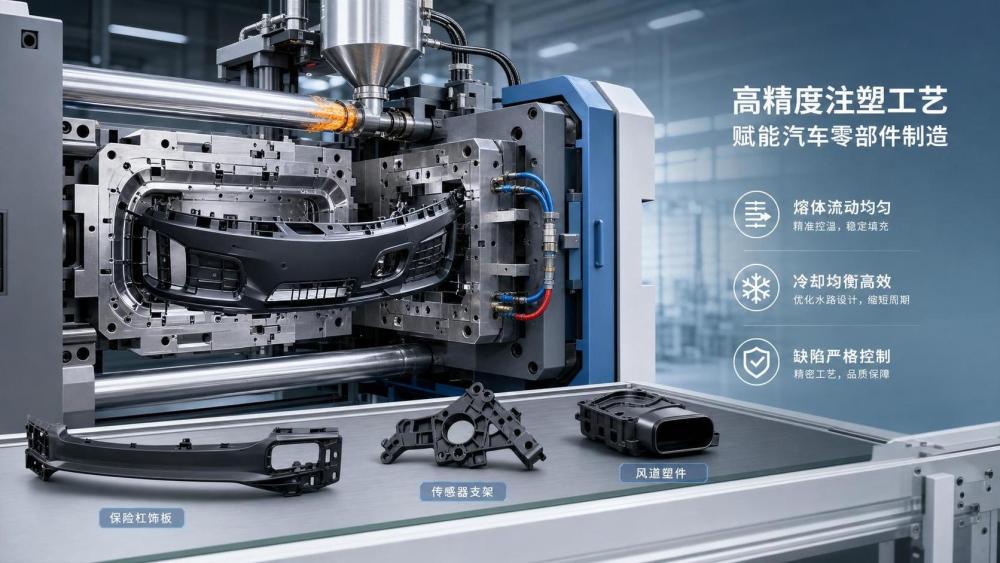
Industrial injection molding for automotive rarely fails for one isolated reason.
A door trim, sensor bracket, air duct, and bumper fascia may share resin families, yet behave very differently in production.
That is why defect control starts with process context, not with a generic adjustment sheet.
In practice, dimensional stability, appearance, weld line strength, and cycle time rarely pull in the same direction.
A setting that helps gloss on visible trim can worsen flash on thin ribs.
A packing profile that protects a thick housing can create over-stress in a glass-filled clip feature.
For PFRS, this is where polymer rheology and machine response become practical, not academic.
Automotive molding quality depends on how melt flow, cooling balance, venting, servo response, and mold design interact under real production pressure.
The more complex the part, the less useful a one-size-fits-all answer becomes.
A better approach is to read each defect through the part’s functional scene.
Visible exterior parts usually punish warpage and sink marks first
Exterior automotive parts expose every process weakness because appearance and fit are judged at the same time.
Bumper skins, mirror housings, pillar trims, and grilles often show warpage, gloss variation, sink marks, or read-through from ribs.
In industrial injection molding for automotive, these defects usually trace back to uneven cooling, poor gate balance, or excessive local packing.
The common mistake is chasing the surface symptom only.
Polishing the mold or raising melt temperature may hide marks temporarily, but it often leaves the root imbalance untouched.
What to check before changing multiple settings
- Compare cavity-side and core-side temperature stability, not only average mold temperature.
- Check rib-to-wall ratio and gate freeze time before increasing holding pressure.
- Review clamp parallelism when flash appears only on one side.
- Confirm resin moisture history if gloss variation appears with splay.
Where surface class is high, slower fill with controlled acceleration often works better than simply lowering total injection speed.
That keeps the flow front stable while reducing shear streaks near visible gates.
If sink persists in thicker bosses, the better fix may be geometry revision or localized cooling improvement.
More holding pressure alone can lock in stress and reshape the defect later as warpage.
Under-hood and structural parts often reveal short shots differently
Under-hood parts are less forgiving in another way.
Air management ducts, battery covers, fan shrouds, and reinforced brackets prioritize fill completeness and mechanical consistency over cosmetic perfection.
Here, short shots, weak weld lines, burn marks, and fiber orientation issues become more critical.
Industrial injection molding for automotive in these applications must account for longer flow paths, filler content, and higher thermal cycling demands.
A short shot in a hidden corner may still create a sealing failure or assembly noise later.
That is why fill studies and vent confirmation matter more than visual acceptance alone.
Typical root causes in this scene
When a glass-filled nylon bracket shows incomplete fill, low melt temperature is only one possible reason.
The real issue may be frozen gates, excessive decompression, worn non-return valves, or trapped gas at end-of-fill.
Burn marks, by contrast, often push teams toward lower speed too quickly.
If the root problem is poor vent depth or blocked vent land, slower filling may only move the defect.
In this kind of automotive molding, pressure trace consistency is often more useful than one-off visual sorting.
Thin-wall interior features need a different reading of flash and stress
Interior bezels, clips, switch carriers, and console parts look simpler, but thin walls and fine details raise their own risks.
Flash, hesitation marks, jetting, and post-assembly cracking are more common than many lines expect.
In industrial injection molding for automotive, small parts often magnify machine response errors.
A slight overshoot in transfer position or an unstable screw recovery profile can change the whole result.
This is where high-response electric or servo platforms show their value.
The process window is narrow, and repeatability matters more than headline tonnage.
The comparison matters because similar-looking defects do not always justify similar corrections.
Regrind, recycled content, and compliance can shift the defect pattern
A growing issue in industrial injection molding for automotive is material variability linked to sustainability targets.
As circular economy pressures increase, more programs evaluate regrind ratios, recycled compounds, or supplier changes.
That does not automatically create poor quality, but it does narrow the safe process window.
Melt viscosity drift can alter fill balance, packing response, and demolding behavior even when nominal datasheets look similar.
This is where the broader PFRS view becomes useful.
Injection molding does not sit alone.
Extrusion compounding quality, filtration efficiency, and recycling line control can all influence downstream automotive molding defects.
If black specks, unstable fill, or unusual odor appear after a material source change, the answer may begin upstream.
Looking only at machine settings can delay the real fix.
Misjudgments on the shop floor often come from treating similar parts as identical
Many recurring losses come from reasonable assumptions applied in the wrong place.
- Using the same holding profile for talc-filled PP and glass-filled PA because both parts share a similar wall thickness.
- Reducing clamp force to protect the mold without checking whether flash is actually caused by trapped gas.
- Increasing barrel temperature to solve short shots while ignoring a moisture problem in hygroscopic resin.
- Approving a cosmetic fix that later increases assembly variation or squeak-and-rattle risk.
- Comparing piece price only, while overlooking scrap, energy draw, maintenance frequency, and mold cleaning intervals.
In real automotive programs, those misreads accumulate across launches, engineering changes, and resin substitutions.
The better habit is to connect defect history with part function, material path, and machine behavior.
A practical way to stabilize industrial injection molding for automotive
Useful correction plans are usually shorter than teams expect.
They are just more disciplined.
Start with a scene-based review
- Map the defect to appearance, sealing, structural load, or assembly fit.
- Check whether the defect is local, cavity-specific, shift-specific, or material-lot specific.
- Separate molding symptoms from upstream material preparation issues.
- Use machine curves, not memory, to judge transfer, cushion, and recovery stability.
Then adjust in the right order
Change only one process family at a time.
Fill profile first, then transfer, then packing, then cooling, and only then broader temperature shifts if needed.
That sequence prevents false improvements.
For industrial injection molding for automotive, the aim is not merely passing the next batch.
The aim is building a repeatable window that survives volume production, material fluctuation, and compliance pressure.
A useful next step is to document defect patterns by part scene, compare them with pressure and temperature traces, and confirm where mold, material, and machine limits truly begin.
That kind of structured review makes later decisions on tooling changes, machine upgrades, recycled-content trials, and maintenance timing far more reliable.
Related News
- 00
0000-00
How Curing Press Control Shapes Uniformity and Tread Life in Truck Tire Manufacturing - 00
0000-00
How to Evaluate German Extrusion Equipment for Stable, High-Output Production - 00
0000-00
How Closed-Loop Bottle-to-Bottle Recycling Maintains Food-Grade PET Quality - 00
0000-00
How to Specify a Food-Grade PET Bottle Recycling System for Safe rPET Production - 00
0000-00
How to Evaluate a Plastics Processing Equipment Manufacturer for Uptime and Support
Weekly Insights
Stay ahead with our curated technology reports delivered every Monday.
Related News
 Ms. Elena RodriguezIn-House Recycling for Factory Scrap: How to Reduce Material Waste and Disposal CostsIn house recycling for factory scrap helps manufacturers cut material waste, reduce disposal costs, and create controlled, quality-focused reuse loops.Sep 07, 2026
 Ms. Elena RodriguezHow Recyclable Packaging Manufacturing Balances Material Recovery and Production CostRecyclable packaging manufacturing: discover how smarter design, feedstock control, and process optimization reduce recovery costs while improving quality and yield.Sep 04, 2026
 Ms. Elena RodriguezHow to Evaluate a Plastic Recycling Systems Supplier for Your Processing NeedsChoose the right plastic recycling systems supplier with a practical guide to feedstock fit, output quality, total cost, testing, service, and compliance.Sep 01, 2026
 Ms. Elena RodriguezCE Marking for Plastic Processing Equipment: Documentation and Safety ChecksPlastic processing equipment CE compliance: learn the essential documentation, risk assessments, safety checks, and validation steps for reliable EU market access.Aug 30, 2026
 Ms. Elena RodriguezPlastic Packaging Compliance Standards: What Tests and Documents Matter Most?Plastic packaging compliance standards explained: learn which migration tests, mechanical checks, and audit-ready documents matter most to reduce risk and pass reviews with confidence.Aug 25, 2026
 Ms. Elena RodriguezHow to Evaluate a Plastic Waste Recycling System for Capacity, Contamination, and ROIPlastic waste recycling system evaluation made practical: compare true capacity, contamination control, and ROI to choose a line that delivers stable output and stronger returns.Aug 24, 2026
 Ms. Elena RodriguezPackaging Molding Equipment Price: What Drives Cost and How to Compare Quotes?Packaging molding equipment price varies by machine type, automation, tooling, energy use, and service scope. Learn what drives cost and how to compare quotes with confidence.Aug 21, 2026
 Ms. Elena RodriguezWhat Packaging Machinery for Plastic Containers Should You Choose for High-Volume Production?Packaging machinery for plastics containers can make or break high-volume production. Learn how to choose the right line for speed, consistency, compliance, and lower lifecycle costs.Aug 16, 2026
 Ms. Elena RodriguezWhat Circular Plastics Mean for Automotive Parts and Material SelectionCircular plastics for automotive are reshaping part selection with lower weight, better sustainability, and reliable performance. Discover how engineers balance recycled content, durability, and compliance.Aug 15, 2026
 Ms. Elena RodriguezBroiler Farming in Cage System: Selection Factors for Commercial FarmsBroiler farming in cage system selection for commercial farms: compare structure, ventilation, automation, and manure handling to improve efficiency and avoid costly mistakes.Aug 14, 2026
 Ms. Elena RodriguezHow to Implement Smart Polymer Manufacturing Without Disrupting Existing Production?Smart polymer manufacturing implementation made practical: learn how to upgrade existing production with phased digitalization, less downtime, better control, and measurable ROI.Aug 11, 2026
 Ms. Elena RodriguezHow to Evaluate a Rubber Compression Molding Supplier for Complex Part ProductionRubber compression molding supplier selection for complex parts starts with process, material, and tooling control. Learn how to compare vendors beyond price and reduce launch risk.Aug 10, 2026
 Ms. Elena RodriguezPackaging Compliance in Canada: Key Labeling and EPR Rules Importers Must KnowPackaging compliance Canada explained for importers: learn bilingual labeling, environmental claims, and provincial EPR rules to reduce risk, avoid costly errors, and stay market-ready.Aug 03, 2026
 Ms. Elena RodriguezWhy Circular Plastics Economy Traceability Matters for Recycled Content ComplianceCircular plastics economy traceability is essential for proving recycled content compliance across sourcing, processing, and reporting. Learn how strong evidence reduces audit risk.Aug 02, 2026
 Ms. Elena RodriguezRecycled Plastic Compliance: Key Standards, Testing Requirements, and DocumentationRecycled plastic compliance explained: key standards, testing requirements, supplier documents, and food-contact risks to help you avoid approval delays and costly compliance mistakes.Aug 01, 2026
 Ms. Elena RodriguezHow to Evaluate an Extrusion Machinery Manufacturer for Quality, Support, and ROIExtrusion machinery manufacturer selection affects quality, uptime, and ROI. Learn how to compare process fit, output claims, service, compliance, and long-term operating costs.Jul 29, 2026
 Ms. Elena RodriguezHow to Evaluate Food Grade Recycled Pellets for Safe Packaging ApplicationsFood grade recycled pellets for safe packaging demand more than a label. Learn how to assess feedstock, process validation, pellet quality, and compliance before approval.Jul 28, 2026
 Ms. Elena RodriguezHow to Evaluate a Rubber Vulcanization Supplier for Quality, Capacity, and Lead TimeRubber vulcanization supplier selection made easier: learn how to assess quality systems, true production capacity, and lead time reliability to reduce sourcing risk and improve supply performance.Jul 25, 2026
 Ms. Elena RodriguezPlastic Waste Recycling Price: What Drives Costs and How Buyers Should Compare QuotesPlastic waste recycling price explained: compare quotes by yield, energy use, pellet quality, and compliance costs to find the best long-term recycling value.Jul 20, 2026
 Ms. Elena RodriguezHow to Plan a Smart Factory for Plastics Packaging: Key Systems, Data, and ROISmart factory for plastics packaging planning starts with the right systems, data architecture, compliance, recycling, and ROI model. Learn the key steps to build a scalable, future-ready plant.Jul 19, 2026