
Plastics Manufacturing Digitalization: Reducing Downtime and Scrap




A molding press stops without a clear reason, or an extrusion line produces off-spec material before anyone notices a process drift. The immediate effects are familiar: lost production time, disrupted schedules, extra inspection, and material that may not be usable. When downtime and scrap records are incomplete, the next shift may face the same problem without knowing what preceded it.
Plastics manufacturing digitalization helps by connecting machine events, process conditions, quality results, and maintenance records so teams can investigate losses while there is still enough context to act. Start with one production constraint, establish a trustworthy baseline, and test whether better information changes a maintenance or operating decision. A dashboard alone will not reduce downtime or scrap; the value comes from a defined response to what it shows.
Start with the loss, not the data platform
Choose a line or machine where the team can describe a recurring loss and has someone responsible for acting on it. A press with frequent unexplained stops may need better event capture. A stable-running extruder with variable product dimensions may benefit more from process-to-quality correlation. These are different projects, even if both use the same connectivity infrastructure.
Before installing sensors or selecting software, review existing shift logs, alarm histories, maintenance work orders, and quality records. Ask operators which interruptions take the longest to diagnose and which rejects are discovered only after a substantial quantity has been produced. Existing records may be imperfect, but they can reveal where missing information prevents a useful decision.
Define the boundaries of the pilot: equipment included, products or materials covered, operating shifts, and the decision the information should support. Avoid comparing a pilot period with an earlier period without accounting for changes in product mix, resin, staffing, planned maintenance, or production volume. Otherwise, a change in the numbers may be mistaken for an effect of the digital project.
Build a baseline that separates different kinds of loss
Downtime and scrap are not single, interchangeable measures. A line may be available but producing reject material, or it may be stopped for a planned mold change rather than a failure. Agree on definitions before comparing equipment or shifts.
- Unplanned downtime: Record the start and end of an unexpected production interruption, its equipment location, and the best available reason. Distinguish the time spent waiting for help or parts from active repair time where practical.
- Scrap: Record the quantity, unit of measure, defect or disposition, and point at which the material was identified. Keep regrind or material held for review separate from confirmed discard if the site treats them differently.
- Production context: Link events to product, material lot, recipe, shift, and work order where those records are available. Record changeovers and trials so they are not mistaken for normal production.
- Quality timing: Capture when a sample was produced as well as when it was inspected. A result entered later must be matched to the conditions that existed when the material was made.
Use a manageable set of reason codes and allow operators to flag uncertainty rather than forcing an incorrect explanation. Review “unknown” events regularly: a large unknown category points to a data-collection problem, while an overly detailed code list can make entry inconsistent. Where possible, retain the original machine alarm alongside the human-entered reason; an alarm is evidence of an event, not necessarily its root cause.
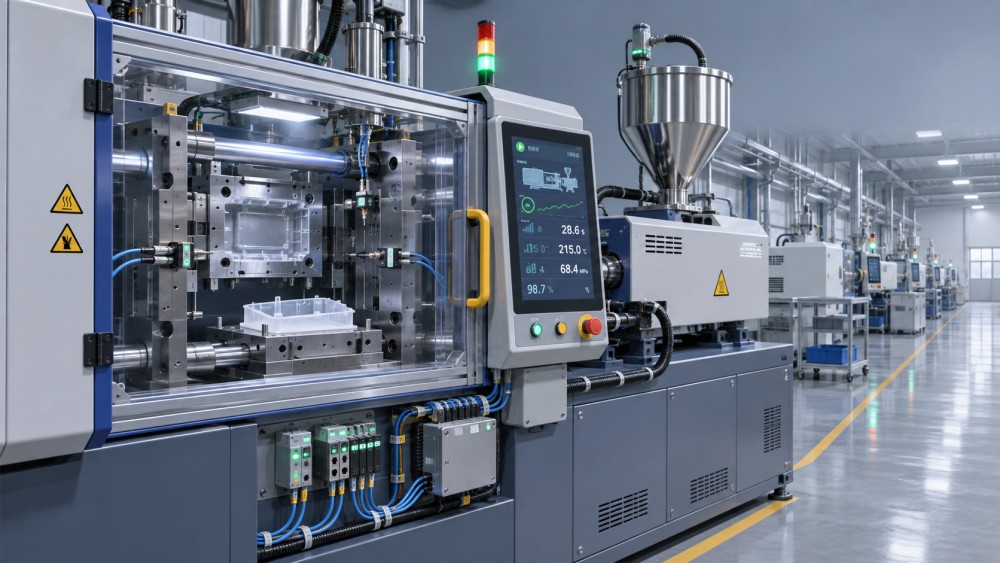
Connect process signals to decisions on the line
The most useful signals are those that help distinguish normal variation from a condition requiring action. They should also be available at a frequency suited to the event. A shift average can conceal a brief pressure excursion, while high-frequency recording of every available tag can create storage and analysis work without improving the response.
Injection molding: relate individual cycles to defects
For a press producing intermittent short shots, dimensional variation, or excessive flash, begin by linking cycle records to the cavity, mold, material, and inspection result where feasible. Depending on the machine and defect, useful signals can include injection transfer position, peak pressure, holding pressure and time, cushion, melt temperature, cycle time, and mold-temperature readings.
Look for changes in the sequence, not just values outside a limit. A declining cushion, for example, may justify checking material feed, non-return valve behavior, or process settings; it does not prove which component is responsible. Establish acceptable ranges with process and quality personnel, then confirm suspected causes through controlled checks. A part can pass a machine alarm limit and still fail its specification.
Extrusion: account for material moving through the process
On a continuous line, melt pressure, melt temperature, screw speed, motor load, throughput, and downstream measurements can help explain dimensional or surface defects. A rising pressure trend may prompt a check of the screen pack or filtration system, but pressure is also affected by material, temperature, output, and equipment configuration.
Timing matters because a process disturbance does not necessarily reach a downstream gauge or inspection point immediately. Estimate the relevant transport delay for the line and operating conditions, then verify the alignment against known events. Without that step, a quality measurement can be associated with the wrong process window. Record screen changes, recipe adjustments, and material changes in the same timeline so analysts do not treat deliberate interventions as unexplained faults.
Recycling and pelletizing: preserve feedstock context
Recycled feed can vary by source, contamination, moisture, and prior processing. Where those characteristics are measured, connect them to feed lots, melt filtration events, process conditions, and pellet quality checks. Frequent screen changes or unstable pressure can then be investigated alongside the incoming material and operating settings rather than attributed automatically to the machine.
Traceability may be approximate when material is blended or held in shared silos. Document that limitation and avoid assigning a defect to a single lot unless the material-flow record supports it. Digital records improve visibility, but they do not replace sampling or material identification.
Turn equipment events into a maintenance response
Condition monitoring is most useful when it answers a maintenance question: which component may be deteriorating, what evidence would justify inspection, and how much time is available to plan the work? Depending on the asset, teams may use motor current, vibration, hydraulic pressure, temperature, or recurring alarm patterns. Select signals with input from maintenance staff and the equipment supplier; a threshold copied from another machine may not be meaningful.
Begin with a failure mode that has a credible relationship to a measurable signal. For example, a change in motor load may warrant investigation of a drive or process restriction, but it can also reflect a different material or operating rate. Compare the signal under similar conditions and record what was found during inspection. This feedback is essential for deciding whether an alert is useful.
Each alert needs an owner, a priority, and a response path. An operator might verify an operating condition, maintenance might inspect at the next safe opportunity, and engineering might review repeated excursions. Route urgent conditions through existing protective systems and site procedures; an analytics dashboard must not be treated as a replacement for machine interlocks or established safety controls.
Make the data usable before automating decisions
Older and newer machines may expose different signals, units, and event histories. Map each required data point to its source, confirm its unit and meaning, and assign a consistent equipment identifier. Synchronize clocks across machines, quality systems, and maintenance records; otherwise, events that appear related may have occurred in a different order.
Test connectivity under normal production conditions. Check for gaps caused by network interruptions, machine restarts, or unavailable controller data, and decide whether missing values will be buffered, flagged, or left blank. Do not silently substitute a previous value where that could hide a process change. Operators should be able to distinguish a genuine zero from a missing reading.
Access also needs attention. Use approved interfaces where available, limit write access, and coordinate changes with operations and IT personnel. Read-only monitoring is often a sensible starting point. Any automated adjustment of process settings requires separate validation, authorization, and safety review; a correlation in historical data is not by itself a safe control strategy.
Run the pilot as an operating change
- Choose one decision. Specify who will act, what information they need, and the expected response. For example, the decision might be whether to inspect a filtration system during a planned stop rather than after an interruption.
- Capture a baseline. Collect downtime and scrap using agreed definitions, along with production context. Check the completeness of records before relying on the totals.
- Validate the signals. Compare displayed values and timestamps with machine readings, operator observations, and quality records. Investigate gaps or inconsistent units before setting alerts.
- Test the workflow. Run alerts or reports with the relevant shift and maintenance teams. Record whether each notification led to a useful action, no action, or an unnecessary interruption.
- Review and adjust. Compare results with the baseline while accounting for production changes. Retain the approach only if the information is reliable and the response is practical.
Set review intervals around the production cycle and the frequency of the problem. A rare failure may require a longer observation period than a recurring quality issue. Include operators from different shifts in the review: a process that works during an engineering trial may fail when its owner is unavailable or when manual data entry competes with production tasks.
Decide what is ready to scale
Do not expand solely because the pilot collected a large volume of data. Look for evidence that loss categories are consistently recorded, signals can be trusted, and the team responds to the information. Compare downtime duration, recurrence, and confirmed scrap against the agreed baseline, but also examine whether a change in inspection practice has simply caused more defects to be detected.
When extending the approach to another line, reuse definitions and workflows where they fit, but revalidate the signal mapping, operating limits, and material-flow timing. A threshold appropriate for one mold, resin, or extrusion product may create nuisance alerts or miss genuine drift elsewhere. If data quality remains poor or the team cannot identify an action for an alert, correct that issue before adding more equipment.
Related News
- 00
0000-00
Plastics Manufacturing Digitalization: Reducing Downtime and Scrap - 00
0000-00
Choosing Rubber Processing Machinery for Elastomer Parts: Key Factors - 00
0000-00
Precision Medical Plastics Manufacturing: Material and Tolerance Choices - 00
0000-00
Choosing High-Speed Pipe Extrusion Lines: Output, Cooling and Pipe Quality - 00
0000-00
What Is a Circular Plastics Platform and How Does It Support Recycling?
Weekly Insights
Stay ahead with our curated technology reports delivered every Monday.
Related News
 Prof. Marcus ChenPlastics Manufacturing Digitalization: Reducing Downtime and ScrapPlastics manufacturing digitalization can reduce downtime and scrap. Discover practical steps to connect process data, improve maintenance, and act on quality issues.Nov 07, 2026
 Prof. Marcus ChenWhat Is a Circular Plastics Platform and How Does It Support Recycling?Discover how a circular plastics platform connects materials, recyclers, and buyers—and learn what to look for when choosing one.Nov 03, 2026
 Prof. Marcus ChenHow Single-Use Plastic Bans Shift Demand for Packaging MaterialsExplore the plastic ban market impact on packaging demand, from fiber and recycled plastics to reuse. Discover viable alternatives and smarter investment opportunities.Oct 15, 2026
 Prof. Marcus ChenWhere Recycled Plastic Innovation Delivers the Biggest Value in PackagingRecycled plastic innovation delivers the greatest packaging value through proven material loops, reliable processing, compliance readiness, and circular design.Oct 08, 2026
 Prof. Marcus ChenEnergy-Efficient Polymer Processing: Where Plants Can Cut kWh per KilogramEnergy-efficient polymer processing solutions help plants reduce kWh per kilogram, protect quality, cut scrap, and prioritize upgrades with data-driven insights.Sep 23, 2026
 Prof. Marcus ChenPlastic Pelletizing Trends: How Recycling Demand Is Reshaping Processing TechnologyPlastic pelletizing trends are redefining recycling quality. Explore filtration, extrusion, degassing, and automation innovations driving cleaner, more consistent recycled resin.Sep 07, 2026
 Prof. Marcus ChenHow Polymer Supply Chains Are Changing to Support High-Quality Recycling FeedstockPolymer supply chain for recycling is shifting toward traceable sourcing, cleaner sorting, and stable processing. See how high-quality feedstock improves performance, compliance, and cost control.Aug 22, 2026
 Prof. Marcus ChenHow Europe’s Circular Plastics Economy Is Reshaping Recycling InvestmentCircular plastics economy Europe is reshaping recycling investment through quality, traceability, and packaging demand. Explore where capital is moving and why it matters now.Aug 04, 2026
 Prof. Marcus ChenBlow Molding Trends Shaping Packaging, Sustainability, and Production EfficiencyBlow molding trends are redefining packaging with lightweighting, recycled content, automation, and energy efficiency. Discover how smarter production boosts sustainability and cuts costs.Jul 23, 2026
 Prof. Marcus ChenExtrusion Equipment Modular Design: When It Makes Sense for Line ExpansionExtrusion equipment modular design helps manufacturers expand lines in phases, cut disruption, and stay ready for recycled content, utility limits, and changing product demands.Jul 15, 2026
 Prof. Marcus ChenPolymer Lifecycle Solutions Explained: From Material Sourcing to End-of-Life RecoveryPolymer lifecycle solutions explained from sourcing and processing to recycling and recovery. Discover how to cut waste, improve quality, and build smarter material strategies.Jul 13, 2026
 Prof. Marcus ChenEnergy-Efficient Polymer Processing Systems: Which Metrics Matter Most?Energy-efficient polymer processing systems: discover the metrics that truly drive ROI—specific energy use, yield, uptime, stability, and compliance for smarter equipment decisions.Jul 11, 2026
 Prof. Marcus ChenPolymer Recycling Systems for Continuous Operation: What to Check Before SpecifyingPolymer recycling systems continuous operation starts with the right specification. Learn what to check for uptime, melt quality, energy efficiency, and reliable pellet output.Jul 09, 2026
 Prof. Marcus ChenCircular Plastics Economy in Japan: Policy Drivers, Recycling Targets, and Market ImpactCircular plastics economy Japan is accelerating as policy, recycling targets, and packaging reforms reshape material choices, processing strategy, and market advantage.Jul 05, 2026
 Prof. Marcus ChenPlastic Extrusion Technology Trends: What Process Changes Are Improving Energy Efficiency?Plastic extrusion technology trends are reshaping energy efficiency through smarter screws, thermal control, servo drives, and digital optimization. See which process changes deliver lower costs and more stable output.Jul 01, 2026
 Prof. Marcus ChenInjection Molding Technology Trends: Which Process Changes Matter Most for Medical and Packaging Parts?Injection molding technology trends shaping medical and packaging parts: discover the process changes that improve validation, precision, efficiency, and recycled-material readiness.Jun 30, 2026
 Prof. Marcus ChenCircular Plastics Economy Compliance Explained: Key Requirements for ManufacturersCircular plastics economy compliance explained for manufacturers: learn key requirements, audit risks, process controls, and how to turn compliance into a competitive advantage.Jun 25, 2026
 Prof. Marcus ChenAdvanced Materials Processing Trends: 5 Shifts Reshaping Capacity Planning and SourcingAdvanced materials processing trends are reshaping capacity planning, sourcing, recycling, and compliance. Explore 5 shifts helping manufacturers cut risk, improve precision, and build resilient growth.Jun 24, 2026
 Prof. Marcus ChenGlobal Plastic Ban Trends: Which Packaging Materials and Export Markets Face the Biggest Changes?Global plastic ban trends are reshaping packaging choices and export strategy. See which materials and markets face the biggest shifts, and how to reduce compliance risk.Jun 22, 2026
 Prof. Marcus ChenPolymer Rheology Trends That Matter in Extrusion: Melt Strength, Shear, and StabilityPolymer rheology trends are reshaping extrusion performance. Learn how melt strength, shear, and stability affect quality, efficiency, and recycled resin processing.Jun 18, 2026


