Digital Polymer Processing Promises Speed, but Where Is the Payback?




Digital polymer processing is winning attention with faster cycles, tighter control, and smarter automation—but for enterprise decision-makers, speed alone is not the payoff. The real question is how quickly these investments improve yield, cut energy use, reduce scrap, and strengthen compliance. This article examines where the financial return truly comes from across modern polymer forming and recycling operations.
For manufacturers running injection molding, extrusion, blow molding, vulcanization, or plastic recycling lines, digitalization changes more than machine speed. It affects Overall Equipment Effectiveness, material consistency, labor structure, maintenance timing, and audit readiness.
That is why the business case for digital polymer processing must be measured across the full operating cycle, not only by headline throughput. In most plants, the strongest payback appears when 4 to 6 operational losses are addressed together rather than one at a time.
Where the Return Really Starts in Digital Polymer Processing
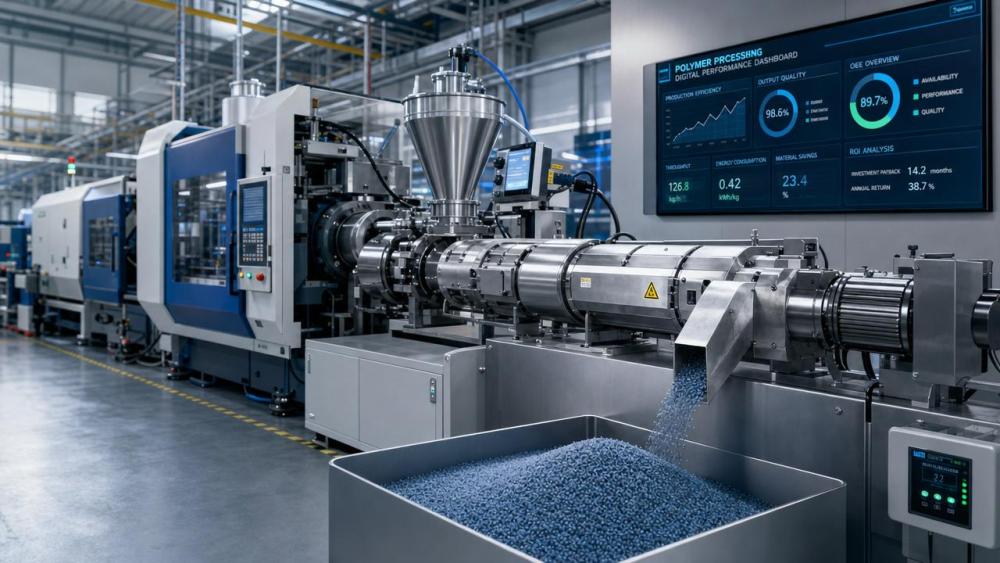
Enterprise buyers often first notice digital polymer processing through dashboards, sensors, and automation claims. Yet the first layer of return usually comes from basic process stabilization: fewer short shots, narrower melt variation, lower reject rates, and more reliable cycle windows.
In injection molding, even a 0.3 to 0.8 second cycle reduction matters only if cavity balance, holding pressure control, and part dimensions remain within tolerance. If scrap rises from 2% to 5%, the productivity gain can disappear in weeks.
The Four Main Payback Levers
Across polymer forming and recycling systems, return on investment commonly comes from four measurable levers:
- Yield improvement, often through tighter process repeatability and less startup loss
- Energy reduction, especially on all-electric molding, servo systems, and optimized heating zones
- Labor efficiency, with fewer manual checks and faster changeover support
- Compliance control, including traceability for recycled content, packaging, and process records
For many mid-to-large factories, a 1% to 3% improvement in material yield can outweigh a 5% speed increase. This is especially true in engineering plastics, medical packaging, food-contact applications, and recycled resin compounding where material cost is a major margin driver.
Why Speed Alone Rarely Delivers the Best Economics
A faster line can create hidden losses if upstream drying, downstream cooling, filtration, trimming, or inspection cannot keep pace. In extrusion and pelletizing, for example, unstable feeding at 2% to 4% variation can trigger melt inconsistency, off-spec pellets, and more screen changes.
The better question is not “How fast can the machine run?” but “At what stable rate can the entire cell or line run for 8 to 24 hours without quality drift?” That distinction defines true payback in digital polymer processing.
Typical Areas Where Financial Gains Show Up First
The table below shows where decision-makers usually see the earliest and most defensible returns after digital upgrades are implemented in polymer processing operations.
The key pattern is clear: payback starts where variability is reduced. Digital polymer processing earns trust when it turns unstable production into repeatable production, not when it simply raises theoretical capacity.
How Different Polymer Operations Produce Different Return Profiles
Not all assets generate value in the same way. A medical injection molding cell, a pipe extrusion line, and a waste plastic pelletizing system will each justify digital investment through different metrics, timelines, and risk controls.
Injection Molding: Payback Through Precision and Repeatability
In precision molding, the largest savings often come from process consistency rather than maximum tonnage use. Closed-loop control of fill time, cushion position, and holding pressure can reduce startup waste over the first 30 to 60 minutes of a shift.
For multi-cavity molds, digital polymer processing also improves cavity-to-cavity visibility. That matters when parts must remain within tight ranges such as ±0.05 mm to ±0.20 mm in medical, electronics, or optical applications.
Extrusion: Payback Through Throughput Stability and Formula Control
In extrusion, material feed precision is often the hidden value driver. When feeders, screw speed, barrel temperatures, and vacuum levels are digitally linked, operators can maintain stable output over long runs of 8, 12, or 24 hours.
For compounding lines, dosage error on additives or fillers can distort product performance and compliance. A small 0.5% to 1.0% deviation may affect color, stiffness, barrier behavior, or recyclability, making digital control economically significant.
Recycling and Pelletizing: Payback Through Quality Credibility
In recycling, digital polymer processing supports one of the market’s hardest tasks: producing recycled pellets with reliable downstream performance. Buyers increasingly want documented melt quality, contamination control, and process traceability before approving recycled content.
That means the return is not only operational. It is commercial. Better process records can shorten customer qualification cycles, reduce disputes over pellet consistency, and support pricing strength for higher-grade rPET, rPE, or compounded recyclates.
Comparing Payback by Application Type
The next comparison helps decision-makers align digital investment goals with the realities of each polymer operation rather than applying one ROI logic to every asset.
These timeframes vary by resin value, shift pattern, and customer quality requirements. Still, they show that digital polymer processing should be assessed by application-specific economics, not by a generic automation promise.
What Decision-Makers Should Measure Before Approving Investment
A digital project becomes easier to defend when baseline losses are quantified. Without a 60 to 90 day production baseline, many teams overestimate speed gains and underestimate losses caused by regrind, energy spikes, line stoppages, or quality holdbacks.
Five Numbers That Matter More Than a Demo Run
- Scrap or off-grade rate by product family
- Energy use per kilogram or per thousand parts
- Unplanned downtime hours per month
- Average startup loss after grade or mold change
- Time required for quality documentation and traceability retrieval
When these five metrics are tracked together, the payback model becomes far more realistic. A plant with 85% OEE and low scrap may need a different digital roadmap than a plant with 68% OEE, unstable utilities, and frequent material variation.
Common Buying Mistakes in Digital Polymer Processing
One frequent mistake is buying software visibility without machine-level process discipline. If sensors are installed but calibration, maintenance routines, and operator response rules are weak, the data may look impressive while production economics remain unchanged.
Another mistake is evaluating a system only on upfront price. For a line expected to run 6,000 to 8,000 hours annually, the larger cost may come from poor integration, delayed training, or inconsistent spare parts support rather than the initial hardware bill.
A Practical Evaluation Sequence
For enterprise teams comparing suppliers or internal upgrade proposals, this 5-step sequence reduces decision risk:
- Map the top 3 operational losses by asset class
- Define whether the target is quality, energy, throughput, or compliance
- Request line-specific integration details, not only generic feature lists
- Test reporting accuracy over at least 2 to 4 production weeks
- Review service response, operator training, and spare parts planning
This approach is especially important for organizations managing multiple technologies, such as molding, extrusion, and in-house recycling under one manufacturing strategy.
The Compliance and Sustainability Payback Is Growing Faster Than Many Plants Expect
For many processors, the next phase of digital polymer processing payback is linked to regulatory and customer pressure. Packaging declarations, recycled content targets, and production traceability now influence purchasing access in ways that were less urgent 5 years ago.
Digital records can help validate material lots, processing windows, and reprocessing ratios. In sectors with food, medical, automotive, or export exposure, that documentation can reduce audit friction and strengthen customer confidence during supplier reviews.
Why Recycling Integration Changes the ROI Equation
Companies adding regrind loops or in-house recycling lines often discover that data discipline matters as much as mechanical capability. Moisture level, contamination events, filtration conditions, and blend ratios must be monitored if recycled content is to remain commercially useful.
In practice, the value comes from avoiding two expensive outcomes: downgraded final product performance and rejected customer lots. Digital polymer processing helps close the loop between sustainability goals and production reality.
When the Payback Period Looks Longer—but Is Strategically Better
Some projects show a slower direct return, especially if the main benefit is traceability, customer approval, or future plant standardization. A system with a 12 to 18 month payback may still be superior if it supports multi-site reporting, ESG targets, and easier global compliance alignment.
For board-level decision-makers, this matters. Capital efficiency is not only about near-term output; it is also about reducing strategic risk in resin supply, packaging regulation, and sustainability commitments.
How to Build a Stronger Business Case for the Next Upgrade
The most convincing investment cases combine process engineering logic with financial discipline. Instead of presenting digital polymer processing as a technology trend, successful teams frame it as a measurable answer to waste, instability, labor pressure, and compliance exposure.
Questions to Ask Before You Commit
- Which machine family creates the highest annual loss today?
- Is the constraint cycle time, scrap, energy, or qualification speed?
- Can existing utilities, molds, feeders, dryers, and filtration systems support the digital upgrade?
- Will the supplier support commissioning, training, and data interpretation over the first 90 days?
- Can the new system help both production efficiency and recycled-content credibility?
These questions are highly relevant for organizations following the PFRS view of the polymer lifecycle: precision forming, continuous processing, elastomer curing, and circular material recovery should not be managed as isolated investments.
A Better Definition of Payback
The real return from digital polymer processing is not merely more speed per hour. It is more stable quality per shift, lower cost per kilogram, more predictable maintenance per quarter, and stronger compliance confidence per customer audit.
When digital tools are linked to real production bottlenecks, the financial case becomes clearer. The strongest projects usually improve 3 outcomes at once: production consistency, resource efficiency, and commercial trust.
For enterprise decision-makers in polymer forming and recycling, that is where the payback lives. If you are evaluating upgrades in injection molding, extrusion, blow molding, vulcanization, or waste plastic pelletizing, a sharper ROI model starts with plant-specific data and a lifecycle view of materials, energy, and compliance. To explore a more tailored roadmap, contact PFRS for customized insights, solution comparisons, or deeper technical guidance on digital polymer processing.
Related News
- 00
0000-00
How to Evaluate a PET Bottle Recycling System Supplier for Reliable rPET Output - 00
0000-00
How to Select Rubber Processing Equipment for High-Precision Automotive Seals - 00
0000-00
How to Qualify a Servo Injection Molding Exporter for Global Sourcing - 00
0000-00
Polymer Processing for Extrusion: How Melt Rheology Affects Line Stability - 00
0000-00
Energy-Efficient Polymer Processing: Where Plants Can Cut kWh per Kilogram
Weekly Insights
Stay ahead with our curated technology reports delivered every Monday.
Related News
 Prof. Marcus ChenEnergy-Efficient Polymer Processing: Where Plants Can Cut kWh per KilogramEnergy-efficient polymer processing solutions help plants reduce kWh per kilogram, protect quality, cut scrap, and prioritize upgrades with data-driven insights.Sep 23, 2026
 Prof. Marcus ChenPlastic Pelletizing Trends: How Recycling Demand Is Reshaping Processing TechnologyPlastic pelletizing trends are redefining recycling quality. Explore filtration, extrusion, degassing, and automation innovations driving cleaner, more consistent recycled resin.Sep 07, 2026
 Prof. Marcus ChenHow Polymer Supply Chains Are Changing to Support High-Quality Recycling FeedstockPolymer supply chain for recycling is shifting toward traceable sourcing, cleaner sorting, and stable processing. See how high-quality feedstock improves performance, compliance, and cost control.Aug 22, 2026
 Prof. Marcus ChenHow Europe’s Circular Plastics Economy Is Reshaping Recycling InvestmentCircular plastics economy Europe is reshaping recycling investment through quality, traceability, and packaging demand. Explore where capital is moving and why it matters now.Aug 04, 2026
 Prof. Marcus ChenBlow Molding Trends Shaping Packaging, Sustainability, and Production EfficiencyBlow molding trends are redefining packaging with lightweighting, recycled content, automation, and energy efficiency. Discover how smarter production boosts sustainability and cuts costs.Jul 23, 2026
 Prof. Marcus ChenExtrusion Equipment Modular Design: When It Makes Sense for Line ExpansionExtrusion equipment modular design helps manufacturers expand lines in phases, cut disruption, and stay ready for recycled content, utility limits, and changing product demands.Jul 15, 2026
 Prof. Marcus ChenPolymer Lifecycle Solutions Explained: From Material Sourcing to End-of-Life RecoveryPolymer lifecycle solutions explained from sourcing and processing to recycling and recovery. Discover how to cut waste, improve quality, and build smarter material strategies.Jul 13, 2026
 Prof. Marcus ChenEnergy-Efficient Polymer Processing Systems: Which Metrics Matter Most?Energy-efficient polymer processing systems: discover the metrics that truly drive ROI—specific energy use, yield, uptime, stability, and compliance for smarter equipment decisions.Jul 11, 2026
 Prof. Marcus ChenPolymer Recycling Systems for Continuous Operation: What to Check Before SpecifyingPolymer recycling systems continuous operation starts with the right specification. Learn what to check for uptime, melt quality, energy efficiency, and reliable pellet output.Jul 09, 2026
 Prof. Marcus ChenCircular Plastics Economy in Japan: Policy Drivers, Recycling Targets, and Market ImpactCircular plastics economy Japan is accelerating as policy, recycling targets, and packaging reforms reshape material choices, processing strategy, and market advantage.Jul 05, 2026
 Prof. Marcus ChenPlastic Extrusion Technology Trends: What Process Changes Are Improving Energy Efficiency?Plastic extrusion technology trends are reshaping energy efficiency through smarter screws, thermal control, servo drives, and digital optimization. See which process changes deliver lower costs and more stable output.Jul 01, 2026
 Prof. Marcus ChenInjection Molding Technology Trends: Which Process Changes Matter Most for Medical and Packaging Parts?Injection molding technology trends shaping medical and packaging parts: discover the process changes that improve validation, precision, efficiency, and recycled-material readiness.Jun 30, 2026
 Prof. Marcus ChenCircular Plastics Economy Compliance Explained: Key Requirements for ManufacturersCircular plastics economy compliance explained for manufacturers: learn key requirements, audit risks, process controls, and how to turn compliance into a competitive advantage.Jun 25, 2026
 Prof. Marcus ChenAdvanced Materials Processing Trends: 5 Shifts Reshaping Capacity Planning and SourcingAdvanced materials processing trends are reshaping capacity planning, sourcing, recycling, and compliance. Explore 5 shifts helping manufacturers cut risk, improve precision, and build resilient growth.Jun 24, 2026
 Prof. Marcus ChenGlobal Plastic Ban Trends: Which Packaging Materials and Export Markets Face the Biggest Changes?Global plastic ban trends are reshaping packaging choices and export strategy. See which materials and markets face the biggest shifts, and how to reduce compliance risk.Jun 22, 2026
 Prof. Marcus ChenPolymer Rheology Trends That Matter in Extrusion: Melt Strength, Shear, and StabilityPolymer rheology trends are reshaping extrusion performance. Learn how melt strength, shear, and stability affect quality, efficiency, and recycled resin processing.Jun 18, 2026
 Prof. Marcus ChenPlastic Circularity Strategies for Manufacturers: Recycled Content, Design, and TraceabilityPlastic circularity strategies for manufacturers: learn how recycled content, smarter design, and traceability can reduce risk, improve compliance, and strengthen supply resilience.Jun 18, 2026
 Prof. Marcus ChenAdvanced Materials Processing Equipment in High-Performance Manufacturing: Where It Fits BestAdvanced materials processing equipment drives precision, speed, and sustainability in manufacturing. Explore where each system fits best to improve quality, efficiency, and ROI.Jun 16, 2026
 Prof. Marcus ChenWhat Is Driving the Circular Economy Plastics Market? Policy, Pricing, and Demand ShiftsCircular economy plastics market trends are being driven by tighter policy, resin price volatility, and stricter buyer demands. Discover what this means for sourcing, processing, and growth.Jun 13, 2026
 Prof. Marcus ChenDigital Polymer Processing Explained: Methods, Materials, and Best-Fit ApplicationsDigital polymer processing explained clearly: explore key methods, materials, and best-fit applications to improve quality, efficiency, and recycling performance.Jun 10, 2026