Energy-Saving Plastics Machinery: How to Calculate Payback Before Buying




Energy saving plastics machinery earns its investment back when verified annual operating savings recover the additional installed cost within an acceptable period. A lower electricity rating alone cannot establish that return. The calculation needs comparable saleable output, a realistic production schedule, the applicable electricity tariff, and the costs of keeping the equipment running.
Start with two figures: the investment attributable to the efficiency upgrade and the annual net cash savings it will generate. Then examine the assumptions behind both. A machine that performs well during a continuous demonstration run can deliver a different financial result in a plant with frequent mold changes, irregular orders, or oversized cooling equipment.
Choose the comparison before calculating payback
The correct investment figure depends on the purchasing decision. When production capacity must be added regardless, compare the efficient machine with a technically suitable conventional alternative. The numerator is the difference between their total installed costs. Charging the entire purchase price against energy savings would misrepresent the incremental investment.
Early replacement requires a different calculation. Compare purchasing and installing the new machine now with continuing to operate the existing asset. Include the net replacement expenditure, proceeds from selling the old machine, and any near-term overhaul expenditure avoided. If replacement would otherwise occur later, a discounted cash-flow comparison should reflect that timing.
A retrofit has its own boundary. A servo drive conversion, barrel insulation package, or control upgrade should include engineering, installation, commissioning, and the production interruption required to complete the work. Its savings must be measured against the existing machine performing the same production task.
Simple payback in years = net incremental installed investment ÷ annual net operating cash savings.
This formula assumes reasonably stable annual savings. If commissioning delays, production ramp-up, or changing utilization materially affect the result, calculate cash flow year by year and identify when cumulative savings recover the investment. Zero or negative annual savings provide no finite simple payback.
Build the baseline around accepted production
Use measured electricity consumption for representative production, rather than motor nameplate power. Installed power indicates equipment capacity; it does not describe the average load across filling, holding, cooling, screw recovery, idle time, or startup. A large difference in connected load can coexist with a modest difference in annual electricity use.
The measurement boundary must match across the alternatives. Comparing an existing molding cell, including its auxiliaries, with a quotation covering only the new machine creates savings on paper that the plant will never receive.
Record both energy and accepted output over the same period. Rejects, purge material, and off-specification production consume energy without creating saleable output. Dividing electricity by gross throughput conceals that loss. For mixed production, retain separate results for the main product families instead of applying one favorable trial result to the entire annual schedule.
Specific energy consumption = electricity measured within the agreed boundary ÷ accepted output.
Lower specific energy consumption supports the investment only if product quality remains acceptable. Reduced barrel temperatures that leave material insufficiently melted, or a shorter molding cycle that introduces dimensional instability, invalidate the comparison.
Measure the loads that change the answer
Temporary electrical logging should cover representative production, startup, idle periods, and changeovers. Synchronize energy records with production counts, operating states, and quality records. This makes it possible to distinguish a genuine equipment improvement from a quieter production week or a change in product mix.
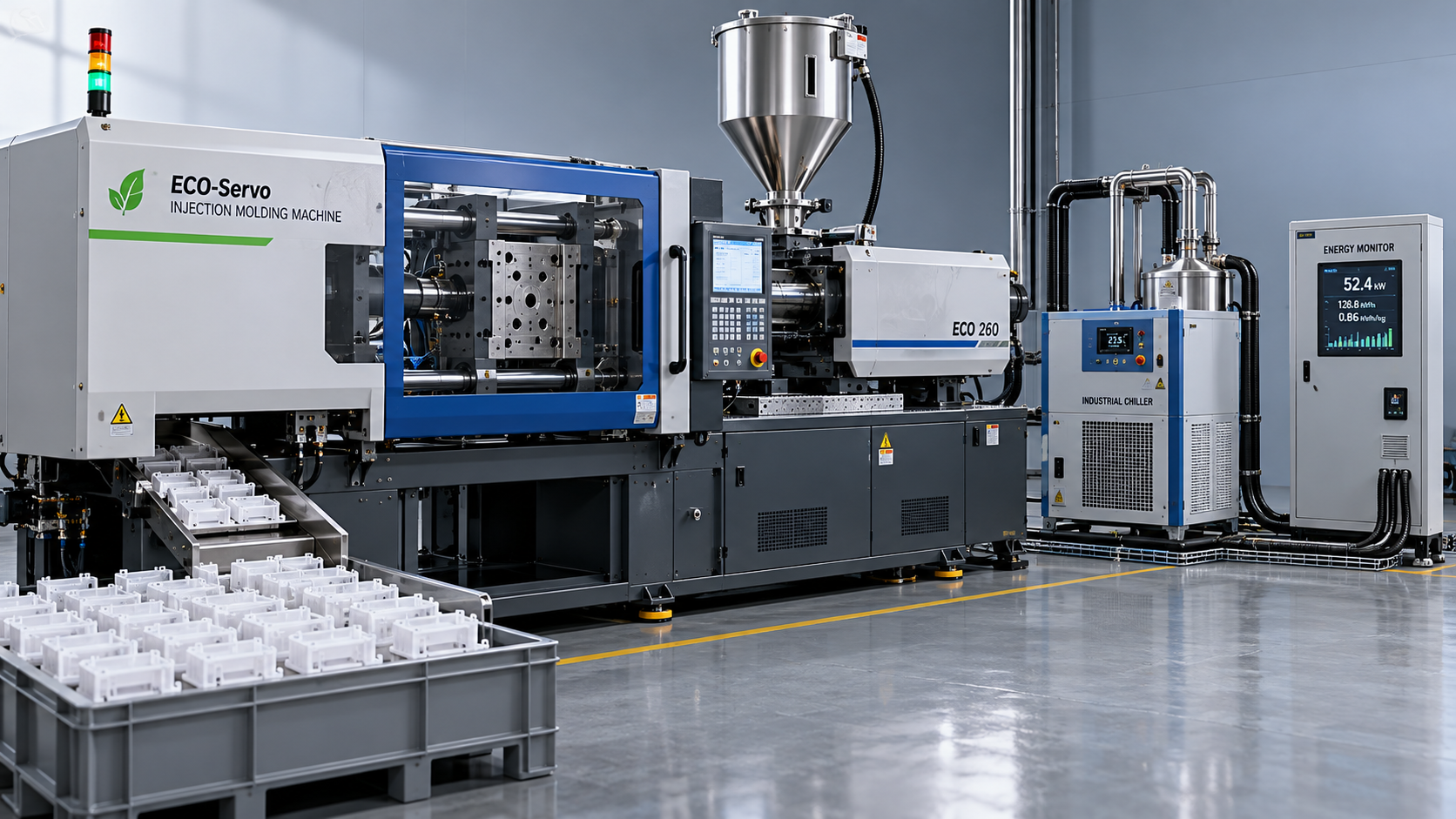
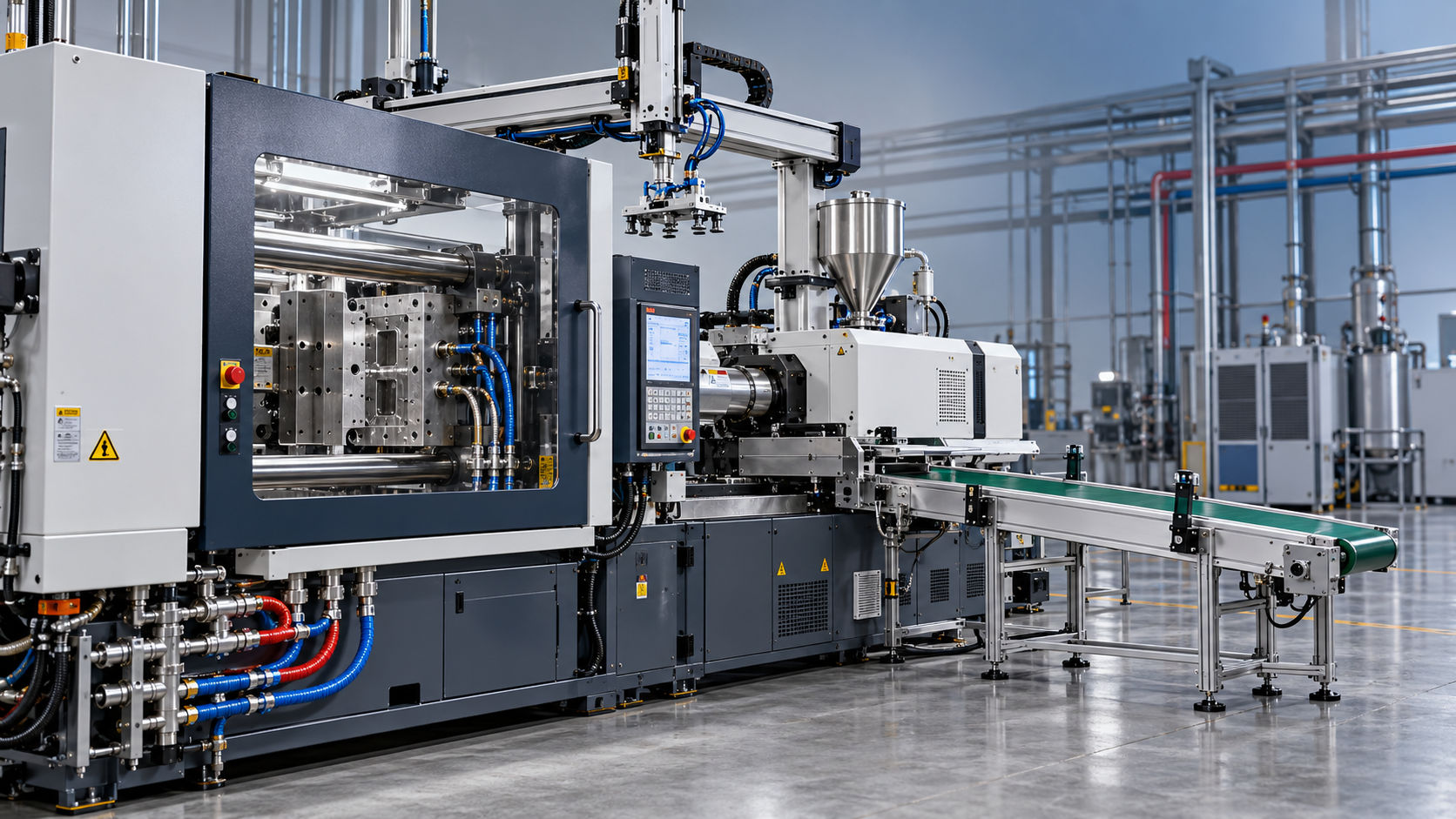
For injection molding, the duty cycle strongly influences the result. Reduced hydraulic idling losses have greater value where the existing pump remains loaded during long waiting periods. An all-electric machine still consumes energy through heaters, drives, controls, and associated equipment. Its performance must be established with the intended mold and process window.
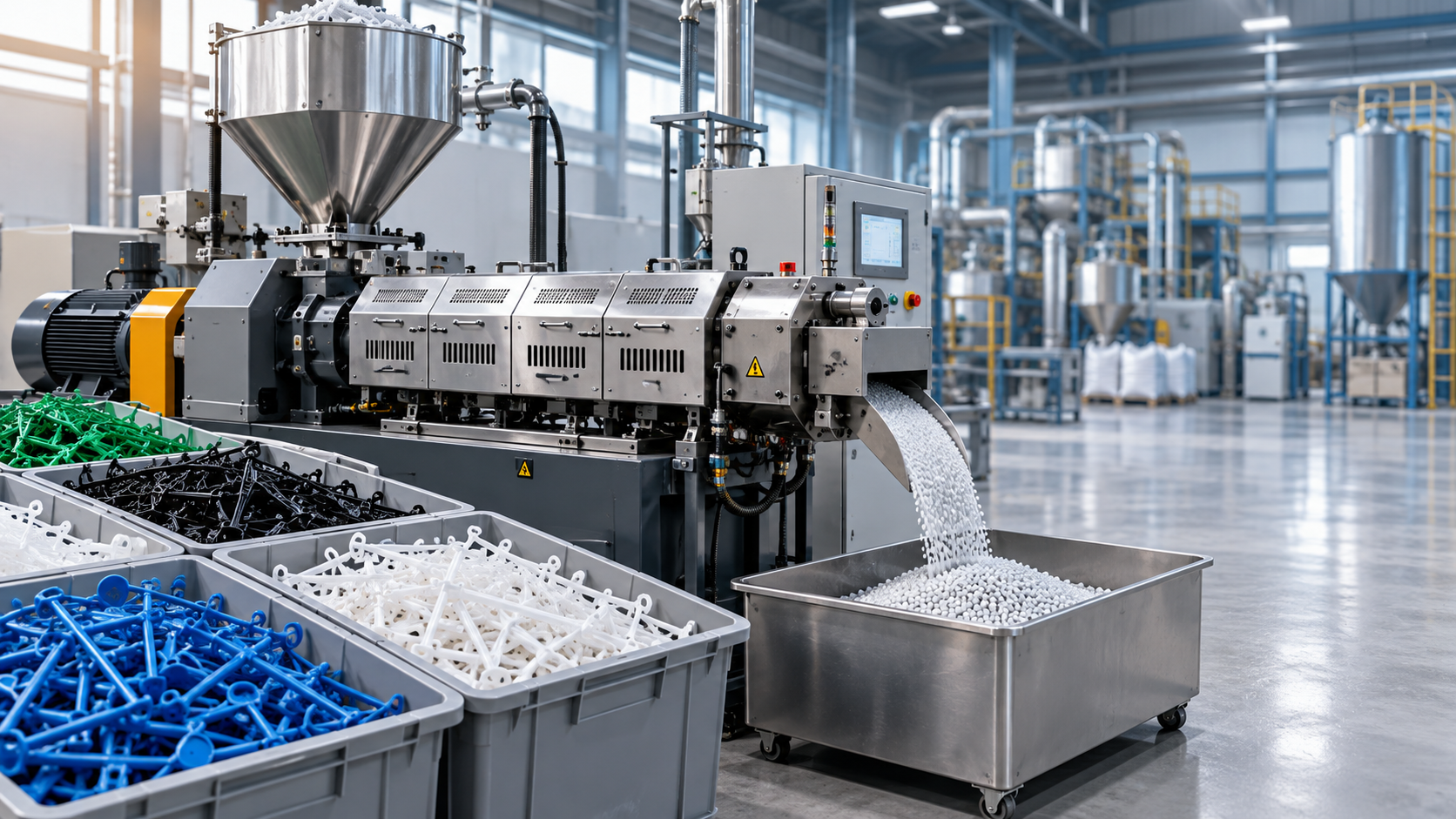
On an extrusion line, screw drive consumption alone is incomplete. Feed drying, vacuum systems, barrel heating and cooling, melt filtration, and downstream cooling can change the total. Higher throughput sometimes spreads fixed loads over more output, improving energy per kilogram while increasing hourly power demand. Compare both measures.
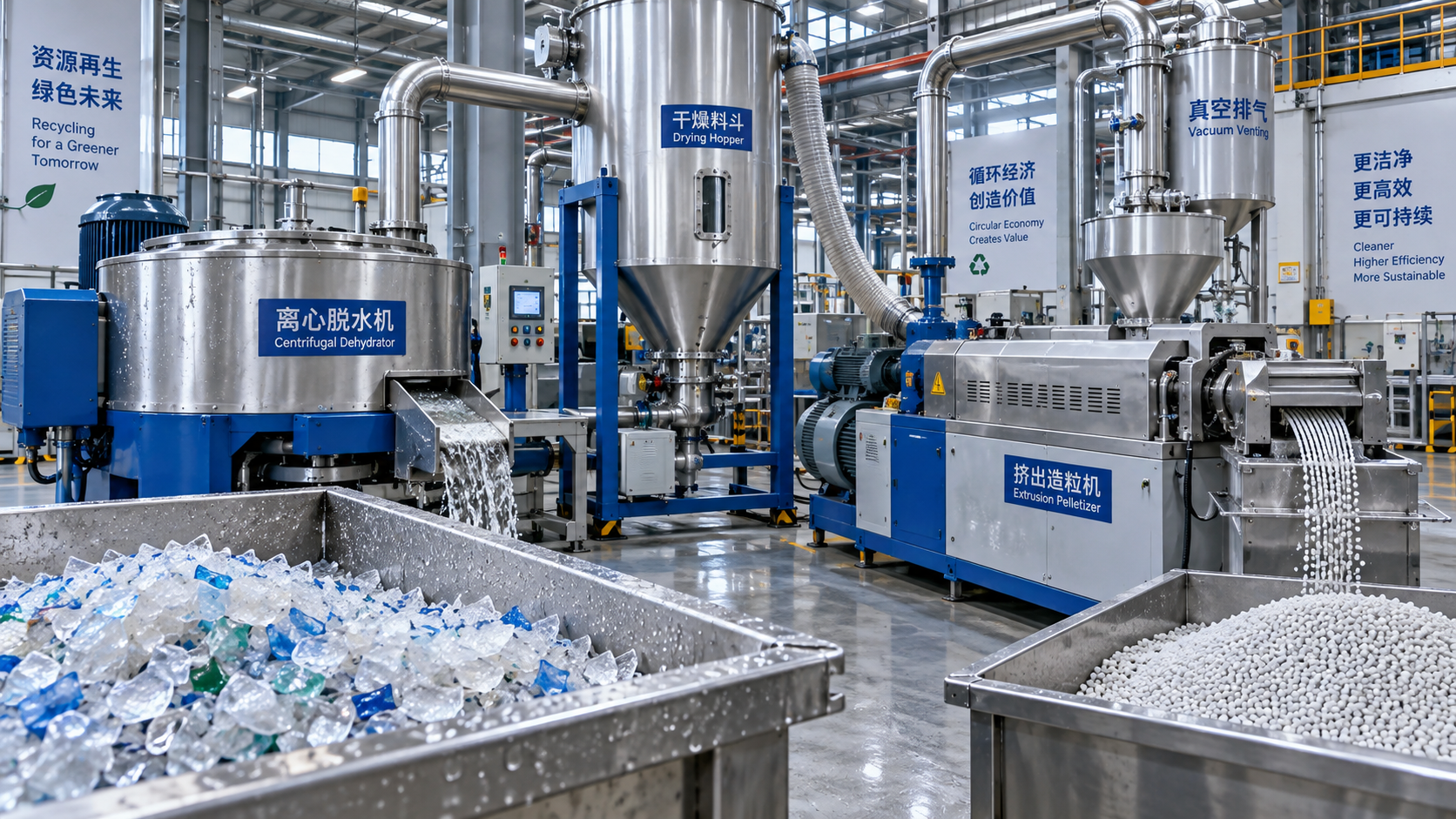
Recycling trials require particular care with feedstock. Clean, dry material does not establish the running cost for wet, variable waste. Moisture removal, screen loading, melt pressure, and degassing duty all affect consumption and output. Retain feedstock samples or documented specifications so that the trial conditions can be related to expected production.
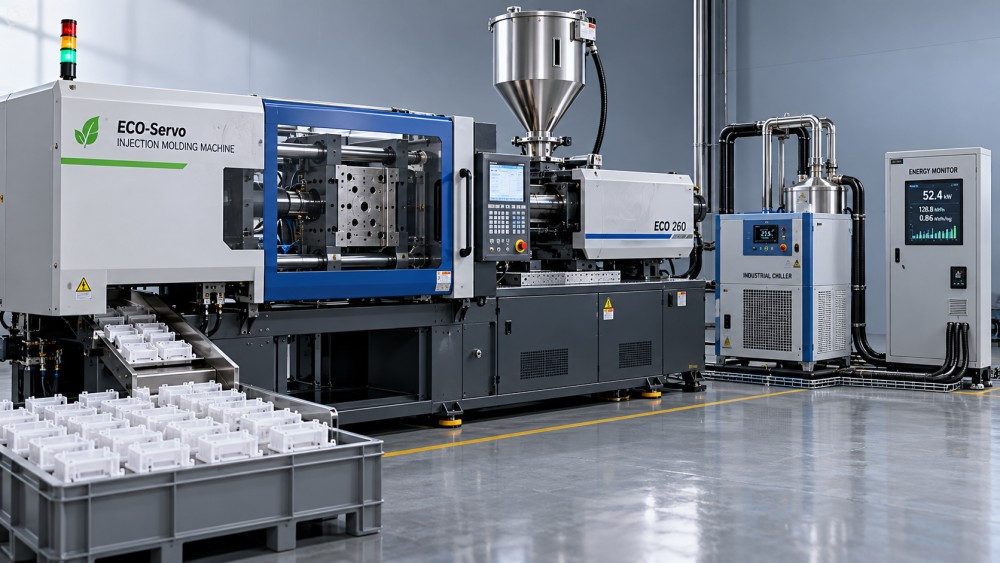
Draw the proposed measurement boundary around the machine and every auxiliary included in the calculation. Where a central chiller or compressed-air system serves several lines, distinguish allocated consumption from an actual reduction in plant electricity. Removing a cooling load does not guarantee proportional savings if the central equipment continues running inefficiently at part load.
Translate energy performance into annual cash savings
For a stable product mix, multiply the difference in specific energy consumption by forecast annual accepted output. With several product families, calculate each separately and add the results. Use operating-state estimates for startup, standby, and changeovers where production-based figures do not capture those loads.
Annual electricity avoided = comparable annual baseline consumption − forecast annual consumption after the investment.
Keep the production assumptions consistent. If the forecast uses a fixed annual sales volume, a faster machine may finish that volume in fewer hours. Applying its energy-per-kilogram improvement to annual output and then adding the same reduced running hours as a separate energy benefit would count savings twice.
The electricity price should represent the charges that will actually disappear. An average bill divided by total kilowatt-hours can overstate the value of savings when the bill includes fixed charges. Time-of-use rates require assigning avoided consumption to the periods when it occurs.
Demand charges need separate treatment. A reduction in average power does not automatically lower the billed demand peak. Savings arise only where the equipment change reduces demand during the interval and conditions used for billing. If another process sets the plant peak, the new machine may produce no demand-charge saving.
Annual net operating cash savings = avoided electricity cost + verified non-energy cash savings − additional recurring costs.
Non-energy savings can include reduced hydraulic oil consumption, fewer replacement filters, or lower maintenance expenditure when supported by maintenance records and the proposed service schedule. Deduct additional service contracts, software subscriptions, consumables, and specialist maintenance required by the new equipment.
Keep released production capacity separate from energy savings. Extra output has financial value only where demand, staffing, tooling, and downstream capacity support additional sales. Value that output using its incremental contribution after associated costs. A shorter cycle does not automatically create revenue.
Capture the installed cost beyond the quotation
The quoted machine price is only part of the cash commitment. Electrical distribution upgrades, transformers, foundations, cooling connections, material handling changes, freight, installation labor, and commissioning belong in the investment when the project requires them. Use equivalent quotation boundaries so that an inexpensive machine does not appear attractive simply because essential items are excluded.
Include tooling or integration changes needed to achieve the demonstrated performance. A shorter injection molding cycle might require improved mold cooling. An extrusion upgrade might need downstream equipment capable of maintaining dimensional control at the proposed line speed. If those changes are necessary for the savings claim, their cost belongs in the same calculation.
Production interruption deserves a realistic estimate. Account for installation downtime, qualification runs, startup scrap, and the period before stable production. Lost contribution belongs in the assessment only when production cannot be recovered through inventory, spare capacity, or rescheduling; otherwise, estimate the actual recovery costs.
Apply consistent treatment to incentives, taxes, and working capital. An incentive should reduce the investment only when eligibility and receipt are sufficiently established. Recoverable taxes are generally a timing issue rather than a permanent equipment cost. Financing and depreciation require consistent treatment within the chosen cash-flow model to avoid counting the same cost twice.
Test the assumptions most likely to reverse the decision
A single payback figure hides how strongly the result depends on utilization and operating conditions. Prepare a central forecast and a conservative case using defensible production assumptions. Keep the relationships between variables intact: lower demand changes annual output, running hours, idle time, and potentially the tariff periods in which production occurs.
- Annual utilization: Use the production hours supported by orders and scheduling. Additional shifts that have not been committed should remain outside the central forecast.
- Energy performance: Apply results from comparable trials. Where only supplier estimates exist, show the financial effect of a smaller improvement and identify the evidence still needed.
- Product mix and feedstock: A move toward thicker parts, longer cooling cycles, moisture-sensitive resins, or more contaminated recycling feed can change the energy balance.
- Electricity charges: Separate contractual rates from assumed future increases. Calculate the investment at current applicable rates before assigning value to price escalation.
A useful additional result is the break-even production volume: the annual accepted output required to achieve the chosen payback period. For approximately constant savings per unit, divide the annual savings needed to meet that period, plus additional fixed recurring costs, by the net saving per accepted unit. If operating efficiency changes substantially with utilization, calculate this through the operating-state model instead.
Simple payback also ignores cash flows after recovery and the time value of money. Compare net present value over a common evaluation period when alternatives differ materially in service life, maintenance costs, or replacement timing. Use the same discounting assumptions and account for any remaining equipment value consistently.
Make the purchase terms support the calculation
The strongest commercial evidence is an acceptance trial tied to the assumptions used in the financial model. Define the material, tooling or product geometry, accepted output rate, quality limits, measurement boundary, stabilization conditions, and test duration before placing the order. Record electricity and production together using suitable metering.
A supplier’s percentage saving is meaningful only when its reference machine and test conditions are disclosed. A comparison against an inefficient legacy machine does not establish the advantage over another current quotation. Request absolute consumption and output figures so that each offer can be evaluated on the same basis.
Where the return depends on a particular energy result, the contract should state how performance will be verified and what happens if it falls short. Include access to the operating data needed for verification. The investment case is ready for commitment when its conservative production forecast, complete installed cost, and measurable acceptance conditions support an acceptable return.
Related News
- 00
0000-00
Energy-Saving Plastics Machinery: How to Calculate Payback Before Buying - 00
0000-00
Automatic Tire Curing: How Temperature and Pressure Controls Affect Cure Uniformity - 00
0000-00
Pallet Injection Molding: How to Size Clamp Force and Shot Capacity - 00
0000-00
Circular Manufacturing Roadmap: From Waste Audits to Material Recovery - 00
0000-00
How Continuous Melt Filtration Limits Pressure Fluctuations During Screen Changes
Weekly Insights
Stay ahead with our curated technology reports delivered every Monday.
Related News
 Ms. Elena RodriguezEnergy-Saving Plastics Machinery: How to Calculate Payback Before BuyingEvaluate energy saving plastics machinery before buying. Learn to calculate payback using verified energy savings, installed costs, and production data to invest with confidence.Oct 23, 2026
 Ms. Elena RodriguezCircular Manufacturing Roadmap: From Waste Audits to Material RecoveryBuild a circular manufacturing roadmap from waste audits to material recovery. Explore practical steps to qualify recycled materials, select equipment, and validate ROI before investing.Oct 20, 2026
 Ms. Elena RodriguezInjection Molding System Costs: Machine, Molds, Automation, and InstallationCompare injection molding systems price proposals with confidence. Uncover machine, mold, automation, and installation costs to avoid hidden expenses and choose a production-ready cell.Oct 17, 2026
 Ms. Elena RodriguezHow Does Feedstock Moisture Affect Plastic Pelletizing Energy Use?How does feedstock moisture affect plastic pelletizing energy use? Discover how smarter drying and dewatering can cut kWh/kg, protect pellet quality, and boost output.Oct 22, 2026
 Ms. Elena RodriguezSmart Factory Costs for Plastics: Estimating ROI for Automation ProjectsSmart factory for plastics cost: learn how to estimate automation ROI, uncover hidden integration expenses, reduce scrap, and build a phased investment plan.Oct 10, 2026
 Ms. Elena RodriguezHow to Evaluate a Packaging Molding Equipment Supplier for High-Volume ProductionChoose a packaging molding equipment supplier with confidence. Learn how to assess throughput stability, tooling, recycled-material capability, lifecycle cost, and service support for high-volume production.Oct 09, 2026
 Ms. Elena RodriguezProcurement Records to Request Before Buying a Used Tyre ShredderUsed tyre shredder for sale? Request maintenance, operating, safety, and parts records to reduce risk, verify condition, and buy with confidence.Oct 16, 2026
 Ms. Elena RodriguezHow to Select Packaging Molding Equipment for High-Volume Production LinesPackaging molding equipment selection guide for high-volume lines: compare processes, throughput, materials, automation, and energy to achieve stable, cost-effective output.Oct 04, 2026
 Ms. Elena RodriguezHow to Evaluate Plastic Recycling Machinery for UAE Heat, Feedstock, and Output NeedsPlastic recycling machinery UAE buyers: evaluate heat resilience, feedstock handling, cooling, pellet quality, energy use, and lifecycle cost for reliable output.Sep 28, 2026
 Ms. Elena RodriguezGerman Extrusion Equipment Suppliers: Comparing Service, Lead Times, and Lifecycle CostExtrusion equipment Germany suppliers compared: evaluate service coverage, credible lead times, spare-parts access, and lifecycle cost to select a reliable, future-ready production partner.Sep 22, 2026
 Ms. Elena RodriguezWhat Should You Check Before Buying a Used Plastic Recycling Line?What should I check before buying a used plastic recycling line? Explore feedstock fit, wear, trials, utilities, controls, and restoration costs before you invest.Sep 26, 2026
 Ms. Elena RodriguezHow to Compare Pelletizing Lines by Energy Use per TonHow do I compare pelletizing lines by kWh per ton? Learn to measure total energy, verify saleable output, and select a cost-efficient line.Sep 23, 2026
 Ms. Elena RodriguezTyre Cutter Blade Wear: When Capacity Loss Needs Inspectionшинорез blade wear can quietly reduce tyre-cutting capacity. Learn the warning signs, inspection triggers, and maintenance actions that protect output and uptime.Sep 28, 2026
 Ms. Elena RodriguezIn-House Recycling for Factory Scrap: How to Reduce Material Waste and Disposal CostsIn house recycling for factory scrap helps manufacturers cut material waste, reduce disposal costs, and create controlled, quality-focused reuse loops.Sep 07, 2026
 Ms. Elena RodriguezHow Recyclable Packaging Manufacturing Balances Material Recovery and Production CostRecyclable packaging manufacturing: discover how smarter design, feedstock control, and process optimization reduce recovery costs while improving quality and yield.Sep 04, 2026
 Ms. Elena RodriguezHow to Evaluate a Plastic Recycling Systems Supplier for Your Processing NeedsChoose the right plastic recycling systems supplier with a practical guide to feedstock fit, output quality, total cost, testing, service, and compliance.Sep 01, 2026
 Ms. Elena RodriguezCE Marking for Plastic Processing Equipment: Documentation and Safety ChecksPlastic processing equipment CE compliance: learn the essential documentation, risk assessments, safety checks, and validation steps for reliable EU market access.Aug 30, 2026
 Ms. Elena RodriguezPlastic Packaging Compliance Standards: What Tests and Documents Matter Most?Plastic packaging compliance standards explained: learn which migration tests, mechanical checks, and audit-ready documents matter most to reduce risk and pass reviews with confidence.Aug 25, 2026
 Ms. Elena RodriguezHow to Evaluate a Plastic Waste Recycling System for Capacity, Contamination, and ROIPlastic waste recycling system evaluation made practical: compare true capacity, contamination control, and ROI to choose a line that delivers stable output and stronger returns.Aug 24, 2026
 Ms. Elena RodriguezPackaging Molding Equipment Price: What Drives Cost and How to Compare Quotes?Packaging molding equipment price varies by machine type, automation, tooling, energy use, and service scope. Learn what drives cost and how to compare quotes with confidence.Aug 21, 2026