German Extrusion Equipment Suppliers: Comparing Service, Lead Times, and Lifecycle Cost




For procurement teams evaluating extrusion equipment Germany suppliers, the decision rarely turns on screw diameter, motor rating, or the initial quotation alone. Those figures matter, but they do not reveal how a supplier will behave when a start-up schedule slips, a critical gearbox component is needed during peak production, or a recycled feedstock changes melt behavior overnight.
German extrusion manufacturers are widely associated with engineered systems, process know-how, and robust machine construction. Yet “German-made” is not a purchasing category in itself. Suppliers vary substantially in service reach, project-engineering depth, delivery discipline, controls architecture, retrofit capability, and the commercial model behind spare parts. For a new pipe line, film line, compounding plant, profile operation, or plastics recycling system, these differences can outweigh a modest gap in purchase price.
The useful question is not simply, “Which German extruder is best?” It is: Which supplier creates the lowest operational risk and most defensible lifecycle cost for this specific product, plant location, material mix, and production plan?
Why the Purchase Price Can Mislead Buyers
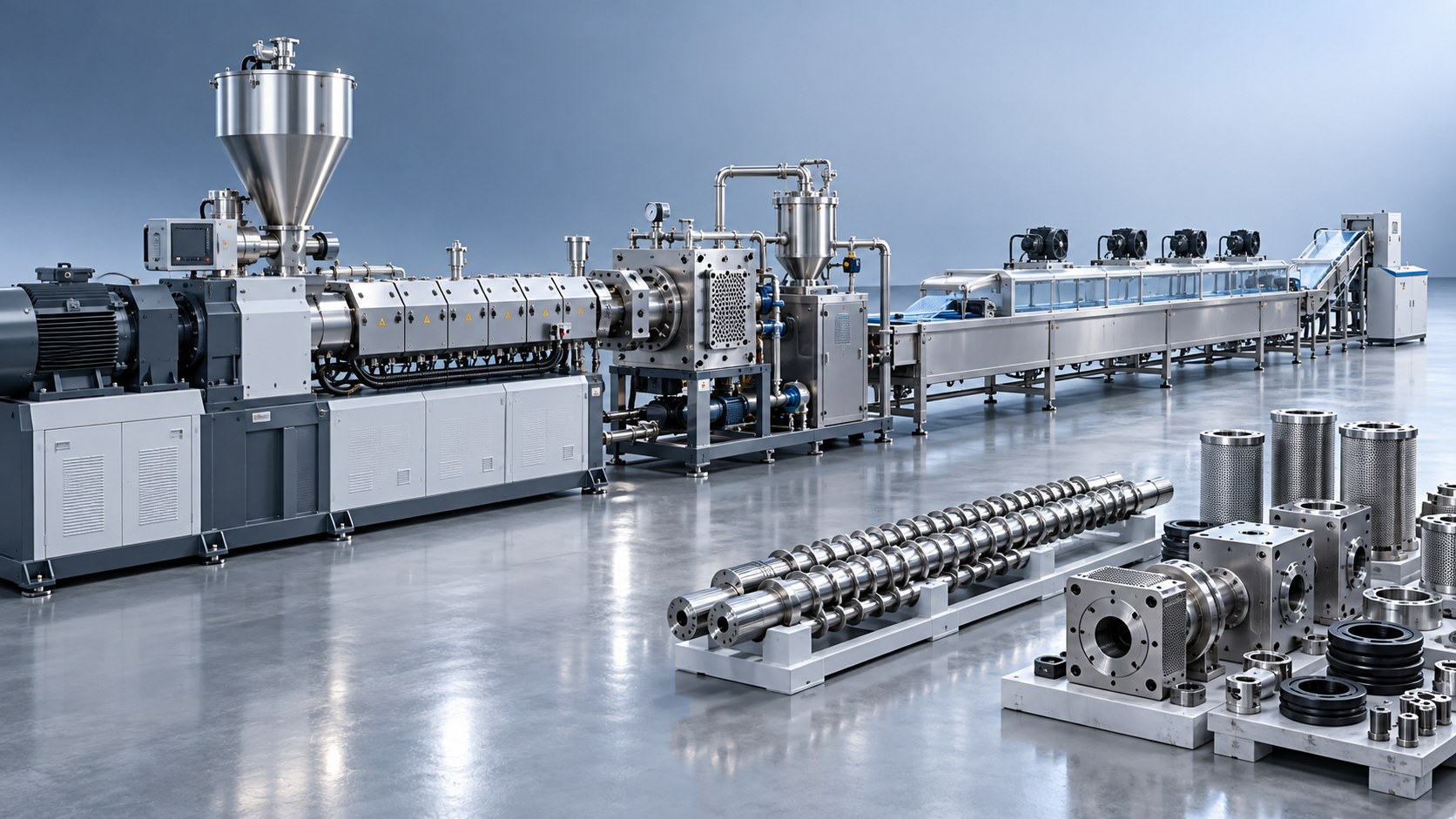
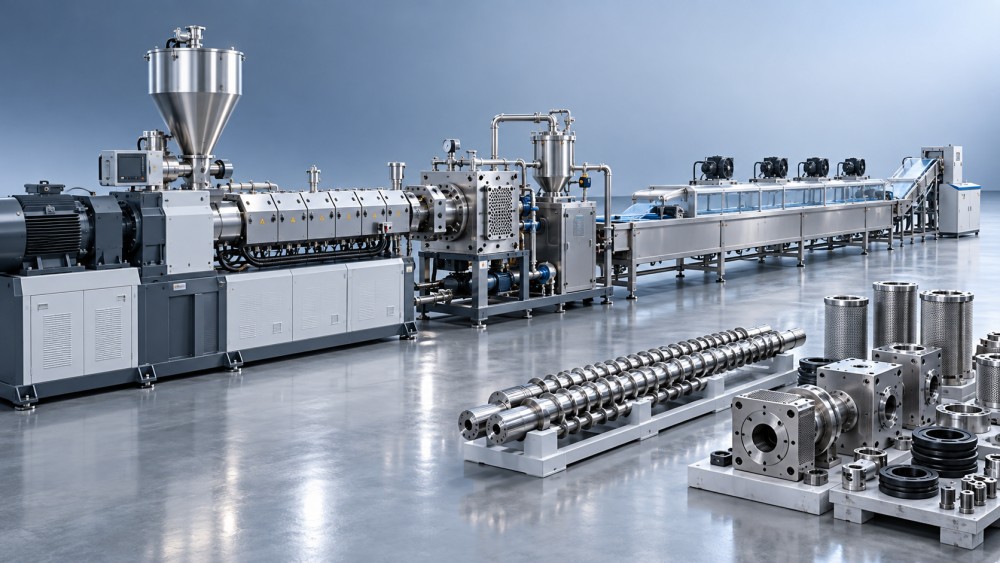
An extrusion line is a connected production system rather than a standalone machine. The extruder itself interacts with dosing, drying, conveying, filtration, die tooling, downstream equipment, automation, cooling, pelletizing, and quality control. A lower-priced core extruder may appear attractive until the buyer accounts for interfaces, process commissioning, local support, energy consumption, or future modifications.
For procurement, lifecycle cost is best viewed as a chain of financial and operational consequences:
- Initial equipment, engineering, installation, and acceptance costs;
- Energy use per kilogram or tonne of saleable output;
- Material losses during start-up, grade changes, and unstable running;
- Labor requirements for operation, cleaning, and troubleshooting;
- Downtime caused by wear, controls faults, or delayed spare parts;
- Planned maintenance and rebuild intervals;
- Upgrade potential when regulations, resin formulations, or customer requirements change.
In high-throughput operations, the cost of lost production can quickly exceed the value of a replacement component. This is particularly true in recycling, where contaminated or inconsistent feedstock can intensify wear and make stable melt filtration a daily commercial issue. It also applies to premium film, medical, cable, and technical compounding applications, where a small shift in dispersion, temperature control, or pressure stability may create costly off-spec material.
Comparing German Extrusion Suppliers Beyond the Brochure
Most established suppliers can demonstrate solid mechanical design. A more meaningful comparison begins by separating their strengths into the areas that affect the buyer after the purchase order is signed.
1. Process specialization: does the supplier understand the actual material window?
Some German extrusion equipment suppliers are strongest in twin-screw compounding, while others have deeper experience in pipe, sheet, blown film, profile, cable insulation, foam, or pelletizing systems. A supplier may also be highly capable with virgin polymers but less prepared for post-consumer recyclate containing moisture, inks, fillers, paper residues, or variable bulk density.
Ask for a discussion centered on your material—not only the machine model. Relevant questions include:
- How will the screw configuration manage shear-sensitive, filled, or recycled formulations?
- What is the expected response to variation in melt flow index, moisture, or contamination?
- Where are venting, filtration, and degassing limitations likely to emerge?
- Can the proposed line maintain output without relying on an unrealistically narrow process window?
- What trial capability exists for your resin, additive package, or recovered plastic stream?
A line designed around a carefully prepared sample can look convincing in a factory acceptance test. Procurement should ensure that acceptance criteria reflect commercial reality: intended throughput, product tolerances, energy conditions, and the feedstock variation that the plant will actually receive.
2. Engineering ownership at the line interfaces
Integration risk often hides between suppliers. If the extruder OEM, screen changer supplier, die maker, automation integrator, and downstream manufacturer each define only their own scope, the buyer may inherit the task of resolving pressure fluctuations, communication mismatches, or throughput bottlenecks.
German suppliers with strong turnkey engineering can reduce this risk, but “turnkey” should be examined carefully. Request a boundary matrix that identifies who owns mechanical interfaces, electrical cabinets, PLC communication, safety circuits, utilities, performance testing, and troubleshooting during commissioning. The matrix should also state which party is accountable if the line meets individual equipment specifications but fails to achieve the agreed end-product result.
Lead Times: Look Past the Promised Shipment Date
Lead time is not one number. It is a sequence of design release, long-lead component procurement, manufacturing, factory testing, packing, shipment, installation readiness, commissioning, and performance acceptance. A supplier may quote an attractive ex-works date while leaving major uncertainty around final engineering approval or site start-up availability.
German extrusion machinery often includes customized screws and barrels, gearboxes, motors, drives, vacuum systems, sensors, dies, and controls. Depending on the project, the critical path may not be the extruder frame at all. It can be a specific drive package, a die set, a melt pump, a control-panel component, or a downstream module supplied by a third party.
What procurement should request in a lead-time review
For buyers under pressure to bring capacity online, a phased strategy may be safer than a single ambitious promise. This can include ordering common platform equipment early, freezing critical interfaces promptly, and treating optional automation or future expansion modules separately. That approach is not always cheaper, but it can protect the business case from schedule uncertainty.
Service Responsiveness Is a Local Question
A German supplier’s engineering reputation does not automatically mean rapid support at your factory. Service quality depends on time zone, regional field technicians, language capability, travel access, remote diagnostic tools, local spare-parts stock, and the practical authority of the service team to make decisions.
Before selecting a supplier, procurement and operations should jointly test the service model. Ask for the location of the nearest qualified technicians, the normal escalation path, remote-access requirements, and the difference between standard support and paid emergency support. It is also reasonable to ask how the supplier handles legacy control systems, discontinued drive components, and machines installed in regions where direct travel can be difficult.
For plants with continuous production, service-level expectations should be written into the commercial agreement where possible. These may address response windows, remote diagnostic availability, named contacts, planned inspection visits, and the process for identifying critical spare parts. Avoid relying on broad language such as “prompt technical assistance.” It sounds reassuring but gives little guidance when a line is down.
Remote service has limits
Modern extrusion controls can provide trend data for torque, melt pressure, barrel temperatures, vacuum performance, energy use, and alarms. Remote access helps suppliers diagnose many issues faster, especially when process data is well organized. Still, remote support cannot replace local mechanical capability when a screw is damaged, a gearbox requires inspection, or a contaminated recycling stream has created a filtration problem.
Buyers should therefore evaluate both digital support and physical readiness. The strongest arrangement combines clear data access, trained in-house operators, a regional technician network, and an agreed list of parts that must be held on site.
The Spare-Parts Question That Changes Lifecycle Cost
Spare parts are often treated as an afterthought during capital expenditure approval. That can be expensive. Wear parts such as screws, barrels, liners, kneader blocks, screen packs, cutter components, seals, and heating elements have predictable lifecycles, but the actual interval is shaped by resin abrasiveness, fillers, contamination, operating temperature, cleaning practices, and operator discipline.
For extrusion equipment Germany suppliers, compare more than the price of an initial spare-parts kit. Request a recommended inventory plan divided into three categories:
- Commissioning spares: parts likely to be needed during installation and ramp-up;
- Operational critical spares: components whose failure would stop production or create a safety risk;
- Planned wear spares: parts ordered according to expected service intervals and inspection findings.
Also ask whether components are proprietary, whether compatible alternatives can be sourced locally, and how long the supplier commits to supporting the selected controls platform. Proprietary parts are not inherently negative; they may protect performance and consistency. But they should be visible in the cost model rather than discovered during an urgent shutdown.
Energy, Yield, and the Cost of Running “Almost Right”
Energy efficiency matters, but buyers should avoid judging it through motor power alone. The more relevant measure is energy consumed per unit of acceptable product at the required quality level. A line that draws less power but produces more scrap, needs frequent purging, or runs below target throughput may have a weaker operating cost than a more robust alternative.
When comparing proposals, request normalized operating assumptions: material type, moisture condition, output rate, melt temperature, downstream configuration, and expected production mode. For recycling lines, include the energy and yield implications of washing, drying, melt filtration, degassing, and pelletizing—not merely the main extruder.
There is also a human element. A line that is difficult to stabilize can consume engineering attention for months. Operators lose confidence, maintenance teams work reactively, and production planning becomes cautious. Equipment designed for process transparency—clear trend displays, sensible alarm logic, documented recipes, and accessible maintenance points—can reduce this hidden cost.
A Practical Supplier Scorecard for the Buying Team
Rather than allowing technical, purchasing, and operations teams to assess suppliers separately, use one weighted scorecard. The precise weighting depends on the project, but the categories should force a balanced discussion.
- Process performance with the intended polymer or recyclate;
- Line integration and single-point engineering responsibility;
- Delivery schedule credibility and change-control discipline;
- Regional service coverage and escalation speed;
- Critical-spares strategy, parts availability, and obsolescence planning;
- Energy, yield, labor, and maintenance assumptions;
- Controls openness, data integration, and cybersecurity requirements;
- Upgrade path for future capacity, material, or compliance changes;
- Commercial clarity: warranty scope, exclusions, payment milestones, and acceptance terms.
The scorecard should not replace technical judgment. Its value is that it exposes where one supplier’s lower capital cost may be offset by weaker service access, a more fragile schedule, or limited flexibility for future changes.
Where Different Applications Shift the Decision
In pipe and profile extrusion, uptime, dimensional consistency, and downstream synchronization may dominate the decision. Film producers may place greater weight on gauge control, melt homogeneity, die performance, and rapid recipe changes. Compounding buyers often focus on dispersion, torque management, feeding accuracy, and the flexibility to process evolving formulations.
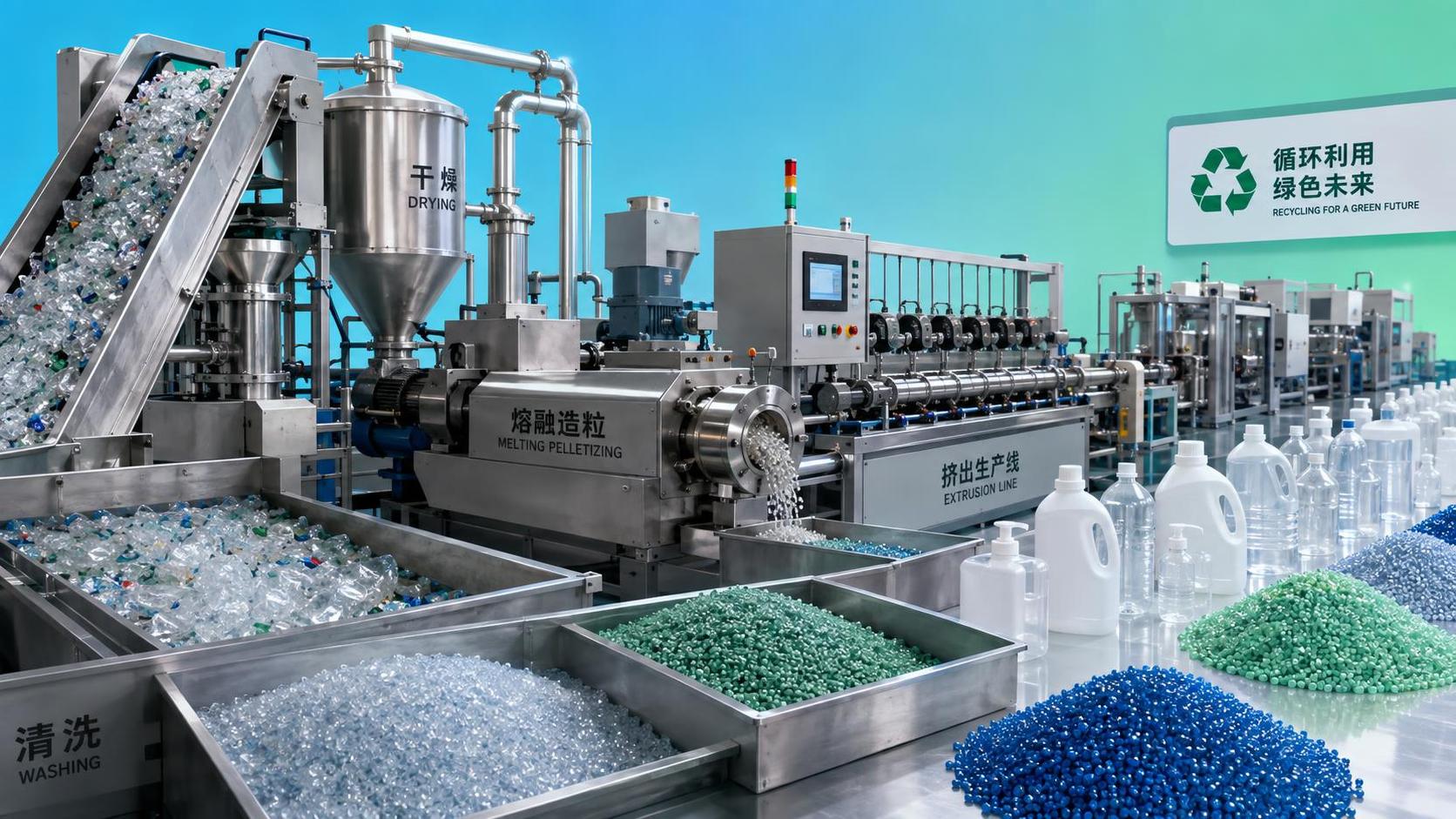
For waste-plastic pelletizing, the evaluation becomes even more demanding. The line must cope with inconsistent input while producing a usable output that meets downstream requirements. Here, screening technology, degassing, odor management, melt pressure stability, and the accessibility of wear components can be as important as nominal throughput. Procurement should resist comparisons based solely on kilograms per hour; saleable pellet quality and stable operating hours tell the more honest story.
This is where market intelligence can support better sourcing decisions. Tracking changing packaging rules, recycled-content targets, virgin resin volatility, and advances in filtration or process automation helps teams avoid buying a line optimized only for today’s conditions. PFRS follows these shifts across extrusion, molding, rubber processing, and circular plastics systems because equipment decisions increasingly sit at the intersection of manufacturing performance and environmental compliance.
The Most Defensible Choice Is Usually the Most Transparent One
A German supplier can be an excellent long-term extrusion partner when its technical strengths align with the plant’s materials, output goals, service geography, and future strategy. The best proposal is not necessarily the fastest-looking, lowest-priced, or most feature-rich. It is the one whose assumptions are visible, whose responsibilities are clearly assigned, and whose lifecycle demands can be managed by your operations team.
For buyers sourcing extrusion equipment Germany suppliers, the final review should bring engineering, maintenance, production, finance, and procurement into the same room. Compare the cost of ownership, not just the cost of acquisition. Challenge lead-time assumptions before they become a project delay. Treat spare parts and service access as production insurance. And make sure the proposed line can handle the materials your business will need to run—not merely the clean, stable material used to win the order.
Related News
- 00
0000-00
German Extrusion Equipment Suppliers: Comparing Service, Lead Times, and Lifecycle Cost - 00
0000-00
How Curing Press Control Shapes Uniformity and Tread Life in Truck Tire Manufacturing - 00
0000-00
How to Evaluate German Extrusion Equipment for Stable, High-Output Production - 00
0000-00
How Closed-Loop Bottle-to-Bottle Recycling Maintains Food-Grade PET Quality - 00
0000-00
How to Specify a Food-Grade PET Bottle Recycling System for Safe rPET Production
Weekly Insights
Stay ahead with our curated technology reports delivered every Monday.
Related News
 Ms. Elena RodriguezGerman Extrusion Equipment Suppliers: Comparing Service, Lead Times, and Lifecycle CostExtrusion equipment Germany suppliers compared: evaluate service coverage, credible lead times, spare-parts access, and lifecycle cost to select a reliable, future-ready production partner.Sep 22, 2026
 Ms. Elena RodriguezIn-House Recycling for Factory Scrap: How to Reduce Material Waste and Disposal CostsIn house recycling for factory scrap helps manufacturers cut material waste, reduce disposal costs, and create controlled, quality-focused reuse loops.Sep 07, 2026
 Ms. Elena RodriguezHow Recyclable Packaging Manufacturing Balances Material Recovery and Production CostRecyclable packaging manufacturing: discover how smarter design, feedstock control, and process optimization reduce recovery costs while improving quality and yield.Sep 04, 2026
 Ms. Elena RodriguezHow to Evaluate a Plastic Recycling Systems Supplier for Your Processing NeedsChoose the right plastic recycling systems supplier with a practical guide to feedstock fit, output quality, total cost, testing, service, and compliance.Sep 01, 2026
 Ms. Elena RodriguezCE Marking for Plastic Processing Equipment: Documentation and Safety ChecksPlastic processing equipment CE compliance: learn the essential documentation, risk assessments, safety checks, and validation steps for reliable EU market access.Aug 30, 2026
 Ms. Elena RodriguezPlastic Packaging Compliance Standards: What Tests and Documents Matter Most?Plastic packaging compliance standards explained: learn which migration tests, mechanical checks, and audit-ready documents matter most to reduce risk and pass reviews with confidence.Aug 25, 2026
 Ms. Elena RodriguezHow to Evaluate a Plastic Waste Recycling System for Capacity, Contamination, and ROIPlastic waste recycling system evaluation made practical: compare true capacity, contamination control, and ROI to choose a line that delivers stable output and stronger returns.Aug 24, 2026
 Ms. Elena RodriguezPackaging Molding Equipment Price: What Drives Cost and How to Compare Quotes?Packaging molding equipment price varies by machine type, automation, tooling, energy use, and service scope. Learn what drives cost and how to compare quotes with confidence.Aug 21, 2026
 Ms. Elena RodriguezWhat Packaging Machinery for Plastic Containers Should You Choose for High-Volume Production?Packaging machinery for plastics containers can make or break high-volume production. Learn how to choose the right line for speed, consistency, compliance, and lower lifecycle costs.Aug 16, 2026
 Ms. Elena RodriguezWhat Circular Plastics Mean for Automotive Parts and Material SelectionCircular plastics for automotive are reshaping part selection with lower weight, better sustainability, and reliable performance. Discover how engineers balance recycled content, durability, and compliance.Aug 15, 2026
 Ms. Elena RodriguezBroiler Farming in Cage System: Selection Factors for Commercial FarmsBroiler farming in cage system selection for commercial farms: compare structure, ventilation, automation, and manure handling to improve efficiency and avoid costly mistakes.Aug 14, 2026
 Ms. Elena RodriguezHow to Implement Smart Polymer Manufacturing Without Disrupting Existing Production?Smart polymer manufacturing implementation made practical: learn how to upgrade existing production with phased digitalization, less downtime, better control, and measurable ROI.Aug 11, 2026
 Ms. Elena RodriguezHow to Evaluate a Rubber Compression Molding Supplier for Complex Part ProductionRubber compression molding supplier selection for complex parts starts with process, material, and tooling control. Learn how to compare vendors beyond price and reduce launch risk.Aug 10, 2026
 Ms. Elena RodriguezPackaging Compliance in Canada: Key Labeling and EPR Rules Importers Must KnowPackaging compliance Canada explained for importers: learn bilingual labeling, environmental claims, and provincial EPR rules to reduce risk, avoid costly errors, and stay market-ready.Aug 03, 2026
 Ms. Elena RodriguezWhy Circular Plastics Economy Traceability Matters for Recycled Content ComplianceCircular plastics economy traceability is essential for proving recycled content compliance across sourcing, processing, and reporting. Learn how strong evidence reduces audit risk.Aug 02, 2026
 Ms. Elena RodriguezRecycled Plastic Compliance: Key Standards, Testing Requirements, and DocumentationRecycled plastic compliance explained: key standards, testing requirements, supplier documents, and food-contact risks to help you avoid approval delays and costly compliance mistakes.Aug 01, 2026
 Ms. Elena RodriguezHow to Evaluate an Extrusion Machinery Manufacturer for Quality, Support, and ROIExtrusion machinery manufacturer selection affects quality, uptime, and ROI. Learn how to compare process fit, output claims, service, compliance, and long-term operating costs.Jul 29, 2026
 Ms. Elena RodriguezHow to Evaluate Food Grade Recycled Pellets for Safe Packaging ApplicationsFood grade recycled pellets for safe packaging demand more than a label. Learn how to assess feedstock, process validation, pellet quality, and compliance before approval.Jul 28, 2026
 Ms. Elena RodriguezHow to Evaluate a Rubber Vulcanization Supplier for Quality, Capacity, and Lead TimeRubber vulcanization supplier selection made easier: learn how to assess quality systems, true production capacity, and lead time reliability to reduce sourcing risk and improve supply performance.Jul 25, 2026
 Ms. Elena RodriguezPlastic Waste Recycling Price: What Drives Costs and How Buyers Should Compare QuotesPlastic waste recycling price explained: compare quotes by yield, energy use, pellet quality, and compliance costs to find the best long-term recycling value.Jul 20, 2026