Plastic Packaging Compliance Standards: What Tests and Documents Matter Most?




Plastic packaging compliance standards are enforced through evidence, not assumptions. A resin grade that passed in one application can fail in another after a pigment change, a multilayer redesign, a different sealing temperature, or a switch from virgin to recycled content. The most important work is therefore to connect the final packaging structure, its intended contact conditions, and the supporting technical file. When that link is weak, audits usually expose gaps in migration data, incomplete declarations, missing formulation traceability, or test reports that describe a laboratory plaque rather than the sold package.
In practice, the highest-risk questions are usually straightforward. Does the packaging release substances into food, pharmaceuticals, cosmetics, or other packed goods beyond the relevant limits? Does the pack maintain integrity during filling, sealing, transport, storage, and opening? Are inks, adhesives, masterbatches, barrier layers, and recycled inputs covered by suitable statements and change control? Plastic packaging compliance standards may look fragmented across regions and applications, but the underlying technical logic remains consistent: identify the exposure route, verify material suitability, validate performance under realistic use, and retain records that can be traced back to batch, supplier, and process conditions.
Migration testing is often the first gate
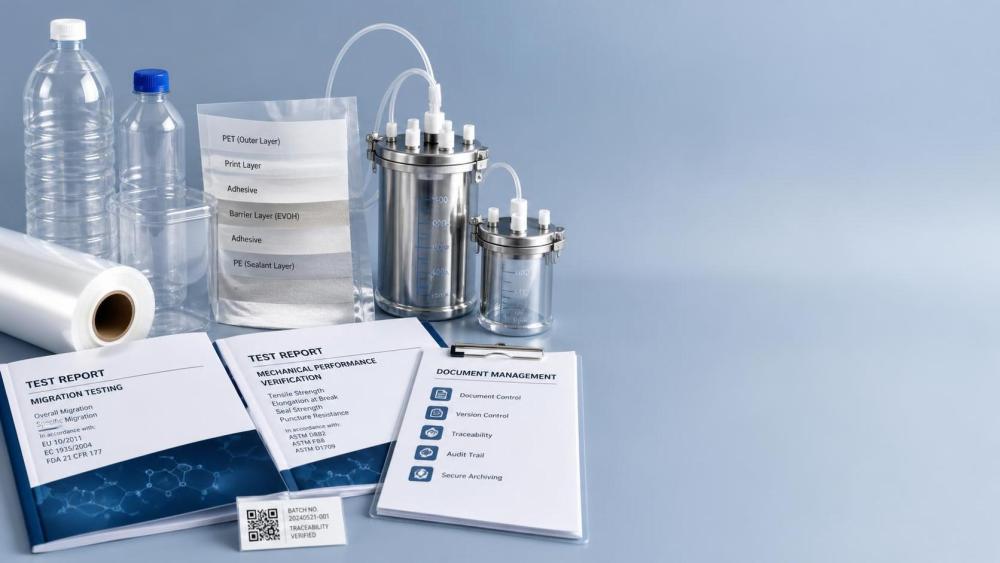
Migration data usually carries the most weight because it addresses chemical transfer from packaging into the packed product or an agreed simulant. The critical distinction is between overall migration and specific migration. Overall migration evaluates total non-volatile substances that may transfer under stated time and temperature conditions. Specific migration targets particular substances with individual limits, such as certain monomers, additives, reaction products, or contaminants that may be relevant to the polymer family, catalyst system, color package, adhesive, or recycled feed stream.
Test validity depends heavily on sample selection. A thick extruded sheet tested before thermoforming may not represent a thin sidewall cup with a different surface-to-volume ratio. A bottle preform can behave differently from the stretch-blown container because orientation, wall thinning, and thermal history may alter diffusion behavior. For printed flexible packaging, the test article should reflect the actual lamination stack and curing status, not a simplified film without ink or adhesive. If the package is intended for hot fill, frozen storage, microwave reheating, fatty foods, alcohol-containing liquids, or long shelf life, those conditions should be captured in the test design rather than assumed to be covered by a generic certificate.
Migration failures are not always caused by the base polymer. They may come from slip agents blooming to the surface, residual solvents in inks or adhesives, inadequate curing in two-component systems, NIAS generated during processing, or contamination introduced through regrind handling. Recycled content increases the need for disciplined input control because contamination risk can shift with bale composition, washing efficiency, filtration level, deodorization performance, and the degree of segregation between food-contact and non-food streams.
Mechanical and functional tests are compliance evidence too
Many teams focus so heavily on chemistry that they underweight mechanical performance. A package that meets migration limits but cracks in distribution, leaks after capping, or loses barrier after drop impact still creates a compliance problem because product safety can no longer be assured. For rigid packs, typical evidence may include top-load resistance, compression, impact resistance, stress cracking behavior, closure torque retention, seal strength, vacuum resistance, and dimensional stability after conditioning. For films, common tests include tensile properties, dart impact, puncture resistance, coefficient of friction, heat-seal window, bond strength in laminates, and resistance to delamination after aging.
These tests matter because changes in processing parameters can shift performance without changing the nominal material specification. Injection speed, melt temperature, mold cooling balance, blow ratio, line speed, die gap control, and moisture content can alter crystallinity, orientation, weld line quality, and residual stress. A declaration from a material supplier does not cover a brittle hinge caused by overpacking or a weak bottom seal caused by contaminated sealing jaws. When reviewing plastic packaging compliance standards, it is useful to treat mechanical data as part of the same evidence chain as migration data, especially where failure in use can expose the product to contamination or loss of sterility.
Barrier performance may also belong in the compliance file when oxygen, moisture, aroma, light, or carbon dioxide transmission affects product stability or regulatory classification. A structure may pass on day one yet drift after retort, scuffing, humidity exposure, or repeated flexing. In multilayer packaging, tie-layer quality and layer distribution should be controlled because local thinning can reduce barrier sharply even when average gauge appears acceptable.
The document set that actually survives an audit
The most valuable document is usually a well-scoped declaration of conformity or equivalent statement, supported by annexes rather than broad marketing language. It should identify the material or packaging article precisely, including grade, structure, intended use, contact type, and any restrictions. It should also reference the basis for compliance, whether that is migration testing, positive-list evaluation, supplier statements, risk assessment for non-intentionally added substances, or process controls for recycled content.
A useful technical file often includes the following elements, though the exact set depends on jurisdiction and product type:
- Material specifications that distinguish resin grade, additive package, colorant, adhesive, ink system, coating, and any post-consumer or post-industrial recycled fraction.
- Signed supplier declarations with issue dates, revision status, and scope limitations. A declaration that covers pellets may not automatically cover compounds, masterbatch additions, or converted articles.
- Migration reports showing test conditions, simulants or media, analytical targets, sample description, and surface-area assumptions. Reports without clear sample identification often become unusable during review.
- Process records that link production batches to approved bills of material, machine settings where relevant, and release criteria such as seal strength or leak test results.
- Change-control records documenting substitutions in additives, regrind ratio, recycled source, pigment supplier, tool maintenance, or sterilization method.
- Artwork and print approvals where low-odor, low-migration, or non-contact side assumptions are part of the compliance rationale.
Traceability is where many systems weaken. Resin certificates may be archived, but the file may not show which lot went into which production batch, whether a temporary colorant substitution was approved, or whether a recycled resin shipment was held pending incoming verification. If a complaint later points to odor, haze, black specks, or unexpected extractables, the absence of lot-level linkage makes root-cause analysis slow and often inconclusive.
Recycled content requires tighter evidence, not broader claims
Recycled plastics can fit within plastic packaging compliance standards, but only when the source, decontamination logic, and intended end use are technically aligned. The main issue is not simply recycled percentage. The harder question is whether the process consistently controls unknown inputs, residual contaminants, and degradation byproducts. For pelletized recycled PET, PE, or PP, supporting records may need to cover feedstock origin, sorting criteria, wash conditions, melt filtration, volatile removal, and contamination monitoring. Odor evaluation alone is not a substitute for a documented compliance pathway.
Multilayer structures using recycled material behind a functional barrier deserve careful scrutiny. The barrier concept must be technically justified for the actual geometry, thickness distribution, and foreseeable storage conditions. Pinholes, channel leaks at seals, aggressive contents, or high-temperature use can undermine assumptions that look acceptable on paper. Where a risk assessment is used instead of extensive finished-pack testing, the reasoning should be explicit and conservative enough to withstand external review.
Frequent misreadings that create avoidable nonconformities
One common mistake is treating a raw-material compliance statement as if it were a complete approval for the finished package. Converted articles introduce processing aids, thermal history, contamination opportunities, and geometry-specific exposure conditions. Another is assuming that a test report remains valid after a formulation adjustment that seems minor, such as a slip additive level increase or a switch to a different antiblock system. Even small changes can affect migration, sealability, haze, friction, or environmental stress cracking.
There is also a tendency to separate packaging development from maintenance activity on equipment. Yet worn screws, degraded barrel zones, unstable hot-runner temperatures, poor drying, or inconsistent blow-pin alignment can change the package enough to trigger compliance or release issues. Black specks from thermal degradation, gel formation in extrusion, and incomplete dispersion of additives are not only cosmetic defects; they may also signal process conditions that should prompt a review of technical evidence.
Another weak point appears during transport and storage qualification. Some packages pass factory release tests but fail after pallet stacking, temperature cycling, or prolonged warehouse dwell time. Caps may back off, seals may creep, flexible packs may lose bond strength, and highly oriented bottles may stress-whiten. If the article is exported across climate zones, conditioning protocols should reflect that reality rather than a narrow room-temperature snapshot.
Where internal coordination usually determines the outcome
Compliance work on plastic packaging rarely fails because a single document is missing in isolation. Problems appear at handoff points: formulation updates not reflected in declarations, tooling modifications not communicated to testing teams, artwork changes that alter ink coverage, recycled feedstock approvals that outpace analytical review, or customer specifications that describe use conditions differently from the original test scope. A technical file should therefore read like a controlled record of a real package in real production, not a stack of unrelated PDFs.
That is especially important for molded, extruded, and blow-molded packaging produced across multiple lines. Two lines may use the same nominal resin but operate with different residence times, screw designs, venting efficiency, or regrind practices. If one line runs closer to thermal degradation limits, it may need separate validation. The same logic applies after mold refurbishment, line relocation, sterilization changes, or a shift from solvent-based to different adhesive chemistry in a laminate.
Strong files are usually specific, current, and restrained in their claims. They describe what has been tested, under which assumptions, and where the boundaries are. That level of precision tends to matter more than volume. When plastic packaging compliance standards are handled this way, the result is a record set that can support release decisions, customer questionnaires, regulatory reviews, and failure investigations without relying on guesswork.
Related News
- 00
0000-00
Smart Factory Costs for Plastics: Estimating ROI for Automation Projects - 00
0000-00
How to Evaluate a Packaging Molding Equipment Supplier for High-Volume Production - 00
0000-00
Where Recycled Plastic Innovation Delivers the Biggest Value in Packaging - 00
0000-00
How to Evaluate a Tire Curing Equipment Supplier for Capacity, Support, and Uptime - 00
0000-00
How to Size a Servo Injection Molding Press for High-Precision Parts
Weekly Insights
Stay ahead with our curated technology reports delivered every Monday.
Related News
 Ms. Elena RodriguezSmart Factory Costs for Plastics: Estimating ROI for Automation ProjectsSmart factory for plastics cost: learn how to estimate automation ROI, uncover hidden integration expenses, reduce scrap, and build a phased investment plan.Oct 10, 2026
 Ms. Elena RodriguezHow to Evaluate a Packaging Molding Equipment Supplier for High-Volume ProductionChoose a packaging molding equipment supplier with confidence. Learn how to assess throughput stability, tooling, recycled-material capability, lifecycle cost, and service support for high-volume production.Oct 09, 2026
 Ms. Elena RodriguezHow to Select Packaging Molding Equipment for High-Volume Production LinesPackaging molding equipment selection guide for high-volume lines: compare processes, throughput, materials, automation, and energy to achieve stable, cost-effective output.Oct 04, 2026
 Ms. Elena RodriguezHow to Evaluate Plastic Recycling Machinery for UAE Heat, Feedstock, and Output NeedsPlastic recycling machinery UAE buyers: evaluate heat resilience, feedstock handling, cooling, pellet quality, energy use, and lifecycle cost for reliable output.Sep 28, 2026
 Ms. Elena RodriguezGerman Extrusion Equipment Suppliers: Comparing Service, Lead Times, and Lifecycle CostExtrusion equipment Germany suppliers compared: evaluate service coverage, credible lead times, spare-parts access, and lifecycle cost to select a reliable, future-ready production partner.Sep 22, 2026
 Ms. Elena RodriguezWhat Should You Check Before Buying a Used Plastic Recycling Line?What should I check before buying a used plastic recycling line? Explore feedstock fit, wear, trials, utilities, controls, and restoration costs before you invest.Sep 26, 2026
 Ms. Elena RodriguezHow to Compare Pelletizing Lines by Energy Use per TonHow do I compare pelletizing lines by kWh per ton? Learn to measure total energy, verify saleable output, and select a cost-efficient line.Sep 23, 2026
 Ms. Elena RodriguezTyre Cutter Blade Wear: When Capacity Loss Needs Inspectionшинорез blade wear can quietly reduce tyre-cutting capacity. Learn the warning signs, inspection triggers, and maintenance actions that protect output and uptime.Sep 28, 2026
 Ms. Elena RodriguezIn-House Recycling for Factory Scrap: How to Reduce Material Waste and Disposal CostsIn house recycling for factory scrap helps manufacturers cut material waste, reduce disposal costs, and create controlled, quality-focused reuse loops.Sep 07, 2026
 Ms. Elena RodriguezHow Recyclable Packaging Manufacturing Balances Material Recovery and Production CostRecyclable packaging manufacturing: discover how smarter design, feedstock control, and process optimization reduce recovery costs while improving quality and yield.Sep 04, 2026
 Ms. Elena RodriguezHow to Evaluate a Plastic Recycling Systems Supplier for Your Processing NeedsChoose the right plastic recycling systems supplier with a practical guide to feedstock fit, output quality, total cost, testing, service, and compliance.Sep 01, 2026
 Ms. Elena RodriguezCE Marking for Plastic Processing Equipment: Documentation and Safety ChecksPlastic processing equipment CE compliance: learn the essential documentation, risk assessments, safety checks, and validation steps for reliable EU market access.Aug 30, 2026
 Ms. Elena RodriguezPlastic Packaging Compliance Standards: What Tests and Documents Matter Most?Plastic packaging compliance standards explained: learn which migration tests, mechanical checks, and audit-ready documents matter most to reduce risk and pass reviews with confidence.Aug 25, 2026
 Ms. Elena RodriguezHow to Evaluate a Plastic Waste Recycling System for Capacity, Contamination, and ROIPlastic waste recycling system evaluation made practical: compare true capacity, contamination control, and ROI to choose a line that delivers stable output and stronger returns.Aug 24, 2026
 Ms. Elena RodriguezPackaging Molding Equipment Price: What Drives Cost and How to Compare Quotes?Packaging molding equipment price varies by machine type, automation, tooling, energy use, and service scope. Learn what drives cost and how to compare quotes with confidence.Aug 21, 2026
 Ms. Elena RodriguezWhat Packaging Machinery for Plastic Containers Should You Choose for High-Volume Production?Packaging machinery for plastics containers can make or break high-volume production. Learn how to choose the right line for speed, consistency, compliance, and lower lifecycle costs.Aug 16, 2026
 Ms. Elena RodriguezWhat Circular Plastics Mean for Automotive Parts and Material SelectionCircular plastics for automotive are reshaping part selection with lower weight, better sustainability, and reliable performance. Discover how engineers balance recycled content, durability, and compliance.Aug 15, 2026
 Ms. Elena RodriguezBroiler Farming in Cage System: Selection Factors for Commercial FarmsBroiler farming in cage system selection for commercial farms: compare structure, ventilation, automation, and manure handling to improve efficiency and avoid costly mistakes.Aug 14, 2026
 Ms. Elena RodriguezHow to Implement Smart Polymer Manufacturing Without Disrupting Existing Production?Smart polymer manufacturing implementation made practical: learn how to upgrade existing production with phased digitalization, less downtime, better control, and measurable ROI.Aug 11, 2026
 Ms. Elena RodriguezHow to Evaluate a Rubber Compression Molding Supplier for Complex Part ProductionRubber compression molding supplier selection for complex parts starts with process, material, and tooling control. Learn how to compare vendors beyond price and reduce launch risk.Aug 10, 2026