How Does Feedstock Moisture Affect Plastic Pelletizing Energy Use?




Feedstock moisture raises plastic pelletizing energy use in two ways: it adds a water-removal load, and it can reduce the amount of acceptable pellets produced from each kilowatt-hour. The second effect can be more important than the first. A line that runs at lower output, suffers venting interruptions, or produces moisture-related rejects may consume substantially more energy per kilogram even when its electrical demand barely changes.
The efficient operating target is therefore not “as dry as possible.” It is the moisture level that the complete drying, extrusion, and pelletizing system can handle at stable throughput while meeting pellet specifications. That target differs between washed polyethylene film, polypropylene regrind, and moisture-sensitive polymers such as PET or polyamide.
Where moisture adds energy demand
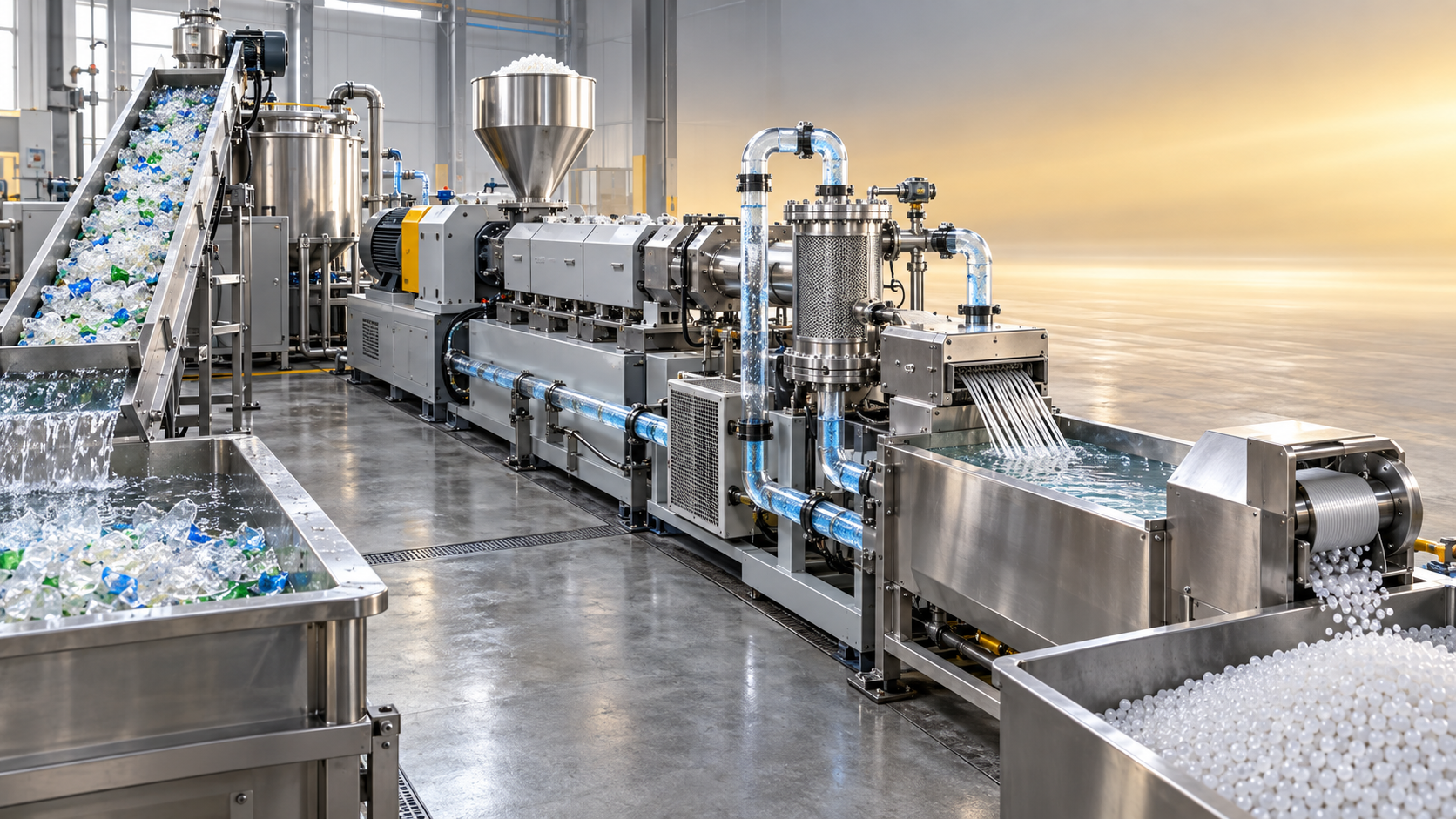
Water entering with washed flakes or regrind must leave somewhere. Mechanical equipment can separate free water before extrusion; thermal dryers can evaporate it; and vented extruders can remove remaining moisture as vapor. Each route has a different energy requirement and a different effect on production stability.
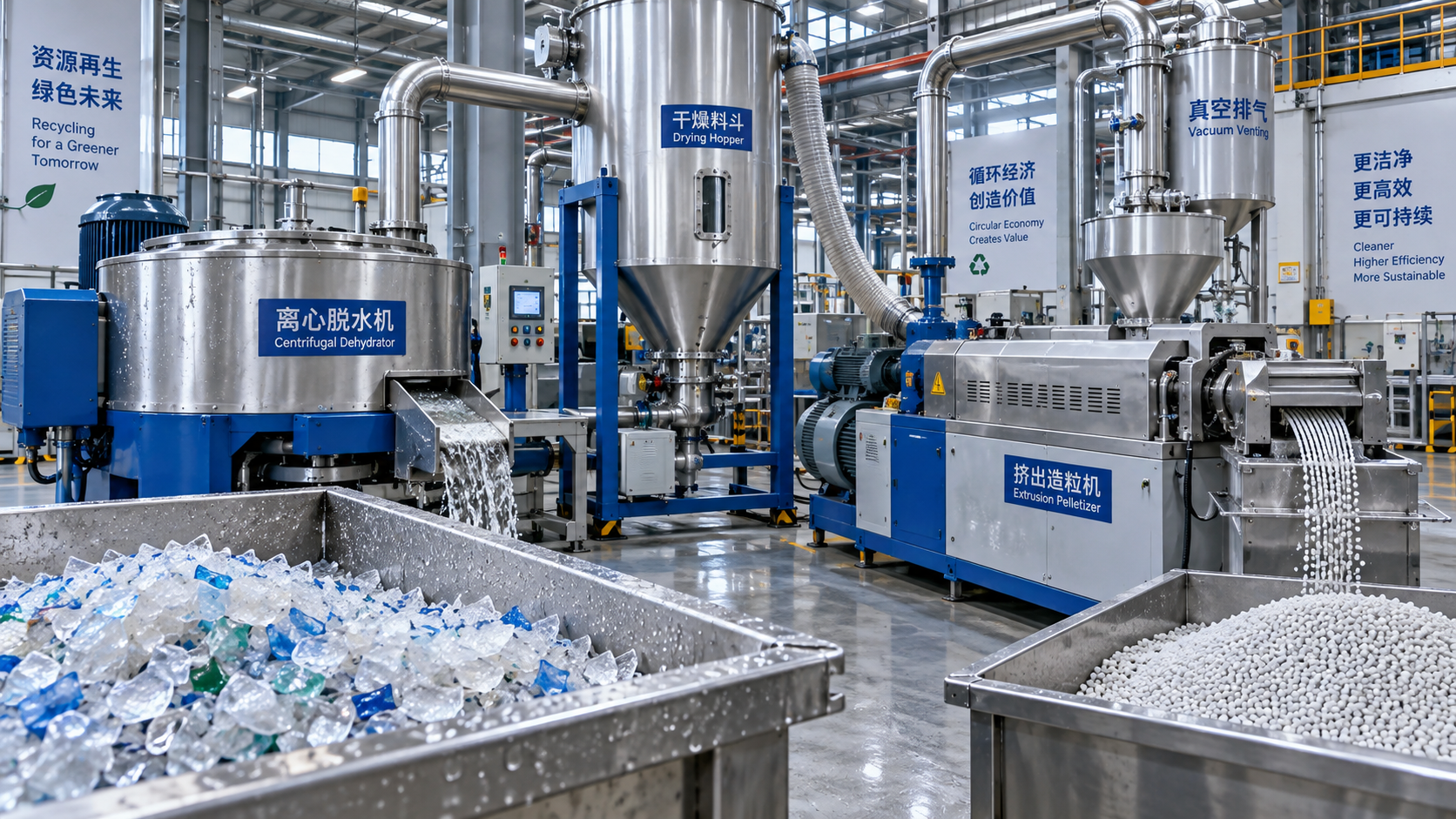
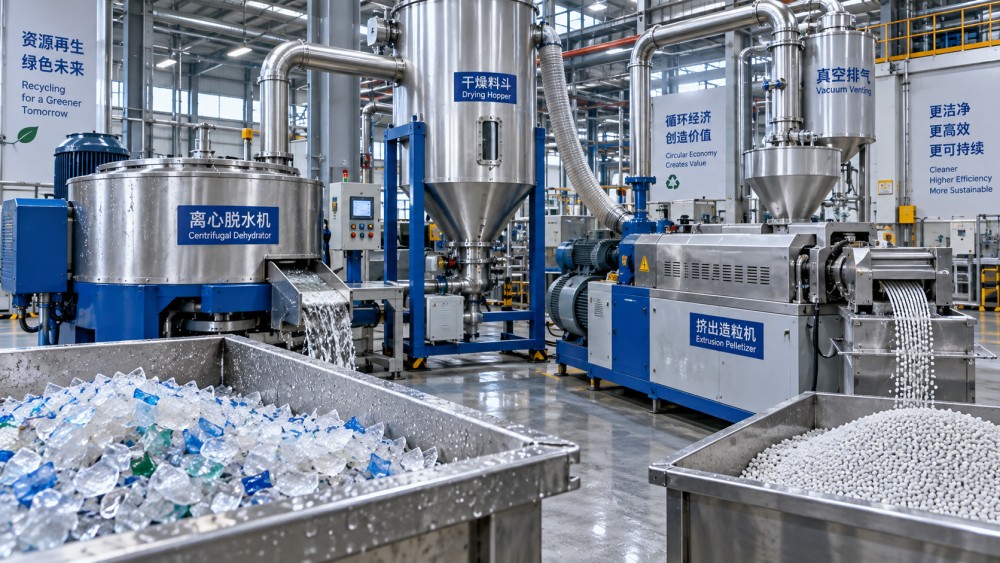
Mechanical dewatering uses electricity to drive centrifuges, presses, or squeezing equipment. It avoids evaporating the water it removes, making it a valuable first stage when the feed carries substantial surface water. Its limit is physical separation: it cannot reliably remove moisture absorbed within a polymer, and its performance depends on particle shape, size, and bulk density.
Thermal drying adds heat, air movement, and, where required, air dehumidification. Electricity consumption depends on the heating source: an electrically heated dryer places its thermal demand on the electricity meter, while a gas-, steam-, or waste-heat-assisted dryer shifts some demand elsewhere. Comparing electricity alone can therefore misrepresent total energy use.
In the extruder, residual water absorbs heat and may vaporize as pressure falls toward a vent. The energy comes from the combined contribution of barrel heating and mechanical work transferred through the screw. Vacuum pumps, condensers, and cooling systems impose additional loads. Moisture does not necessarily cause a proportional rise in every motor’s power, but it still consumes processing capacity and requires vapor-handling equipment.
These routes are interconnected. Reducing dryer energy by feeding wetter material can increase extrusion losses; adding drying capacity can waste energy if existing dewatering already supplies material within the line’s operating window. The useful boundary is the whole process, not one machine.
The heat required to remove water—and what that number does not tell you
Heating water from approximately 20°C to 100°C and evaporating it at atmospheric pressure requires about 0.72 kWh of thermal energy per kilogram of water. This is a physical reference value, not a predicted dryer electricity consumption. Exhaust losses, heating of the polymer, equipment heat losses, and heat recovery all change the actual requirement.
Vacuum changes the boiling temperature and evaporation conditions, but it does not eliminate the energy needed to vaporize water. A lower-pressure vent can improve moisture removal without making evaporation energetically free.
Consider an illustrative feed containing 1,000 kg of dry polymer. At 10% moisture on a wet basis, it carries approximately 111 kg of water. At 2%, it carries approximately 20 kg. Removing the difference mechanically rather than thermally avoids evaporating about 91 kg of water—equivalent to roughly 65 kWh of the reference thermal load described above.
That figure is not a guaranteed electrical saving. The dewatering equipment consumes power, the dryer may use a non-electrical heat source, and the real evaporation conditions differ. The calculation nevertheless identifies why removing bulk surface water before heating deserves attention.
Moisture calculations must also use a consistent basis. Wet-basis moisture is water mass divided by total wet material mass; dry-basis moisture is water mass divided by dry polymer mass. Confusing the two distorts water balances, dryer sizing, and comparisons between supplier specifications.
Lost throughput can outweigh the direct evaporation load
Specific energy consumption should be calculated against saleable output:
Specific electricity consumption = total electricity used within the defined process boundary ÷ kilograms of saleable pellets produced.
This measure captures a problem that machine-level power readings miss. Wet feed may require a lower feed rate so the vent can handle the vapor load. It can also contribute to unstable feeding, melt-pressure variation, bubbles, porous strands, or strand breaks when moisture removal is inadequate.
For illustration, a line consuming 250 kW while producing 1,000 kg/h of acceptable pellets uses 0.25 kWh/kg. If moisture-related constraints reduce acceptable output to 850 kg/h while power remains at 250 kW, consumption rises to approximately 0.294 kWh/kg—about 18% higher. These are hypothetical operating values, not a performance benchmark.
The increase comes entirely from the smaller output denominator. Additional drying or vacuum electricity would raise it further. Conversely, a modest increase in dryer power can lower total kWh/kg if it restores enough stable throughput or reduces rejected material.
This is why extruder motor amperage alone cannot establish whether wetter feed is economical. Lower motor power may simply reflect a lower polymer processing rate. Rejects that require another extrusion pass also carry a second processing load, which should not disappear from the energy calculation.
Polymer type determines how far venting can replace drying
For polyethylene and polypropylene, much of the moisture associated with washed feed is surface water or water retained between particles, folds, and contaminants. These polymers are not subject to the same moisture-driven hydrolysis mechanism as PET. Effective mechanical dewatering followed by a suitable drying or extrusion-degassing arrangement can therefore be a practical route.
However, low moisture absorption does not mean unlimited tolerance for wet feed. Vapor still needs sufficient venting capacity, and residual moisture can impair pellet appearance and downstream processing. Thin film and rigid flakes can also present very different feeding and water-retention behavior even when they contain the same polymer.
PET, polyamide, and other hydrolysis-sensitive polymers require a stricter distinction between external water and absorbed moisture. At melt-processing temperatures, moisture can contribute to polymer-chain degradation. The resulting loss of viscosity or mechanical performance cannot be corrected merely by producing pellets with a dry exterior.
A vacuum vent may remove water from the melt, but removal must occur quickly enough to limit damage. Conventional melt venting should not automatically be treated as a substitute for controlled predrying. Specialized processes may permit different feed conditions, but those conditions need validation against the required material properties—not just pellet appearance.
For moisture-sensitive feed, drying conditions must address temperature, residence time, airflow, and drying-air moisture. PET may also require crystallization management to prevent sticking during suitable high-temperature drying. A universal inlet-moisture limit would conceal these differences; the appropriate specification must reflect the polymer grade, recycling route, equipment design, and final application.
Match each removal stage to the water it can handle efficiently
The strongest process arrangement removes water at the stage best suited to its physical form. Bulk free water belongs primarily in mechanical separation. Residual surface moisture may justify thermal treatment or a validated extrusion-degassing step. Absorbed moisture requires drying conditions capable of moving it from inside the material to the surrounding drying medium.
For washed polyolefin film, increasing hot-air temperature is not necessarily the best response to wet feed. Poor squeezing performance, inconsistent upstream drainage, or compacted wet material may be the underlying constraint. Adding heat treats the symptom while preserving an unnecessarily large evaporation load.
Equally, using the extruder as the principal dryer can overload its vapor-removal function. Vent geometry, exposed melt surface, screw configuration, vacuum level, and melt seals determine what the system can remove without entraining polymer or disrupting conveying. A larger vacuum pump alone cannot resolve every limitation.
Excessive drying has its own costs. Longer residence time and higher temperature consume energy and can increase the risk of sticking, oxidation, or other material changes where conditions are unsuitable. The aim is a validated moisture window, with sufficient margin for variation, rather than the lowest measurable moisture value.
Measure moisture where it affects the process
A sample taken immediately after washing does not establish what enters the extruder. Dewatering, drying, storage, and conveying can all change moisture. Hygroscopic material can regain moisture after drying if exposed to humid air, while wet film can form localized clusters that a single grab sample misses.
Measurements are most useful after mechanical dewatering, at the dryer outlet where applicable, and at the extruder feed point. These locations separate the performance of each stage and reveal whether moisture is being reintroduced before melting.
The test method must suit the material and the decision. Loss-on-drying measurements can include substances other than water if the feed contains volatile residues. Water-specific methods such as Karl Fischer analysis can help distinguish moisture from other mass losses when properly applied. Inline sensors require calibration for the feed’s composition, geometry, temperature, and expected moisture range.
Average moisture alone is insufficient. A line may handle a steady vapor load but struggle with short wetter slugs. Record variability alongside the mean, and compare it with vent pressure, feed rate, interruptions, and pellet quality. This helps distinguish a moisture-capacity problem from contamination, feeding, or filtration problems that produce similar symptoms.
Set the operating target from controlled comparisons
A useful trial compares several moisture levels while holding polymer composition, particle size, contamination, and product requirements as consistent as practicable. Allow the system to reach stable conditions before recording results; transition periods can obscure the relationship between drying effort and extrusion performance.
Record energy for dewatering, drying, extrusion, vacuum generation, cooling, and pellet handling within a clearly stated boundary. Report thermal fuel separately from electricity, and include saleable output, reject quantity, downtime, and relevant pellet properties. Otherwise, an apparent dryer saving may simply be a cost transferred to the extruder or to reprocessing.
The economic target lies where further drying no longer provides enough additional output, quality improvement, or avoided energy elsewhere to justify its cost. For moisture-sensitive polymers, the material-quality limit remains a constraint even if a wetter setting looks cheaper on the electricity meter.
Equipment guarantees should use the same logic: define the feedstock, inlet moisture and measurement basis, required pellet quality, stable output, and included auxiliaries. A kWh/kg figure without those conditions is not a reliable basis for comparing pelletizing systems.
The practical decision is to remove free water before paying to evaporate it, protect moisture-sensitive polymers before damage occurs, and verify that remaining moisture does not restrict saleable output. Drying and venting settings should then be adjusted together, using whole-line energy per kilogram—not isolated machine power—as the deciding measure.
Related News
- 00
0000-00
Automatic Tire Curing: How Temperature and Pressure Controls Affect Cure Uniformity - 00
0000-00
Pallet Injection Molding: How to Size Clamp Force and Shot Capacity - 00
0000-00
Circular Manufacturing Roadmap: From Waste Audits to Material Recovery - 00
0000-00
How Continuous Melt Filtration Limits Pressure Fluctuations During Screen Changes - 00
0000-00
Choosing High-Speed All-Electric Injection Molding Machines for Thin-Wall Parts
Weekly Insights
Stay ahead with our curated technology reports delivered every Monday.
Related News
 Ms. Elena RodriguezCircular Manufacturing Roadmap: From Waste Audits to Material RecoveryBuild a circular manufacturing roadmap from waste audits to material recovery. Explore practical steps to qualify recycled materials, select equipment, and validate ROI before investing.Oct 20, 2026
 Ms. Elena RodriguezInjection Molding System Costs: Machine, Molds, Automation, and InstallationCompare injection molding systems price proposals with confidence. Uncover machine, mold, automation, and installation costs to avoid hidden expenses and choose a production-ready cell.Oct 17, 2026
 Ms. Elena RodriguezHow Does Feedstock Moisture Affect Plastic Pelletizing Energy Use?How does feedstock moisture affect plastic pelletizing energy use? Discover how smarter drying and dewatering can cut kWh/kg, protect pellet quality, and boost output.Oct 22, 2026
 Ms. Elena RodriguezSmart Factory Costs for Plastics: Estimating ROI for Automation ProjectsSmart factory for plastics cost: learn how to estimate automation ROI, uncover hidden integration expenses, reduce scrap, and build a phased investment plan.Oct 10, 2026
 Ms. Elena RodriguezHow to Evaluate a Packaging Molding Equipment Supplier for High-Volume ProductionChoose a packaging molding equipment supplier with confidence. Learn how to assess throughput stability, tooling, recycled-material capability, lifecycle cost, and service support for high-volume production.Oct 09, 2026
 Ms. Elena RodriguezProcurement Records to Request Before Buying a Used Tyre ShredderUsed tyre shredder for sale? Request maintenance, operating, safety, and parts records to reduce risk, verify condition, and buy with confidence.Oct 16, 2026
 Ms. Elena RodriguezHow to Select Packaging Molding Equipment for High-Volume Production LinesPackaging molding equipment selection guide for high-volume lines: compare processes, throughput, materials, automation, and energy to achieve stable, cost-effective output.Oct 04, 2026
 Ms. Elena RodriguezHow to Evaluate Plastic Recycling Machinery for UAE Heat, Feedstock, and Output NeedsPlastic recycling machinery UAE buyers: evaluate heat resilience, feedstock handling, cooling, pellet quality, energy use, and lifecycle cost for reliable output.Sep 28, 2026
 Ms. Elena RodriguezGerman Extrusion Equipment Suppliers: Comparing Service, Lead Times, and Lifecycle CostExtrusion equipment Germany suppliers compared: evaluate service coverage, credible lead times, spare-parts access, and lifecycle cost to select a reliable, future-ready production partner.Sep 22, 2026
 Ms. Elena RodriguezWhat Should You Check Before Buying a Used Plastic Recycling Line?What should I check before buying a used plastic recycling line? Explore feedstock fit, wear, trials, utilities, controls, and restoration costs before you invest.Sep 26, 2026
 Ms. Elena RodriguezHow to Compare Pelletizing Lines by Energy Use per TonHow do I compare pelletizing lines by kWh per ton? Learn to measure total energy, verify saleable output, and select a cost-efficient line.Sep 23, 2026
 Ms. Elena RodriguezTyre Cutter Blade Wear: When Capacity Loss Needs Inspectionшинорез blade wear can quietly reduce tyre-cutting capacity. Learn the warning signs, inspection triggers, and maintenance actions that protect output and uptime.Sep 28, 2026
 Ms. Elena RodriguezIn-House Recycling for Factory Scrap: How to Reduce Material Waste and Disposal CostsIn house recycling for factory scrap helps manufacturers cut material waste, reduce disposal costs, and create controlled, quality-focused reuse loops.Sep 07, 2026
 Ms. Elena RodriguezHow Recyclable Packaging Manufacturing Balances Material Recovery and Production CostRecyclable packaging manufacturing: discover how smarter design, feedstock control, and process optimization reduce recovery costs while improving quality and yield.Sep 04, 2026
 Ms. Elena RodriguezHow to Evaluate a Plastic Recycling Systems Supplier for Your Processing NeedsChoose the right plastic recycling systems supplier with a practical guide to feedstock fit, output quality, total cost, testing, service, and compliance.Sep 01, 2026
 Ms. Elena RodriguezCE Marking for Plastic Processing Equipment: Documentation and Safety ChecksPlastic processing equipment CE compliance: learn the essential documentation, risk assessments, safety checks, and validation steps for reliable EU market access.Aug 30, 2026
 Ms. Elena RodriguezPlastic Packaging Compliance Standards: What Tests and Documents Matter Most?Plastic packaging compliance standards explained: learn which migration tests, mechanical checks, and audit-ready documents matter most to reduce risk and pass reviews with confidence.Aug 25, 2026
 Ms. Elena RodriguezHow to Evaluate a Plastic Waste Recycling System for Capacity, Contamination, and ROIPlastic waste recycling system evaluation made practical: compare true capacity, contamination control, and ROI to choose a line that delivers stable output and stronger returns.Aug 24, 2026
 Ms. Elena RodriguezPackaging Molding Equipment Price: What Drives Cost and How to Compare Quotes?Packaging molding equipment price varies by machine type, automation, tooling, energy use, and service scope. Learn what drives cost and how to compare quotes with confidence.Aug 21, 2026
 Ms. Elena RodriguezWhat Packaging Machinery for Plastic Containers Should You Choose for High-Volume Production?Packaging machinery for plastics containers can make or break high-volume production. Learn how to choose the right line for speed, consistency, compliance, and lower lifecycle costs.Aug 16, 2026