Injection Molding System Costs: Machine, Molds, Automation, and Installation




A competitive press quotation can still lead to an expensive production cell. The difference appears when the mold needs additional temperature control, the robot requires guarding, or the factory needs electrical and cooling upgrades before commissioning. When comparing injection molding systems price proposals, use the installed, production-ready cost as the purchasing baseline—not the machine price alone.
That baseline should include the press, production molds, automation, auxiliary equipment, freight, site preparation, installation, and acceptance testing. No reliable system price can be established without a defined part, resin, output target, and delivery scope. The practical approach is to specify those requirements first, separate one-time investment from recurring expenses, and compare suppliers against the same production conditions.
Define the production requirement before requesting prices
A request based only on clamping force leaves substantial room for suppliers to quote different solutions. Two presses with the same nominal tonnage may differ in injection capacity, platen dimensions, tie-bar spacing, injection speed, and available options. Neither may suit the intended mold without further checks.
Start the quotation package with the part drawing, resin grade, expected annual demand, quality requirements, and planned operating schedule. Include permissible regrind content and any traceability or material-handling restrictions. These details determine whether a standard production cell is sufficient or whether the quotation needs specialized equipment.
- Part and runner weight: Establish the required shot volume using the intended resin, rather than relying only on a machine’s published reference-material shot weight.
- Mold envelope: Confirm mold dimensions, weight, opening stroke, daylight, ejector requirements, and connection locations.
- Output requirement: State the required number of acceptable parts per scheduled production period, not merely the desired cycle time.
- Process constraints: Identify thin walls, tight tolerances, inserts, cosmetic surfaces, or materials that affect pressure, drying, wear resistance, and handling.
Ask suppliers to identify assumptions explicitly. A short cycle estimate based on an unconfirmed cooling design should not carry the same purchasing weight as a demonstrated cycle using the production mold and specified resin.
Build the budget around the complete production cell
The following cost structure makes omissions visible. Request separate line items even when a supplier offers a bundled package; otherwise, later scope changes become difficult to price or challenge.
Installed capital cost = equipment and tooling + logistics + site works + integration + commissioning. Keep startup scrap, initial consumables, and working capital visible alongside this total, even where accounting policy treats them differently. Use a separate contingency allowance for unresolved scope rather than treating it as a substitute for obtaining firm quotations.
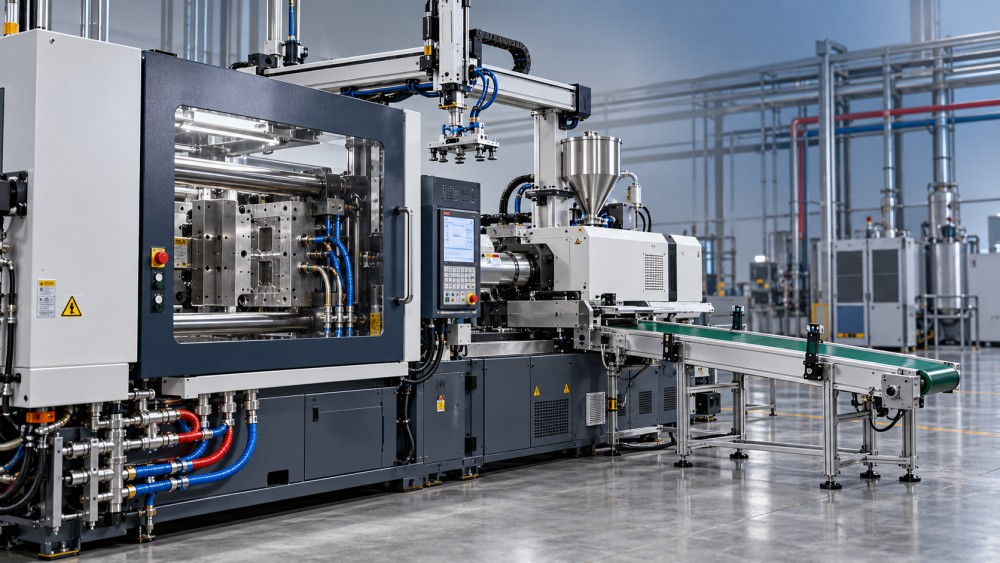
Machine cost: pay for the required process capability
Clamping force influences machine selection, but buying a larger press is not automatically a safer decision. Excess capacity can increase investment, floor-space requirements, and operating expenses without improving the part. The supplier should explain the selection using projected area, anticipated cavity pressure, mold fit, shot requirements, and injection performance.
Compare drive technologies under the same conditions
Hydraulic, servo-hydraulic, all-electric, and hybrid machines can have different purchase and operating-cost profiles. All-electric equipment may justify a higher quotation through application-specific repeatability, motion control, or energy performance. Servo-hydraulic equipment may be commercially attractive where its process capability meets the requirement. The result depends on machine design and duty cycle, not the technology label alone.
Request energy consumption measured over a defined production run, with the same mold, resin, cycle, and quality criteria. Clarify whether the figure covers only the press or includes dryers, chillers, robots, and other auxiliaries. Comparing a press-only measurement with a whole-cell measurement produces a misleading payback calculation.
Also price the options that the actual process needs: wear-resistant screw and barrel packages, additional hydraulic circuits, valve-gate control, process-data recording, or specialized injection units. Features added after delivery can involve more than hardware cost, including engineering, downtime, and control-system changes.
Molds can change both capital cost and cost per part
A mold quotation is incomplete without its technical and commercial assumptions. Cavity count, tool material, slide mechanisms, surface finish, dimensional requirements, and expected service conditions all affect price. A low tooling quote may exclude the validation effort needed to demonstrate stable production.
Higher cavitation can increase output per cycle, but it also raises tooling complexity and may require a larger press, greater plasticizing capacity, and more demanding cooling. Compare the complete cell for each tooling option. The relevant question is whether additional cavities reduce the cost of acceptable parts at realistic demand—not whether they maximize theoretical output.
A hot-runner system may reduce runner waste and eliminate some handling, but it introduces heaters, controls, maintenance requirements, and color-change considerations. Cold runners may be commercially reasonable where runner material can be reused within product requirements. Neither choice should be justified by material savings alone without considering resin sensitivity, scrap restrictions, and production scheduling.
- Specify ownership of the mold, drawings, and process documentation, together with access and transfer arrangements.
- Define trial materials, sample quantities, dimensional reports, and the approval procedure.
- State responsibility for corrections when the mold does not meet agreed requirements.
- Identify spare inserts, wear components, hot-runner parts, and maintenance documentation included in delivery.
Tooling acceptance and machine acceptance must also align. A press may meet its technical specification while an unresolved mold-cooling problem prevents the cell from reaching the quoted production rate.
Automation and auxiliaries: price the interfaces, not just the devices
A robot quotation does not necessarily represent an automated production solution. End-of-arm tooling, part-presence sensing, safe access, reject segregation, conveyor arrangements, and downstream equipment determine what the robot can actually do. Changes to the mold or part orientation can also alter the gripper design and programming scope.
Request a layout and sequence of operation before approving automation spending. It should show where parts go during startup, normal production, inspection failure, and equipment stoppages. Assign responsibility for each interface; unclear boundaries between the press supplier, robot integrator, and tooling supplier can create additional engineering charges.
Auxiliary selection needs the same discipline. Hygroscopic resins require drying equipment matched to material requirements and throughput. A dryer’s purchase price is not comparable unless usable capacity, drying conditions, residence time, and conveying arrangements are consistent. Cooling equipment must be sized against the actual thermal load and available factory utilities.
Existing central cooling, compressed air, or material-conveying systems may reduce new equipment purchases, but only after their spare capacity and compatibility are verified. Treating existing utilities as free capacity can shift expenditure into emergency upgrades during installation.
Installation costs begin before the machine arrives
Site work is often excluded from equipment quotations because suppliers cannot determine it from a basic inquiry. A site survey should confirm delivery access, unloading arrangements, floor loading, equipment clearances, electrical supply, cooling-water conditions, and maintenance access. Qualified personnel should verify structural, electrical, and machine-safety requirements applicable to the installation.
Request utility requirements with operating conditions attached. Electrical connected load is not the same as typical energy consumption. Cooling-water flow requirements need corresponding temperature and pressure conditions. Compressed-air consumption should distinguish normal operation from intermittent demand where relevant.
- Before shipment: Approve the cell layout, utility drawings, delivery route, installation responsibilities, and factory acceptance procedure.
- Before positioning: Complete required foundations or floor work, power distribution, piping, and access preparation.
- During commissioning: Verify connections, protective functions, machine–robot communication, and process setup.
- Before production release: Run the agreed acceptance test and record outstanding actions, documentation, and training completion.
Commercial terms should identify who pays for freight, cargo insurance, customs clearance, applicable duties and taxes, crane hire, technician travel, and waiting time. Delivery terms alone do not define every installation responsibility. Delays caused by an unprepared site can generate charges even when the equipment itself arrives on schedule.
Normalize quotations using cost per acceptable part
Once scope is aligned, compare operating economics over a consistent evaluation period. Include resin consumption, expected scrap, electricity, labor, maintenance, consumables, and planned tooling service. Financing and depreciation can be added according to the organization’s investment method, but avoid counting the same capital expense twice.
Evaluated cost per acceptable part = allocated ownership and operating costs ÷ acceptable parts produced. Use achievable utilization and saleable demand, not continuous operation at an ideal cycle. Separate startup losses from steady-state scrap when frequent changeovers are expected.
Ask suppliers to distinguish guaranteed performance from estimates. A cycle-time commitment should state the resin, mold, cooling conditions, quality limits, and automation sequence. Labor-saving claims should identify which tasks disappear and which remain, such as replenishment, inspection, packing, or changeovers.
Test the investment against lower utilization, slower cycles, and higher material or energy costs. This reveals whether a more expensive cell depends on optimistic assumptions to appear economical. For an existing machine, include inspection, refurbishment, control compatibility, spare-parts availability, and installation in the comparison rather than treating its acquisition price as the complete alternative.
Make payment milestones reflect production readiness
The purchase agreement should convert quotation assumptions into measurable acceptance criteria. Define the approved part, resin, mold configuration, sustained production conditions, quality evidence, and documentation required at factory and site acceptance. State who provides material, test equipment, operators, and inspection resources.
Link appropriate payment milestones to agreed deliverables, with a written process for deviations and corrective work. Confirm when warranty coverage begins, what travel or labor it excludes, and how support is handled across machine, mold, and automation suppliers.
Before award, resolve every exclusion that can prevent the cell from running: an unpriced gripper, missing cooling connection, incomplete safety integration, or undefined tooling correction. A quotation is ready for approval when both the production responsibility and the cost of reaching acceptance are assigned—not merely when the equipment subtotal fits the budget.
Related News
- 00
0000-00
Injection Molding System Costs: Machine, Molds, Automation, and Installation - 00
0000-00
Truck Tire Manufacturing Equipment: Sizing Curing Presses for Target Output - 00
0000-00
How Single-Use Plastic Bans Shift Demand for Packaging Materials - 00
0000-00
PET Pelletizing Equipment: Strand vs. Underwater Systems for Recycled PET - 00
0000-00
Tire Manufacturing Equipment: Choosing Curing Presses by Tire Size and Output
Weekly Insights
Stay ahead with our curated technology reports delivered every Monday.
Related News
 Ms. Elena RodriguezInjection Molding System Costs: Machine, Molds, Automation, and InstallationCompare injection molding systems price proposals with confidence. Uncover machine, mold, automation, and installation costs to avoid hidden expenses and choose a production-ready cell.Oct 17, 2026
 Ms. Elena RodriguezSmart Factory Costs for Plastics: Estimating ROI for Automation ProjectsSmart factory for plastics cost: learn how to estimate automation ROI, uncover hidden integration expenses, reduce scrap, and build a phased investment plan.Oct 10, 2026
 Ms. Elena RodriguezHow to Evaluate a Packaging Molding Equipment Supplier for High-Volume ProductionChoose a packaging molding equipment supplier with confidence. Learn how to assess throughput stability, tooling, recycled-material capability, lifecycle cost, and service support for high-volume production.Oct 09, 2026
 Ms. Elena RodriguezProcurement Records to Request Before Buying a Used Tyre ShredderUsed tyre shredder for sale? Request maintenance, operating, safety, and parts records to reduce risk, verify condition, and buy with confidence.Oct 16, 2026
 Ms. Elena RodriguezHow to Select Packaging Molding Equipment for High-Volume Production LinesPackaging molding equipment selection guide for high-volume lines: compare processes, throughput, materials, automation, and energy to achieve stable, cost-effective output.Oct 04, 2026
 Ms. Elena RodriguezHow to Evaluate Plastic Recycling Machinery for UAE Heat, Feedstock, and Output NeedsPlastic recycling machinery UAE buyers: evaluate heat resilience, feedstock handling, cooling, pellet quality, energy use, and lifecycle cost for reliable output.Sep 28, 2026
 Ms. Elena RodriguezGerman Extrusion Equipment Suppliers: Comparing Service, Lead Times, and Lifecycle CostExtrusion equipment Germany suppliers compared: evaluate service coverage, credible lead times, spare-parts access, and lifecycle cost to select a reliable, future-ready production partner.Sep 22, 2026
 Ms. Elena RodriguezWhat Should You Check Before Buying a Used Plastic Recycling Line?What should I check before buying a used plastic recycling line? Explore feedstock fit, wear, trials, utilities, controls, and restoration costs before you invest.Sep 26, 2026
 Ms. Elena RodriguezHow to Compare Pelletizing Lines by Energy Use per TonHow do I compare pelletizing lines by kWh per ton? Learn to measure total energy, verify saleable output, and select a cost-efficient line.Sep 23, 2026
 Ms. Elena RodriguezTyre Cutter Blade Wear: When Capacity Loss Needs Inspectionшинорез blade wear can quietly reduce tyre-cutting capacity. Learn the warning signs, inspection triggers, and maintenance actions that protect output and uptime.Sep 28, 2026
 Ms. Elena RodriguezIn-House Recycling for Factory Scrap: How to Reduce Material Waste and Disposal CostsIn house recycling for factory scrap helps manufacturers cut material waste, reduce disposal costs, and create controlled, quality-focused reuse loops.Sep 07, 2026
 Ms. Elena RodriguezHow Recyclable Packaging Manufacturing Balances Material Recovery and Production CostRecyclable packaging manufacturing: discover how smarter design, feedstock control, and process optimization reduce recovery costs while improving quality and yield.Sep 04, 2026
 Ms. Elena RodriguezHow to Evaluate a Plastic Recycling Systems Supplier for Your Processing NeedsChoose the right plastic recycling systems supplier with a practical guide to feedstock fit, output quality, total cost, testing, service, and compliance.Sep 01, 2026
 Ms. Elena RodriguezCE Marking for Plastic Processing Equipment: Documentation and Safety ChecksPlastic processing equipment CE compliance: learn the essential documentation, risk assessments, safety checks, and validation steps for reliable EU market access.Aug 30, 2026
 Ms. Elena RodriguezPlastic Packaging Compliance Standards: What Tests and Documents Matter Most?Plastic packaging compliance standards explained: learn which migration tests, mechanical checks, and audit-ready documents matter most to reduce risk and pass reviews with confidence.Aug 25, 2026
 Ms. Elena RodriguezHow to Evaluate a Plastic Waste Recycling System for Capacity, Contamination, and ROIPlastic waste recycling system evaluation made practical: compare true capacity, contamination control, and ROI to choose a line that delivers stable output and stronger returns.Aug 24, 2026
 Ms. Elena RodriguezPackaging Molding Equipment Price: What Drives Cost and How to Compare Quotes?Packaging molding equipment price varies by machine type, automation, tooling, energy use, and service scope. Learn what drives cost and how to compare quotes with confidence.Aug 21, 2026
 Ms. Elena RodriguezWhat Packaging Machinery for Plastic Containers Should You Choose for High-Volume Production?Packaging machinery for plastics containers can make or break high-volume production. Learn how to choose the right line for speed, consistency, compliance, and lower lifecycle costs.Aug 16, 2026
 Ms. Elena RodriguezWhat Circular Plastics Mean for Automotive Parts and Material SelectionCircular plastics for automotive are reshaping part selection with lower weight, better sustainability, and reliable performance. Discover how engineers balance recycled content, durability, and compliance.Aug 15, 2026
 Ms. Elena RodriguezBroiler Farming in Cage System: Selection Factors for Commercial FarmsBroiler farming in cage system selection for commercial farms: compare structure, ventilation, automation, and manure handling to improve efficiency and avoid costly mistakes.Aug 14, 2026