When non-Newtonian fluid simulations improve line stability




For project managers responsible for throughput, quality consistency, and commissioning risk, non-Newtonian fluid simulations offer a practical way to improve line stability before problems reach the shop floor.
By showing how polymer melts react to shear, pressure, and temperature inside equipment, they support better design choices, faster startup, and fewer expensive production surprises.
What project managers are really trying to decide
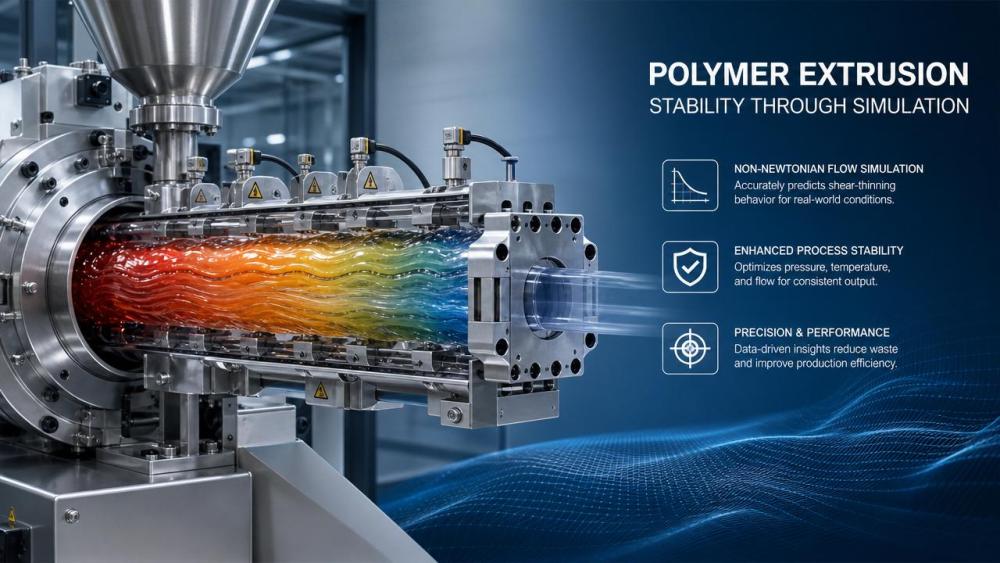
When people search for non-Newtonian fluid simulations in this context, they usually are not looking for theory alone. They want to know whether simulation can prevent instability that hurts output.
For project managers and engineering leads, the key question is simple: will simulation reduce commissioning risk, improve quality consistency, and justify its cost on a real extrusion or molding line?
The practical answer is yes, especially when the process involves shear-thinning melts, temperature-sensitive compounds, recycled feedstock variation, or geometry changes that amplify pressure fluctuation and flow imbalance.
In polymer processing, line instability often appears as unstable output, surging pressure, uneven melt temperature, dimensional drift, die lines, poor mixing, or inconsistent downstream behavior.
These problems rarely come from one isolated cause. They usually result from the interaction of material rheology, screw design, channel geometry, heating, residence time, and operating window.
That is exactly where non-Newtonian fluid simulations become useful. They help teams see interacting effects before steel is cut, settings are frozen, or startup time becomes the most expensive troubleshooting phase.
Why Newtonian assumptions miss the real stability problem
Many production risks are underestimated when teams rely on simplified flow assumptions. Polymer melts do not behave like water or standard low-viscosity fluids under processing conditions.
Their viscosity changes with shear rate, temperature, and sometimes time. In filled systems, recycled blends, and reactive materials, behavior can become even more complex and less forgiving.
A Newtonian model may be acceptable for rough screening, but it often hides the causes of pressure spikes, dead zones, overheating, and local flow imbalance.
For a project manager, the issue is not academic accuracy. The issue is whether the model reflects the behavior that will drive scrap, missed throughput targets, or repeated tuning after installation.
Non-Newtonian fluid simulations better represent shear-thinning behavior, extensional effects in some applications, and thermal-viscous coupling that strongly influence polymer process stability.
That means teams can evaluate whether a screw, adapter, manifold, die, runner, or melt channel will behave predictably under realistic production loads rather than idealized conditions.
Where non-Newtonian fluid simulations improve line stability most
Not every project needs the same depth of modeling. The highest value usually appears where the process window is narrow and the cost of instability is high.
In extrusion, simulations are especially useful for twin-screw compounding, film and sheet dies, profile extrusion, pipe heads, and melt delivery sections with known pressure sensitivity.
They help identify flow separation, uneven residence time, localized overheating, and channel regions where minor process changes can trigger large output variation.
In injection molding, they support decisions around runner balance, gate behavior, pressure loss, shear heating, and pack-hold sensitivity that can drive part-to-part inconsistency.
For recycled plastics processing, the value can be even greater. Variable feedstock properties create unstable rheological behavior, making empirical scale-up slower and more expensive.
In blow molding and rubber processing, simulations help teams understand how viscosity changes affect filling uniformity, pressure demand, and thermal exposure across complex tool paths.
If your project includes new materials, recycled content targets, higher output expectations, or tighter dimensional tolerance, simulation becomes less of a luxury and more of a risk-control tool.
What business outcomes matter most to project leaders
Project managers are usually judged on schedule, budget, startup speed, and performance after handover. Non-Newtonian fluid simulations can influence all four if used early enough.
First, they reduce redesign loops. Finding a high-shear hot spot or a pressure bottleneck in software is far cheaper than modifying hardware after fabrication.
Second, they shorten commissioning. Teams start with a narrower and more realistic operating window, reducing trial runs, material waste, and operator frustration during ramp-up.
Third, they improve confidence in scale-up. A lab or pilot result often looks stable until production throughput changes shear history and thermal load inside the full-size machine.
Fourth, they support quality consistency. Better flow balance and temperature control reduce variability in dimensions, appearance, mechanical properties, and downstream convertibility.
Fifth, they strengthen internal decision-making. Procurement, process engineering, and plant leadership can compare design options using evidence rather than assumptions or supplier preference alone.
For organizations with ESG targets or recycled-content commitments, the benefit also includes lower waste generation and a better chance of making difficult materials commercially stable.
How simulation helps teams make better design decisions before launch
The strongest return usually comes when simulations are integrated before major equipment decisions are locked. At that stage, teams still have room to change geometry and specifications.
For example, a simulation may show that a proposed die layout creates uneven velocity distribution, which later would appear as gauge variation or unstable product dimensions.
It may reveal that an adapter introduces excessive pressure loss, forcing the line to run near the limits of the pump or screw, leaving little room for normal variation.
It can also show whether thermal control zones are placed effectively or whether certain regions are likely to develop stagnant pockets that degrade material over time.
In compounding systems, simulation can help compare screw configurations and determine whether distributive and dispersive mixing targets can be met without damaging sensitive additives.
For project leaders, this means simulation should not be treated only as troubleshooting support. It is most valuable as a pre-launch decision framework.
Used this way, it improves vendor conversations, clarifies technical trade-offs, and makes scope reviews more objective during design freeze meetings.
What to check before trusting the results
Simulation is powerful, but it is not automatically reliable. Poor inputs create false confidence, which is dangerous in capital projects with aggressive performance guarantees.
The first checkpoint is rheology data quality. If viscosity curves do not reflect actual material grades, moisture condition, filler content, or operating temperatures, the model may mislead the team.
The second checkpoint is boundary condition realism. Throughput, inlet temperature, wall conditions, screw speed, pressure assumptions, and heat transfer settings must match the intended process.
The third checkpoint is model scope. Some problems are dominated by flow, while others depend on solid conveying, phase change, chemical reaction, venting, or machine dynamics beyond the simulation domain.
The fourth checkpoint is validation. The best teams compare simulation outputs with pilot data, historical line data, pressure trends, melt temperature readings, or short production trials.
Project managers do not need to run the model themselves, but they should ask whether the result has been calibrated against reality or only presented as colorful graphics.
Good simulation work reduces uncertainty. Bad simulation work can hide it. The difference usually lies in input discipline and validation practice.
How to evaluate ROI without overcomplicating the business case
Many managers hesitate because simulation seems technical and indirect. The business case becomes clearer when linked to specific project risks rather than general innovation goals.
Start with the cost of instability on your line: startup scrap, delayed acceptance, labor-intensive tuning, missed throughput, customer complaints, tooling modifications, and unplanned downtime.
Then compare that exposure with the cost of simulation, rheology testing, and engineering review. In many projects, preventing one post-installation hardware change can justify the analysis effort.
ROI is strongest when the line uses expensive resin, complex dies, tight tolerances, or materials that are known to be unstable across temperature and shear ranges.
It is also attractive when project timelines leave little room for iterative troubleshooting, especially for multinational installations where field support and downtime are costly.
A practical internal metric is this: if simulation can reduce startup time, lower scrap during ramp-up, or avoid one major redesign, it has likely paid for itself.
That framing helps non-specialists see non-Newtonian fluid simulations as a delivery tool, not just an engineering study.
Common implementation mistakes that limit value
One common mistake is starting too late. If the model begins after equipment is purchased, the team may only confirm problems it can no longer economically fix.
Another mistake is asking simulation to answer vague questions. Better outcomes come from defined decisions such as selecting a die concept, checking pressure stability, or comparing temperature profiles.
A third mistake is separating simulation from plant reality. Process engineers, operators, material specialists, and machine suppliers should all contribute assumptions and review findings.
Some teams also overfocus on average values. Instability often comes from local extremes, transient behavior, or sensitivity to small disturbances, not just nominal performance points.
Finally, many organizations fail to convert results into operating guidance. A useful study should inform equipment design, startup settings, alarm limits, and scale-up rules.
Without that translation step, even accurate analysis may have limited operational impact after handover.
When should a project manager insist on simulation?
Project managers should push for simulation when any of the following conditions apply: new polymer grades, high recycled content, tight dimensional targets, high output ambitions, or repeated historical instability.
It is also worth insisting on when process changes are coupled, such as material reformulation plus equipment upgrade plus faster cycle or higher throughput expectations.
If the supplier promises broad operating flexibility but cannot show how rheology was considered, simulation provides a disciplined way to test those claims.
Likewise, if scale-up from pilot to production is central to project success, non-Newtonian fluid simulations can reveal whether the process window will shrink at commercial rates.
For brownfield projects, the trigger may be chronic line behavior that operators manage through experience but never fully eliminate. Simulation can expose the root mechanism behind recurring variability.
In short, the more expensive the instability, the stronger the case for modeling it before it reaches the floor.
Conclusion: better stability comes from earlier visibility
When non-Newtonian fluid simulations improve line stability, the real benefit is not only better flow pictures. It is earlier visibility into the causes of startup delays, quality drift, and hidden process risk.
For project managers, that visibility supports stronger design reviews, faster commissioning, more credible vendor evaluation, and better confidence in throughput commitments.
In polymer processing, line stability depends on how complex melts truly behave under stress, not how simplified models assume they should behave.
That is why non-Newtonian fluid simulations matter most in projects where consistency, scale-up, and risk reduction directly affect commercial success.
If used early, validated properly, and tied to specific decisions, they become one of the most practical tools for turning rheology complexity into operational stability.
Related News
- 00
0000-00
How to Evaluate Plastic Pelletizing Machine Suppliers for Output, Support, and Risk - 00
0000-00
How to Select a Plastic Pipe Manufacturing System for Output, Resin, and Pipe Range - 00
0000-00
How to Specify Injection Molding Equipment for High-Volume Closure Production - 00
0000-00
How to Specify a Medical Molding Machine for Cleanroom Device Production - 00
0000-00
Plastic Extrusion Technology for Films: Process Controls That Improve Gauge Uniformity
Weekly Insights
Stay ahead with our curated technology reports delivered every Monday.
Related News
 Extrusion Process ArchitectHow to Select a Plastic Pipe Manufacturing System for Output, Resin, and Pipe RangePlastic pipe manufacturing systems: learn how to match output, resin, tooling, cooling, and automation for reliable, scalable pipe production. Read the guide.Oct 02, 2026
 Extrusion Process ArchitectPolymer Processing for Extrusion: How Melt Rheology Affects Line StabilityPolymer processing for extrusion: discover how melt rheology influences pressure, output, die swell, and line stability for more consistent production.Sep 24, 2026
 Extrusion Process ArchitectHow to Evaluate German Extrusion Equipment for Stable, High-Output ProductionExtrusion equipment Germany: evaluate stable, high-output lines through melt control, feeding, tooling, energy use, maintenance, and acceptance trials.Sep 20, 2026
 Extrusion Process ArchitectHow to Size an HDPE Pipe Extrusion Line for Output, Diameter Range, and Pipe QualityHDPE pipe extrusion lines: learn how to size output, diameter range, cooling, and downstream equipment for stable, high-quality pipe production.Aug 29, 2026
 Extrusion Process ArchitectWhat Affects Output Quality in Polymer Processing Equipment Extrusion?Polymer processing equipment extrusion quality depends on material control, screw design, temperature, pressure, and die stability. Learn practical fixes to boost output, reduce defects, and improve consistency.Jul 14, 2026
 Extrusion Process ArchitectWindow Profile Extrusion Lines: Key Parameters for Output, Surface Finish, and StabilityWindow profile extrusion lines compared beyond nameplate output—learn how throughput, surface finish, and long-term stability affect scrap, quality, and production risk.Jul 13, 2026
 Extrusion Process ArchitectRecycled Polymer Applications in Pipe Extrusion: Material Limits, Performance, and Use CasesRecycled polymer applications pipe extrusion explained: discover material limits, real performance trade-offs, and the best use cases for reliable, cost-smart pipe production.Jul 12, 2026
 Extrusion Process ArchitectHow to Choose Extrusion Equipment for HDPE Pipe and Profile ProductionExtrusion equipment for HDPE selection starts with product goals. Learn how to compare extruders, dies, cooling, and controls to improve quality, cut scrap, and choose the right pipe or profile line.Jul 11, 2026
 Extrusion Process ArchitectExtrusion Systems for Pipe Selection Guide: Output, Screw Design, Cooling, and Wall ControlExtrusion systems for pipe selection made practical: compare output, screw design, cooling, and wall control to improve stability, cut scrap, and choose the right line with confidence.Jul 10, 2026
 Extrusion Process ArchitectExtrusion Equipment PLC Control: Which Functions Matter Most for Stable Line Operation?Extrusion equipment PLC control directly shapes line stability. Learn which functions matter most for steady output, fewer alarms, better quality, and smarter extrusion performance.Jul 05, 2026
 Extrusion Process ArchitectPP Sheet Extrusion Line Price Factors for Used Equipment BuyersLearn the main price factors for used PP sheet extrusion lines, from screw and die condition to controls, output, packing and commissioning risk.Jul 05, 2026
 Extrusion Process ArchitectUsed PP PE ABS PS Sheet Extruder Line Buying GuideA practical buyer guide for used PP, PE, ABS and PS sheet extruder lines, including inspection points, output checks and purchasing questions.Jul 01, 2026
 Extrusion Process ArchitectPVC Plastic Pipe Manufacturing Process Explained: Key Stages, Quality Checks, and Common DefectsPVC plastic pipe manufacturing explained clearly: explore key stages, quality checks, common defects, and practical insights to improve consistency, compliance, and pipe performance.Jun 30, 2026
 Extrusion Process ArchitectSmart Plastic Extrusion Technology: Which Sensors and Controls Improve Output Stability?Smart plastic extrusion technology starts with better sensing and control. Learn which sensors and closed-loop systems improve output stability, cut scrap, and boost ROI.Jun 27, 2026
 Extrusion Process ArchitectExtrusion Systems for Pipes: How to Choose the Right Line for Your Product RangeExtrusion systems for pipes: learn how to choose the right line for your product range, materials, output goals, compliance needs, and long-term ROI.Jun 26, 2026
 Extrusion Process ArchitectPipe and Profile Extrusion for Water Supply: Key Design Points for Stable OutputPipe and profile extrusion for water supply demands stable output, precise die design, and smart cooling control to reduce waste and boost reliability.Jun 26, 2026
 Extrusion Process ArchitectPipe Plastic Extrusion Machinery Selection Guide: Output, Diameter Range, and Cooling DesignPipe plastic extrusion machinery selection starts with output, diameter range, and cooling design. Learn how to compare line stability, flexibility, and ROI for better pipe production.Jun 16, 2026
 Extrusion Process ArchitectPlastic Extrusion Machinery Price Comparison: Which Specs Have the Biggest Budget Impact?Plastic extrusion machinery price depends most on screw design, output, energy systems, and automation. Compare specs smarter to cut hidden costs and improve ROI.Jun 15, 2026
 Extrusion Process ArchitectPolymer Rheology Basics: Which Viscosity and Shear Data Matter in Process Setup?Polymer rheology basics explained: learn which viscosity and shear data truly matter for process setup, faster startup, stable flow, better quality, and smarter machine adjustments.Jun 12, 2026
 Extrusion Process ArchitectPlastic Extrusion Technology vs Injection Molding: Which Offers Better Cost Control at Scale?Plastic extrusion technology vs injection molding: discover which process delivers better cost control at scale, with practical insights on tooling, scrap, energy, and ROI.Jun 10, 2026