What Affects Recycled HDPE Blow Molding Quality?




What Affects Recycled HDPE Blow Molding Quality?
Why do some recycled HDPE bottles perform reliably while others develop weak seams, uneven walls, or surface defects? Recycled HDPE blow molding quality depends on more than recycled content: feedstock consistency, contamination, melt flow behavior, thermal history, and processing conditions all influence the finished container. For packaging manufacturers and recycling operators, understanding these variables is essential to reducing scrap and maintaining product performance.
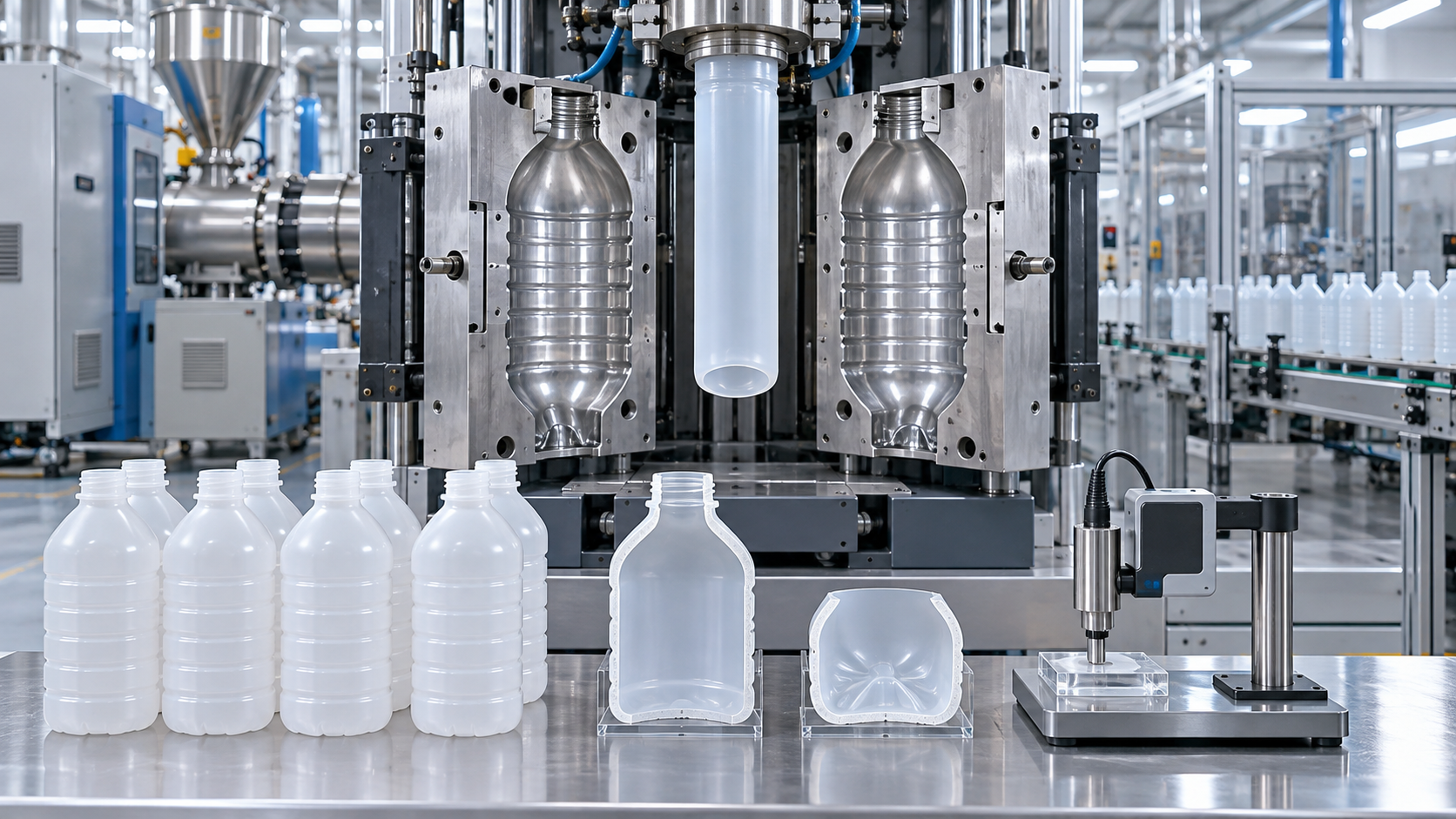
Most conventional HDPE bottles and jerrycans are produced by extrusion blow molding. A molten tube, or parison, leaves the die, is enclosed by the mold, and expands under air pressure. Recycled resin must therefore do two things well: flow through the extrusion system and retain enough melt strength to resist excessive stretching before inflation. Material that pellets cleanly does not necessarily meet both requirements.
Quality starts with the container’s job
A visually acceptable bottle can still fail during filling, stacking, transport, or storage. Before choosing a recycled grade, define what the package must withstand: product chemistry, closure torque, handling temperature, drop conditions, storage duration, and stacking load. Appearance matters, but it is only one acceptance criterion.
For detergent and chemical packaging, environmental stress cracking deserves particular attention. This is cracking caused by the interaction of stress and an aggressive environment, rather than simply insufficient tensile strength. Resin characteristics, molded-in stress, thin sections, and the packaged formulation can all influence performance. A short leak test cannot establish long-term compatibility.
Food-contact suitability is a separate question. Good molding performance, washing, or fine filtration does not establish regulatory compliance. Recycled-material eligibility needs verification against the intended application, recycling process, supporting documentation, and destination-market requirements.
Feedstock consistency matters more than a recycled-content percentage
“Recycled HDPE” describes a material category, not a tightly defined grade. Post-consumer bottle streams may contain different original resin grades, pigments, closures, label residues, and traces of other polymers. Post-industrial material can be more predictable when it comes from a controlled source, but mixed production scrap is not automatically consistent.
Injection-molded HDPE entering a bottle recycling stream can change the blend’s flow behavior. Polypropylene contamination can create incompatible regions and alter mechanical performance. Other polymer contaminants may remain as inclusions or degrade under the selected processing conditions. These risks explain why a supplier’s average melt flow value is not enough to qualify a material.
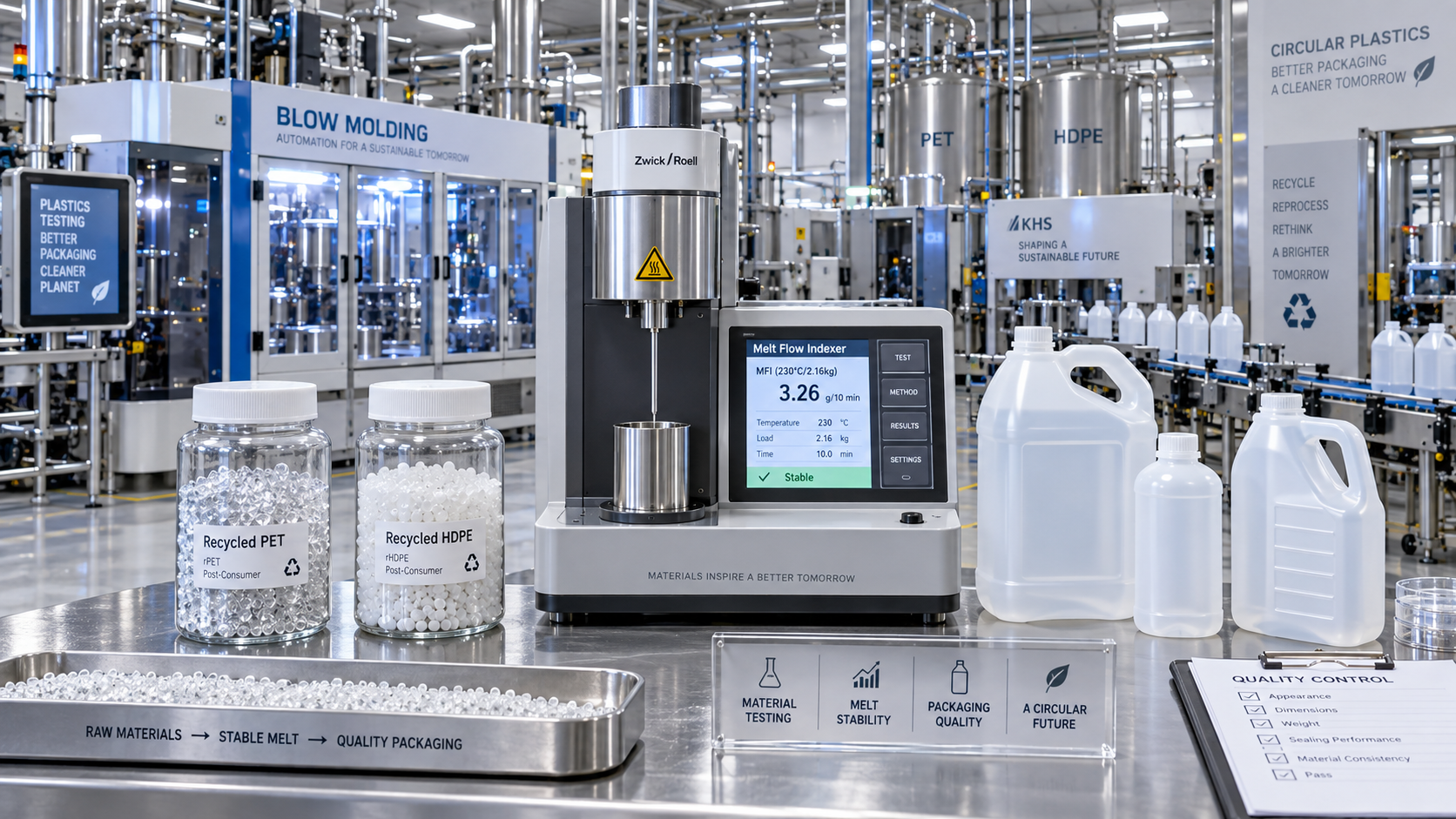
Useful incoming controls include melt flow rate under a specified test condition, density, moisture, ash content, visible contamination, and color variation. Periodic polymer identification or thermal analysis can help investigate unexpected changes. Sampling should represent the delivery rather than a convenient handful from the top of one bag.
Blending can reduce lot-to-lot variation, provided the blending method and proportions are controlled. It cannot reliably correct unknown contamination. Keep approved feedstock sources, blend recipes, and production lots traceable so a quality shift can be linked to material changes instead of being blamed on the machine.
Melt flow rate is a screening tool, not a performance guarantee
Melt flow rate helps compare materials, but it measures flow under one defined condition. Two recycled batches with similar values can behave differently at the die because their molecular weight distributions, degradation histories, and compositions differ. Neither parison stability nor stress-crack resistance can be inferred confidently from melt flow rate alone.
Watch the parison during qualification. Excessive sag, changing swell, unstable extrusion, or a tendency to draw down can reveal differences that a routine material certificate misses. Where the application warrants it, additional rheological testing can help explain those observations.
Repeated melting also changes the material’s processing history. Heat, oxygen, shear, and residence time can contribute to oxidation and molecular changes. Depending on the conditions, these changes may affect viscosity, toughness, odor, or gel formation. Stabilizers can limit further degradation when correctly selected and dispersed, but they do not restore every property lost during previous use and processing.
Cleaning, filtration, and degassing solve different problems
Washing removes accessible dirt and residues before melting. Melt filtration captures certain solid contaminants. Degassing removes some moisture and volatile substances. Treating these operations as interchangeable leads to expensive equipment decisions without addressing the actual defect.
HDPE is not strongly hygroscopic, but washed flakes can carry surface water. Poor dewatering or unsuitable storage can introduce enough moisture to disturb processing. Volatile residues may also produce bubbles, odor, or surface defects. Drying requirements should follow measured conditions and the feedstock supplier’s guidance, rather than a schedule borrowed from PET processing.
Finer melt filtration can reduce visible inclusions, but it also increases flow resistance and may increase pressure, residence time, or thermal exposure. A filter cannot be assumed to remove molten polymer contamination, dissolved substances, or every odor-causing compound. Select filtration around the contaminant profile and acceptable pressure behavior, not simply the smallest available opening.
Track pressure before and after the filter. A rising pressure differential can indicate loading; pressure fluctuations may coincide with output instability. Screen changes and cleaning practices also deserve attention, since inconsistent procedures can interrupt production even when the resin specification remains unchanged.
Parison control determines where the material ends up
A bottle can meet its target weight and still have dangerously thin corners or shoulders. Total mass does not show how material is distributed. Geometry, die alignment, melt temperature, extrusion rate, parison programming, and the delay before mold closure all influence local wall thickness.
Parison programming varies the die gap during extrusion to place more material where greater stretching is expected. However, a profile developed for virgin resin may not transfer directly to recycled HDPE. Changes in swell and sag can shift the relationship between the programmed profile and the finished wall.
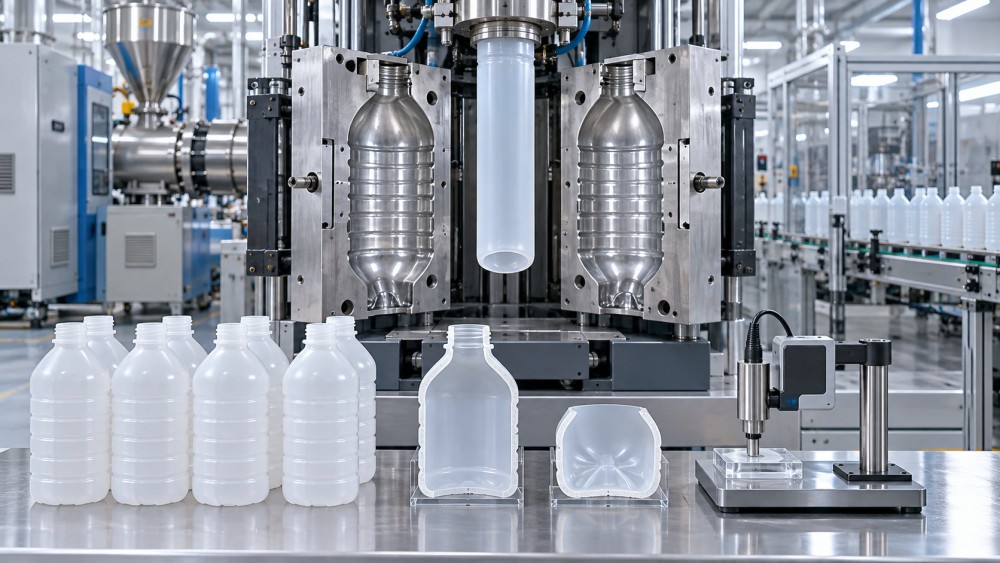
During trials, map thickness at repeatable locations: shoulder transitions, corners, handle regions, the base, and the pinch-off area. Compare those measurements with drop and load failures. Increasing bottle weight may conceal poor distribution while adding material to sections that were already thick enough.
Weak bottom seams need a separate investigation. Pinch-off geometry, mold closure, local parison thickness, melt temperature, and contamination can all affect weld integrity. Raising temperature may help fusion in some circumstances, but excessive heat can worsen sag and degradation. Check the physical failure location before changing the entire process.
Temperature, cooling, and machine condition define the usable window
Barrel settings are not the same as actual melt temperature. Screw work, throughput, back pressure, and residence time contribute to the thermal condition reaching the die. When production rate changes, an unchanged temperature recipe may produce a different melt.
An overly hot parison may stretch before the mold closes. Insufficient or uneven melting can create rough surfaces, unstable flow, or poor fusion. The objective is a stable processing window, not the highest temperature that makes extrusion easier. Record measured melt temperature where practical, along with screw speed, output, and head pressure.
Cooling controls shape retention and shrinkage. Uneven cooling circuits, scale buildup, blocked passages, or inconsistent water supply can contribute to distortion and dimensional variation. Shortening the cycle before the container is sufficiently rigid may cause deformation during ejection or downstream handling. Longer cooling, however, will not correct a badly distributed wall.
Check air pressure and timing, mold venting, die centering, and screw and barrel wear as part of the investigation. Recycled resin often gets blamed for defects that originate in equipment condition. If a previously stable reference material also shows the defect, that is a strong reason to examine the machine and tooling.
Qualify the material-process combination, not just the pellets
A useful qualification trial separates material effects from process effects. Start with a documented reference run, introduce the candidate recycled grade at a controlled proportion, and change settings deliberately. Record startup scrap, stable output, pressure behavior, wall distribution, dimensions, and functional performance. One successful shift does not establish robustness across feedstock lots.
When defects appear, use their pattern to narrow the investigation:
- Defects following a material-lot change: compare retained resin samples, contamination levels, flow behavior, and blend records.
- Defects recurring at one mold location: inspect local wall thickness, venting, cooling, and pinch-off condition.
- Defects increasing during long runs: investigate filter loading, deposits, thermal residence, and cooling stability.
- Failures appearing only after filling or storage: evaluate product compatibility, residual stress, closure loading, and the test duration.
Multilayer structures or blending with a suitable virgin grade may offer options where the package specification allows them. Neither approach removes the need for validation. Layer distribution, interlayer integrity, recycled-core variability, and applicable contact requirements must still be considered.
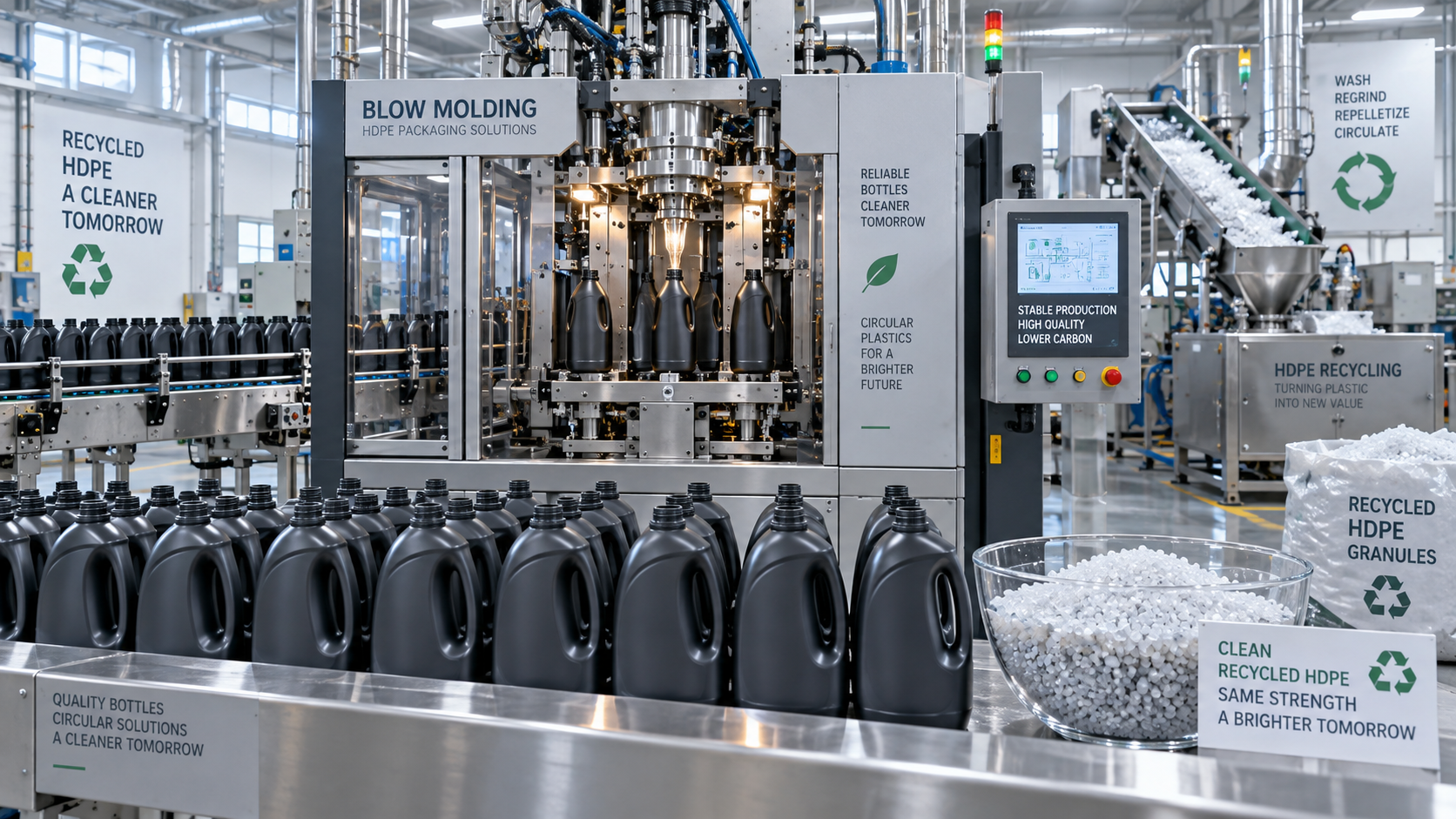
This connection between recycling equipment and molding performance is central to the Global Polymer Forming & Recycling Systems (PFRS) intelligence scope. Washing, extrusion, pelletizing, filtration, and blow molding should be evaluated as a connected production chain. Cleaner pellets have limited value if their rheology is unsuitable for the container; a more advanced molding machine cannot compensate for uncontrolled feedstock.
The next practical step is to agree on an acceptance specification shared by the recycler, converter, and packaging customer. It should cover material variability, critical container dimensions, wall-thickness locations, functional tests, traceability, and application restrictions. Dependable recycled HDPE blow molding quality comes from maintaining that agreed window across deliveries—not from finding one setting that produces a good bottle once.
Related News
- 00
0000-00
Energy-Saving Plastics Machinery: How to Calculate Payback Before Buying - 00
0000-00
Automatic Tire Curing: How Temperature and Pressure Controls Affect Cure Uniformity - 00
0000-00
Pallet Injection Molding: How to Size Clamp Force and Shot Capacity - 00
0000-00
Circular Manufacturing Roadmap: From Waste Audits to Material Recovery - 00
0000-00
How Continuous Melt Filtration Limits Pressure Fluctuations During Screen Changes
Weekly Insights
Stay ahead with our curated technology reports delivered every Monday.
Related News
 Packaging Tech FellowWhat Affects Recycled HDPE Blow Molding Quality?Improve recycled HDPE blow molding quality with insights on feedstock, melt flow, filtration, and parison control. Discover practical ways to reduce scrap and produce reliable containers.Oct 23, 2026
 Packaging Tech FellowWhich Recycled Resin Tests Matter Before Blow Molding?What recycled resin tests matter before blow molding? Explore melt flow, IV, moisture, contamination, density, and package performance checks for reliable bottles.Sep 27, 2026
 Packaging Tech FellowCan Recycled HDPE Be Used for Blow-Molded Bottles?Can recycled HDPE be used for blow-molded bottles? Explore material performance, processing tips, quality controls, and food-contact considerations for reliable circular packaging.Sep 24, 2026
![]() Packaging Tech FellowBlow Molding Fully Automatic Systems: Which Products and Output Levels Are They Best For?Blow molding fully automatic systems excel in beverage, pharma, cosmetics, and chemical packaging. See which products, output levels, and ROI factors make automation the smart choice.Jul 07, 2026
 Packaging Tech FellowHow to Evaluate Blow Molding Equipment for Bottle, Medical, and Technical PartsBlow molding equipment evaluation guide for bottle, medical, and technical parts: compare process fit, quality control, compliance, and lifecycle cost to choose smarter and reduce risk.Jun 24, 2026
 Packaging Tech FellowBottle Blow Molding Defects: How to Fix Uneven Wall Thickness, Flash, and Poor SealingBottle blow molding troubleshooting guide: learn how to fix uneven wall thickness, flash, and poor sealing with practical process tips to cut scrap, improve quality, and boost line stability.Jun 20, 2026
 Packaging Tech FellowHow to Choose Blow Molding Equipment for PET, HDPE, and Multi-Layer PackagingBlow molding equipment selection for PET, HDPE, and multi-layer packaging: compare process fit, energy use, barrier control, and recycled resin readiness to choose a stable, future-proof line.Jun 12, 2026
 Packaging Tech FellowWhen blow molding equipment becomes too costly to runBlow molding equipment costing too much to run? Learn the key warning signs, compare repair, retrofit, and replacement options, and make smarter capital decisions with confidence.May 24, 2026
 Packaging Tech FellowWhat to check before buying blow molding equipmentBlow molding equipment buying guide: learn what to check first, from process fit and bottle quality to energy costs, flexibility, service, and compliance before you invest.May 21, 2026
 Packaging Tech FellowWhen blow molding equipment needs an upgrade or repairBlow molding equipment showing downtime, scrap, or quality drift? Learn when repair is enough and when an upgrade delivers better efficiency, compliance, and long-term ROI.May 18, 2026
 Packaging Tech FellowNon-Newtonian Fluid Simulations for More Stable Blow MoldingNon-Newtonian fluid simulations reveal parison behavior, wall-thickness variation, and melt stability in blow molding—helping teams reduce defects, improve consistency, and make smarter process decisions.May 11, 2026
 Packaging Tech FellowBlow Molding Equipment Choices for Faster Bottle ChangeoversBlow molding equipment choices can cut bottle changeover time, reduce scrap, and restore stable output faster. See which features help plants improve uptime and flexibility.May 11, 2026