How melt viscosity affects polymer underwater pelletizing




Melt viscosity affects polymer underwater pelletizing by controlling the pressure required to feed the die holes, the consistency of flow between those holes, and the response of the emerging melt to the cutter blades. A resin that flows steadily and separates cleanly at one operating point can produce tails, fines, or intermittent discharge after a material change, even when the equipment settings remain unchanged.
The relationship is not a simple ranking in which lower viscosity always produces better pellets. Excessively viscous melt raises pressure demand and restricts flow; very fluid melt can deform, smear, or remain tacky after cutting. Stable pellet formation requires a workable combination of melt rheology, die temperature, flow per hole, blade condition, and water cooling. Pellet defects become useful diagnostic evidence only when these variables are recorded together.
The viscosity value must represent conditions inside the die
Most polymer melts are shear-thinning: their apparent viscosity decreases as shear rate increases. Consequently, a viscosity measured at low shear does not directly describe resistance inside a narrow die hole. Two materials with similar laboratory flow indices can develop different pressure requirements at production throughput because their viscosity curves respond differently to shear and temperature.
Melt flow rate or melt volume-flow rate is useful for tracking consistency within a material family under the same test conditions. It provides limited evidence for comparing unrelated polymers, filled compounds, or recycled blends. Results measured at different temperatures or loads are not directly comparable, and a single flow-index value does not describe the full processing range.
For die-flow assessment, capillary rheometry provides more relevant information when its temperature and shear-rate range represent the intended process. Entrance-pressure and non-Newtonian corrections matter when deriving quantitative viscosity values. Rotational measurements add information about low-shear behavior and viscoelasticity, but extrapolating them into die conditions requires a validated material model.
Shear viscosity also leaves part of the cutting behavior unexplained. Molecular relaxation, elastic recovery, and extensional response influence whether a short melt segment separates cleanly or stretches into a tail. A broad molecular-weight distribution, branching, fillers, or an elastomeric component can change these responses without producing an equally obvious change in melt flow rate.
Pressure and flow reveal different parts of the problem
At a fixed flow rate through an open die hole, higher apparent viscosity increases the required pressure drop. Hole diameter and land length strongly affect that demand. A longer land increases resistance, while a smaller diameter increases both resistance and shear rate. Shear thinning moderates the pressure increase, so simple constant-viscosity calculations should serve only as preliminary comparisons.
The familiar fourth-power dependence of pressure on inverse hole diameter applies to ideal Newtonian flow through a circular channel. Applying it directly to a production polymer die overlooks shear thinning, entrance losses, temperature gradients, and partial solidification. Actual die sizing needs rheological data and a model appropriate to the material and geometry.
Pressure location is equally important. An increase measured upstream of the screen pack can reflect filter loading rather than a change in die resistance. Measurements before and after filtration, together with pressure near the pelletizing die, help separate these causes. A melt pump makes delivery less sensitive to upstream pressure fluctuations within its operating limits, but cannot correct blocked holes or uneven die heating.
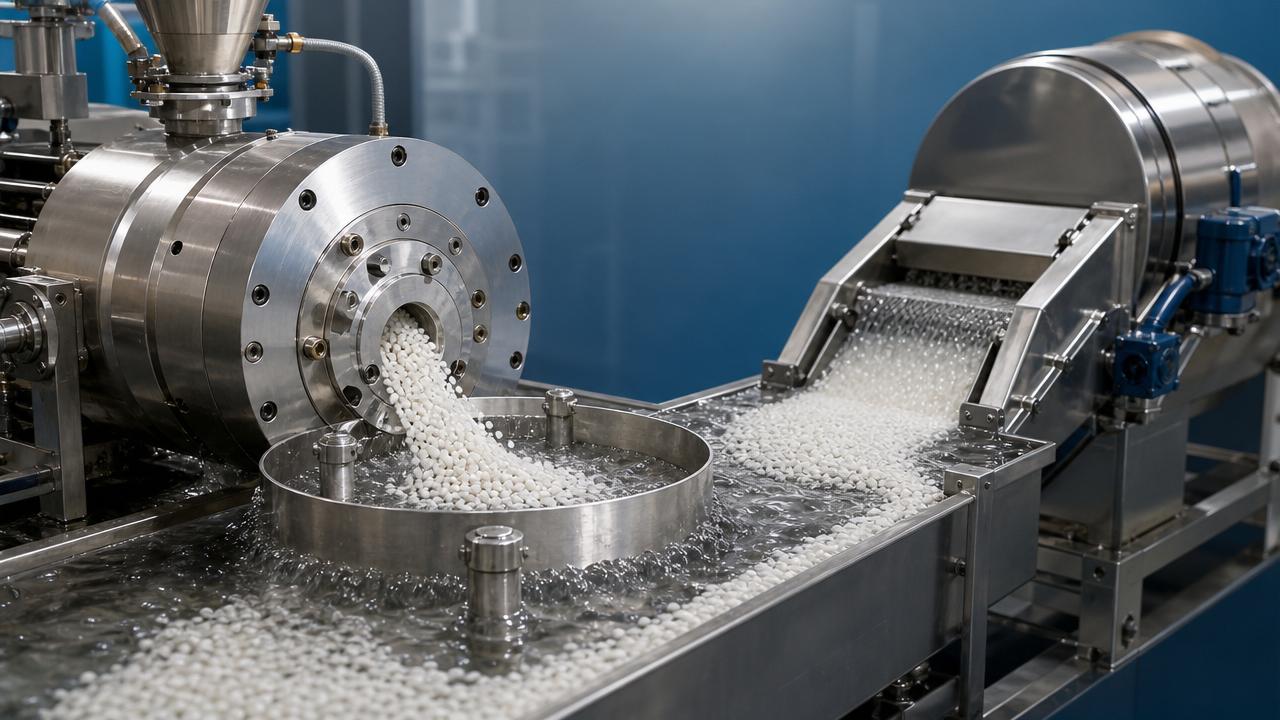
Unequal flow creates unequal pellets. If some holes become restricted, the remaining holes carry more melt at constant total throughput. Their discharge rate rises, and the same cutter speed produces larger pellets from those holes. The resulting size distribution can therefore widen while the average line output appears stable.
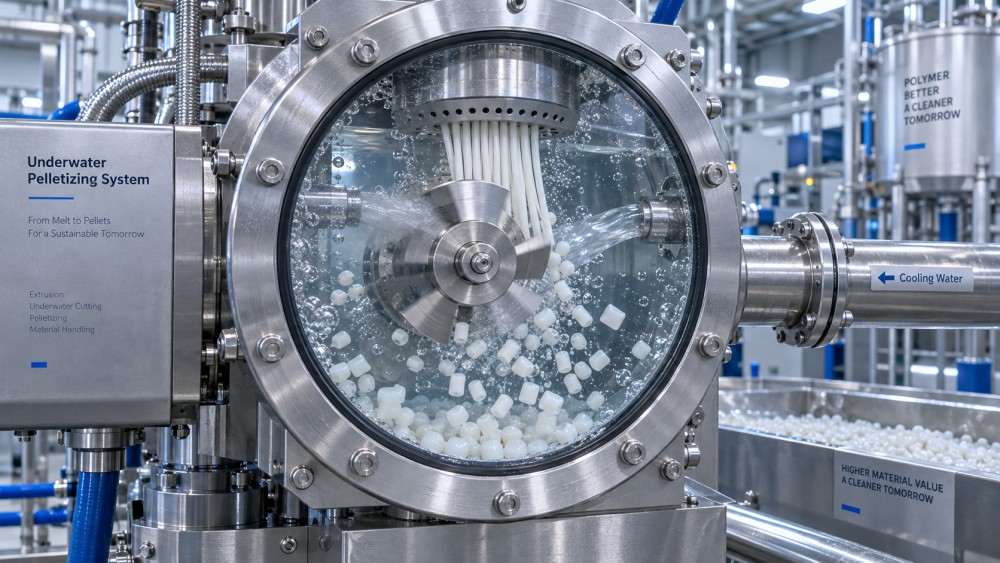
This redistribution also explains why increasing cutter speed sometimes improves average pellet size without restoring uniformity. The blades cut more frequently across every hole, but the flow imbalance persists. Missing discharge from part of the die face, rising pressure, and simultaneous oversized pellets point toward restriction or thermal imbalance before they justify another cutter-speed adjustment.
Temperature changes viscosity and the condition of the die face
Raising melt temperature generally lowers viscosity and reduces the pressure required for a given throughput. That adjustment has limits: thermal degradation, additive sensitivity, moisture-related degradation, and residence time define the usable temperature window. Lower pressure after a temperature increase does not by itself establish that the material remains suitable.
The measured melt temperature and the die-heater setpoint describe different conditions. Water continuously removes heat from the cutting face, while flowing polymer supplies heat through the holes. Local cooling can create a solidified or highly viscous layer near a hole outlet even when the upstream melt temperature is satisfactory.
This is particularly significant at low throughput per hole. Reduced melt flow supplies less heat, increasing the chance of restriction or freeze-off. Increasing temperature upstream may give limited relief if inadequate die heating, poor thermal isolation, or an unsuitable active-hole count is the underlying constraint. Die geometry and heating capacity must support the required minimum throughput as well as maximum output.
Warmer process water reduces the cooling severity at the face, but also delays pellet solidification. For soft or tacky materials, that tradeoff increases deformation and agglomeration risk. Colder water accelerates skin formation while increasing heat extraction from the die. Water temperature therefore needs adjustment alongside die heating, water flow, and the material’s crystallization or softening behavior.
Cutting frequency controls pellet mass; rheology controls separation
With steady, equal flow through the active holes, average pellet mass follows a useful mass balance: total mass throughput divided by the number of active holes and effective blade passes per unit time. This assumes each pass produces one pellet from each flowing hole. It explains why increasing cutter speed reduces average pellet mass and why losing active holes increases it at unchanged throughput.
The mass balance does not predict pellet shape. Viscous drag, melt elasticity, blade sharpness, contact conditions, and cooling determine how the material separates. A stretched tail can originate from elastic melt recovery or incomplete severing. Smearing can indicate a fluid or tacky melt, excessive local temperature, or unsuitable blade contact. Similar-looking defects can therefore require different adjustments.
Blade speed also changes mechanical and thermal conditions at the cutting face. Increasing speed adds cutting events and changes relative motion, while excessive contact loading increases wear and frictional heating. Adjustments must respect the cutter’s specified contact mechanism; a blade system designed for controlled contact cannot be treated as one using a deliberate clearance.
Fines require attention to where they originate. They can form during cutting, from brittle pellet fracture, or through abrasion in water transport and drying. Sampling near the pelletizer outlet and after the dryer helps distinguish these locations. Increasing melt temperature to address fines created downstream can worsen pellet tackiness without removing the cause.
Similar defects need different evidence
No single row establishes a diagnosis. For example, high pressure combined with tails could involve both restricted flow and worn blades. Changing temperature, water conditions, and cutter speed simultaneously removes the evidence needed to distinguish those mechanisms.
Recycled feedstocks add variability beyond viscosity
A recycled polymer stream can change rheology because of molecular degradation, mixed grades, contamination, fillers, or incompatible polymers. Chain scission often lowers viscosity, while branching or cross-linking can increase elasticity or create gels. The direction of change depends on the polymer and degradation mechanism; processing history alone cannot predict it.
Moisture creates a separate complication. In hydrolysis-sensitive polymers, inadequate drying reduces molecular weight during melting. Moisture or other volatiles can also create bubbles and irregular discharge. A lower apparent viscosity accompanied by porous pellets, unstable pressure, or reduced material properties should therefore prompt investigation of drying and devolatilization conditions.
Solid contaminants and gels can obstruct individual holes even when the bulk melt flow index remains acceptable. Filtration addresses particle contamination within its separation capability, but it does not remove all incompatible molten polymers or restore degraded molecular chains. The material specification needs to describe both flow behavior and contaminants that affect die operation.
For variable feedstocks, retaining samples from stable and unstable runs makes later comparisons more useful. Pair each sample with drying conditions, filtration pressure drop, actual melt temperature, throughput, and pellet defect observations. A laboratory result without the associated process record rarely explains why a specific production run failed.
Define an operating window through controlled trials
A meaningful trial establishes stable operation at a reference condition before testing the limits. Record actual melt temperature near the die, relevant melt pressures, total throughput, active-hole count, cutter speed, blade condition, and process-water temperature and flow. Pellet measurements should distinguish size distribution, tails, fines, and agglomerates rather than combining every defect into one rejection figure.
Changes should answer a specific question. Varying throughput at fixed cutter settings shows how pressure, flow per hole, and pellet mass respond. Varying cutter speed at steady throughput isolates cutting-frequency effects. A temperature trial tests whether reduced flow resistance improves operation within the material’s thermal limits. Each condition needs enough stabilization time for melt residence, die heating, and water temperature to settle.
Start-up and turndown deserve separate trials because a system that runs well at nominal output can lose holes during low-flow operation or water introduction. The acceptable window should include recovery after interruption, with the die-heating and water sequence documented. Continuous running at one favorable condition provides little evidence about these transitions.
An equipment specification becomes more useful when its capacity statement identifies the resin or compound, rheological range, die configuration, filtration condition, and acceptable pellet defects. The supported minimum throughput is especially informative where freeze-off limits operation. These conditions make performance reproducible and expose whether a material change calls for a setting adjustment, a different die configuration, or a revised processing window.
Related News
- 00
0000-00
Truck Tire Manufacturing Equipment: Sizing Curing Presses for Target Output - 00
0000-00
How Single-Use Plastic Bans Shift Demand for Packaging Materials - 00
0000-00
PET Pelletizing Equipment: Strand vs. Underwater Systems for Recycled PET - 00
0000-00
Tire Manufacturing Equipment: Choosing Curing Presses by Tire Size and Output - 00
0000-00
How melt viscosity affects polymer underwater pelletizing
Weekly Insights
Stay ahead with our curated technology reports delivered every Monday.
Related News
 Circular Plastics ExpertHow melt viscosity affects polymer underwater pelletizingImprove polymer underwater pelletizing by understanding melt viscosity. Discover how to balance die pressure, cutting, and cooling for fewer defects and more uniform pellets.Oct 16, 2026
 Circular Plastics ExpertSizing an underwater pelletizing line for recycled plastic outputSize an underwater pelletizing line for plastics to meet recycled output targets. Learn how feedstock, filtration, cooling, and drying affect capacity—and compare suppliers with confidence.Oct 16, 2026
 Circular Plastics ExpertWhat Drives Underwater Pelletizing System Cost in High-Throughput Compounding?Underwater pelletizing systems cost depends on throughput, material wear, automation, water treatment, and lifecycle needs. Learn how to compare quotes for reliable compounding performance.Oct 12, 2026
 Circular Plastics ExpertIs an Underwater Pelletizer Worth the Added Cost for Recycled Plastics?Is an underwater pelletizer worth the extra cost for recycled plastics? Compare quality, uptime, fines, and ROI to choose the right pelletizing solution.Sep 25, 2026
 Circular Plastics ExpertWhen Is Underwater Pelletizing for Bioplastics the Right Choice?Underwater pelletizing for bioplastics is the right choice when weak strands, sticky melts, or tight pellet specs challenge output. Learn when it improves quality, stability, and scale-up.Aug 09, 2026
 Circular Plastics ExpertHow to Evaluate Pelletizing Equipment in Germany for Throughput, Energy Use, and SupportPelletizing equipment Germany buyers compare needs more than nameplate output. Learn how to verify real throughput, energy use, maintenance costs, and local support before you invest.Aug 08, 2026
 Circular Plastics ExpertHow to Evaluate High Output Plastic Pelletizing Machines for Stable Capacity and Pellet QualityHigh output plastic pelletizing machines should be judged by stable throughput, pellet quality, filtration, and energy use. Learn how to compare systems for reliable recycling performance.Jul 21, 2026
 Circular Plastics ExpertPlastic Pelletizing Machines Price Breakdown: What Drives CapEx and Operating Cost?Plastic pelletizing machines price explained: compare CapEx, energy, labor, wear parts, and uptime to see what truly drives total cost and smarter recycling ROI.Jul 15, 2026
 Circular Plastics ExpertWaste Plastic Pelletizing Line Selection: Output, Energy Use, and Contamination ControlWaste plastic pelletizing line selection affects output, energy cost, and pellet quality. Learn how to match feedstock, cut contamination, and improve ROI.Jul 09, 2026
 Circular Plastics ExpertUnderwater Pelletizing in Japan: Why Process Control Matters for Uniform Pellet QualityUnderwater pelletizing Japan demands precise process control for uniform pellet quality, lower fines, and stable output. See how better control improves safety, compliance, and plant reliability.Jul 04, 2026
 Circular Plastics ExpertHow to Choose Plastic Pelletizing Machines for PET: Output, IV Retention, and Melt QualityPlastic pelletizing machines PET buyers can trust should balance output, IV retention, and melt quality. Learn how to compare PET recycling lines for stable pellets and better ROI.Jul 03, 2026
 Circular Plastics ExpertPlastic Pelletizing Methods Compared: Strand, Underwater, and Water-Ring SystemsPlastic pelletizing compared: explore strand, underwater, and water-ring systems to choose the best fit for pellet quality, throughput, cost, and efficient production.Jun 29, 2026
 Circular Plastics ExpertPlastic Pelletizing Machines Price: What Factors Affect Cost and ROI?Plastic pelletizing machines price depends on capacity, automation, energy use, and service. Learn what drives cost, compare offers wisely, and improve ROI faster.Jun 26, 2026
 Circular Plastics ExpertUnderwater Pelletizing Technology vs Strand Pelletizing: Which Materials Fit Best?Underwater pelletizing technology vs strand pelletizing: discover which materials perform best, how pellet quality and throughput differ, and which system can cut cost and boost uptime.Jun 25, 2026
 Circular Plastics ExpertHow Underwater Pelletizing Technology Works and Which Polymers It Fits BestUnderwater pelletizing technology explained: learn how it works, which polymers it fits best, and how it improves pellet quality, recycling efficiency, and line stability.Jun 23, 2026
 Circular Plastics ExpertHow to Choose a Pelletizing Equipment System for Output, Resin Type, and Plant SpacePelletizing equipment system selection starts with output, resin type, and plant space. Discover practical tips to improve pellet quality, uptime, and long-term efficiency.Jun 21, 2026
 Circular Plastics ExpertHow Continuous Underwater Pelletizing Systems Work and Which Materials They Handle BestContinuous underwater pelletizing systems explained: learn how they work, which polymers and recycled materials they handle best, and when they outperform strand pelletizing for stable output.Jun 16, 2026
 Circular Plastics ExpertHow to Choose Plastic Pelletizing Equipment for Output, Material, and Pellet QualityPlastic pelletizing equipment selection depends on output, material behavior, and pellet quality. Compare methods, hidden cost factors, and practical criteria to choose the right system.Jun 13, 2026
 Circular Plastics ExpertWaste Plastic Pelletizing Problems: How to Fix Moisture, Black Specks, and Unstable OutputWaste plastic pelletizing issues can stem from moisture, black specks, or unstable output. Learn practical fixes, root causes, and process checks to improve pellet quality and line performance.Jun 11, 2026
 Circular Plastics ExpertWaste Plastic Pelletizing: How to Avoid Black Specks and LossWaste plastic pelletizing: learn how to reduce black specks and material loss, improve pellet quality, protect yield, and boost recycling line profitability.May 11, 2026